Quietude Part 2: Portrait of a Young Girl on Fire

Both Portrait de la jeune fille en feu (2019) and La Mort de Louis XIV (2016) use silence to enhance viewer’s immersion in the world they are experiencing. In Portrait, the absence of a soundtrack enhances the quietude of Héloïse (Adele Haenel) and Marianne’s (Noemie Merlant) world where the crackling of the fire and the crashing of the waves are the major audio landmarks. The silence and slow pacing also enhance the impact of the Latin chant in the climatic bonfire scene. Albert Serra’s La Mort also used music sparingly in a similar manner, but in a way that was more effective in my opinion since it was period appropriate.

When you’re so in love that you don’t even notice your dress caught on fire.

The Latin chant, “Portrait de la jeune fille en feu,” was composed by Para One (Jean-Baptiste de Laubier), who is an electronic dance music producer. Writer/director Céline Sciamma claims she searched for a historical piece that fit the scene but was unable to find a suitable song (O’Falt). As a result, the chant has a modern beat to it that feels somewhat jarring and out of place since the rest of the film has only a few sparse examples of period appropriate diegetic music. The chant was inspired by György Ligeti’s “Requiem” which was made famous by 2001: A Space Odyssey which also provides a more modern feel that is incongruous. Critics describe the climatic chant as “beautiful” and “rapturous” (Dessem) as well as “skin tingling” (Johnson). Johnson also critiqued the music as “strange” and “utterly shocking”. I tend to agree with Johnson that the music was not totally suited for the scene. It also seems implausible that the women, who appear to be commoners, attending the feast would understand the significance of the Latin lyrics.

While I have no doubt that Sciamma had trouble finding an appropriate historical piece, music commissioned for this pivotal scene should have been more period appropriate as to be less distracting. Otherwise, the Latin chant stands out as an anachronism amid an otherwise immersive 18th century portrait. On the other hand, Serra’s use of classical music with angelic vocals in La Mort fit seamlessly with the scene.

References

Dessem, Matthew. “What’s the Deal With the Song at the Center of Portrait of a Lady on Fire?.” Slate, published Dec. 10, 2019, https://slate.com/culture/2019/12/portrait-lady-fire-celine-sciamma-music-song-score-para-one-arthur -simonini.html. Accessed Nov. 19, 2021.

Johnson, Ellen. “Music’s Visceral, Pivotal Role in Portrait of a Lady on Fire.” Paste Magazine, published Feb. 27, 2020,
https://www.pastemagazine.com/music/portrait-of-a-lady-on-fire/portrait-of-a-
lady-on-fire-review-bonfire-scene-mu/.
Accessed Nov. 19, 2021.

La Mort de Louis XIV. Directed by Albert Serra, performances by Jean-Pierre Léaud, Patrick d’Assumçao, and Marc Susini. Capricci Films, 2016.

O’Falt, Chris. “Portrait of a Lady on Fire’ Bonfire Scene: How Céline Sciamma Crafted the Year’s Best Musical Moment.” Indie Wire, published Dec. 10, 2019, https://www.indiewire.com/2020/02/portrait-of-a-lady-on-firesong-bonfire-lyrics-chanting-1202211855/. Accessed Nov. 19, 2021.

Portrait de la jeune fille en feu. Directed by Céline Sciamma, performances by Noémie Merlant and Aèdele Haenel. Lilies Films, Arte, and Hold Up Films, 2019.


The enduring appeal of Jeanne Dielman (1975)

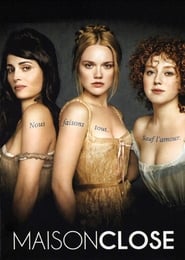
Maison Close (2010-13) and Jeanne Dielman, 23 Quai du Commerce, 1080 Bruxelles (1975) offer contrasting approaches to addressing the issue of prostitution (albeit in different time periods). Although director Chantal Akerman presented an innovative perspective on the daily routine of Jeanne Dielman during the 1970s, the film does not appear to have had much commercial success.[i] On the other hand, Maison Close used a more conventional approach to depict the women of the Le Paradis brothel in the early 1870s. Maison Close attracted enough attention to only last two seasons on French TV.[ii]

Delphine Seyring plays the titular housewife whose daily routine falls apart in Jeanne Dielman.

Akerman shot Jeanne Dielman in a hyper-realist style with no musical soundtrack and a focus on real-time activity. On the other hand, the movie also elides the details of Jeanne’s prostitution until the very end in contrast to the frequent explicit and more erotic sex scenes in Maison Close. Although Jeanne Dielman is not an easy or short watch ( nearly 3.5 hours) with numerous “unwatchable dull moments,” it also received critical acclaim.[iii] Jeanne Dielman has experienced a slight renaissance in recent years after being released on DVD and in conjunction with the COVID 19 pandemic.[iv]

Clearly, Maison Close was intended to titillate more than provoke.

On the other hand, Maison Close told the stories of 19th century prostitutes with a more modern style. The series includes a soundtrack featuring modern music (as opposed to songs from the late 1800s) with some lyrics inexplicably in English. The show has several gritty and realistic moments (such as the brutal rape of Rose) but also glamorizes the story as well with more explicit sex scenes (such as the introduction to the 1st episode or the orgy in episode 2). Maison Close apparently did not offer enough to keep viewers watching and was not renewed for a third season on French TV. HBO had also planned to remake Maison Close for an American audience, but the project seems to be dead in the water.[v]

However, I think critics and professors will still be discussing Jeanne Dielman for years to come because Akerman dared to create something bold and innovative. On the other hand, Maison Close will probably not stand the test of time since it did not distinguish itself from other costume dramas. Akerman challenged the viewer while Maison Close did not.


[i] Lim, Dennis. “Then as Now, the Terrors of the Routine.” New York Times, Jan. 16, 2009.

[ii] “Maison Close ferme ses portes définitivement, pas de saison 3 pour la série de Canal,” Internet Archive, May 7, 2013, https://web.archive.org/web/20130510074830/http://series-tv.premiere.fr/News-Series/Maison-Close-ferme-ses-portes-definitivement-pas-de-saison-3-pour-la-serie-de-Canal-3750303

[iii] Schwartz, Dennis, “Jeanne Dielman, 23 Quai de Commerce, 1080 Bruxelles,” Aug. 5, 2019, https://dennisschwartzreviews.com/jeannedielman/

[iv] Trnka, Alexandra, “Domestic Gestures: Revisiting Jeanne Dielman in Social Isolation,” July 2020, https://www.sensesofcinema.com/2020/cinema-in-the-age-of-covid/domestic-gestures-revisiting-jeanne-dielman-in-social-isolation/

[v] Willmore, Allison, “BO Remaking Racy French Brothel Costume Drama ‘Maison Close’,” Nov. 9, 2012, https://www.indiewire.com/2012/11/hbo-remaking-racy-french-brothel-costume-drama-maison-close-43541/

The Art of Leaving in La Haine (1995)

I thought La Haine (Hatred) was quite remarkable when I first saw it about 20 years ago. After watching it again, I particularly enjoyed Mathieu Kassovitz’ use of space, especially the 360-degree shots that rotated around the characters. These shots really helped immerse the audience in the world of three young men, Vinz (Vincent Kassel), Saïd (Saïd Taghmaoui) and Hubert (Hubert Konde), who live in the poor suburbs of Paris. The panning shots helped contribute to the sense of realism Kassovitz was trying to create in the aftermath of the recent riots there (on screen and in real-life). In addition, I felt like Kassovitz also made good use of lingering shots when the main characters exited a scene to add both levity and weight to the film.

Hubert, Said and Vinz (left to right)

In the Parisian bathroom scene, Kassovitz continues to focus the camera on the bathroom doors as they gradually cease swinging back and forth. This provides a momentum of quietude as a respite from the swirling chaos and energy that surrounds the trio. It also offers a moment of levity as another previously unseen man pokes his head out and looks around in shock at what he had just overheard.

Kassovitz also uses a lingering departure shot to humorous effect when the trio leave the Parisian rooftop where they had tried to extinguish the lights on the Eiffel tower. A few moments after the trio exit the shot, the lights on the tower go out. One of the characters complains that kind of perfect timing only happens in the movies!

The characters’ departure also had humorous effect, perhaps unbeknownst to them, when they confronted the armored policeman in the abandoned building. After Hubert punched the officer, the trio escaped through a small doorway. Vinz paused to taunt the police before turning around and letting the door close. The camera remains focused on the side facing the audience to reveal that it was covered in obscene graffiti. The image adds a parting insult to the officer’s injuries.

The ending to La Haine is intentionally ambiguous.

In addition to providing some levity, departures also serve to add foreshadowing and a more serious tone. The visual and thematic emphasis on departures seems to be a way to psychologically prepare the audience to accept Vinz’s death and final departure (as well as possibly Hubert’s). It forces the audience to realize that the world will continue to move forward in the absence of Vinz and/or Hubert. The use of lingering departure shots is a distinctive method that helps make La Haine so powerful.

References

La Haine. Directed by Mathieu Kassovitz, performances by Vincent Cassel, Hubert Koundé and Saïd Taghmaoui. Canal+, 1995.

The Quietude of La Mort de Louis XIV (2016)

For my French film class, I presented a quest lecture on the role of music in the 2006 film Indigènes.

Therefore, it made an interesting exercise to contrast it against the minimal musical presence in Albert Serra’s La Mort de Louis XIV (2016). Serra’s film has very limited music which leaves the focus on Jean-Pierre Léaud’s performance as the dying king (r. 1643-1715). The sparsity of music also heightens its intensity when it is used.

The opening scene where Louis salutes the ladies at the party has some very quiet background music (possibly Domenico Gallo’s “Trio Sonata No. 1 in G – Moderato, according to the IMDB). The next piece of music does not appear until about 50 minutes later when some faint notes begin to intrude from outside. The valet confirms that the music is in celebration of St. Louis’ Day (August 25) which is the king’s namesake. The valet smiles and Louis XIV lifts himself off his pillows. The film’s relatively quiet tone accentuates the impact of the music since it’s so rare. For a moment, the music helps lift the audience’s spirits, and seems as if the king might recover (despite the name of the film).

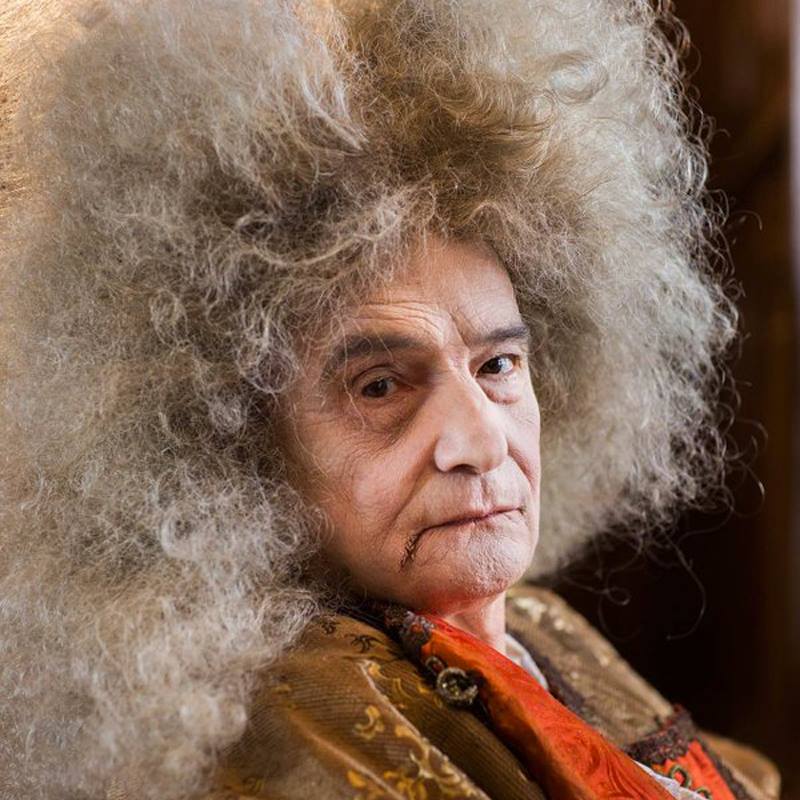
Jean Pierre Leaud and his amazing wig.

The pinnacle comes at about 1 hour 21 minutes while the king is taking small sips of wine and eating small morsels of biscotin. The relative quiet of the film means the music is actually a little jarring when it begins, but the angelic vocals underline that the king’s demise approaches. Louis’ activity gradually slows during the music, and, by the time it ends, it’s hard to tell if the king is still alive. He is very still and barely breathing. There is a long pause before the dialogue resumes which makes the audience to concentrate on Louis’ stillness and frailty. The piece was composed by Marc Verdaguer and is titled “Es fa de nit” (which means “it’s getting dark” in Catalan, Serra’s native tongue). Verdaguer seems to work exclusively with Serra.

Music resumes after the credits have started rolling. This time it’s Mozart’s “Mass in C Minor, K.427,” which has been described as “impressive” and “monumental” (Baerenreiter.com). It provides a suitably emotional accompaniment as the audience is left to reflect on their own mortality. Serra’s minimalist approach towards the soundtrack for La Mort de Louis XIV was effective because it forced the audience to sit alongside the king, without any distractions, as he slowly succumbed to gangrene over the course of 2 hours. It also made the few instances of extradiegetic music standout due to the overall lack thereof. The very slow pacing and lack of music present an interesting challenge to the viewer, but one that’s well worth it in my opinion.

References

“Mass in C minor K.427.” Bärenreiter, https://www.baerenreiter.com/en/shop/product/details/BA9188/. Accessed September 24, 2021.

La Mort de Louis XIV. Directed by Albert Serra, performances by Jean-Pierre Léaud, Patrick d’Assumçao, and Marc Susini. Capricci Films, 2016.

“Soundtrack Credits.” Internet Movie Database, https://www.imdb.com/title/tt5129510/soundtrack. Accessed September 24, 2021.

Memory and Forgetting in Hiroshima Mon Amour (1959)

I haven’t updated this blog recently, so I thought I would share some of my academic writing. Since I’m still spending a lot of time at home due to COVID-19, I have been taking some classes at the University of Cincinnati. In the fall of 2021, I took a French studies class about French film and TV. I wrote a series of short response papers and the first paper is about the 1959 romantic drama Hiroshima Mon Amour which tells the story of a 36-hour love affair between a Japanese architect and a French actress.

I thought director Alain Resnais’ use of perspective to create a sense of intimacy or, conversely, emotional distance in Hiroshima Mon Amour was very effective. I noticed that Resnais used a lot of extreme close-ups in the first half of the film the first time I watched it; however, I didn’t notice that he had used wider shots in the second half, especially for “Her” memories of a wartime affair with a German soldier, until our class discussion. Although we discussed in class how the longer shots created a sense of voyeurism, I feel that using a longer lens also served other functions as well.

She/Nevers (Emmanuelle Riva, left) and He/Hiroshima (Eiji Okada, right).

First, the two main characters, “Her”/”Nevers” (Emmanuelle Riva) and “Him”/”Hiroshima” (Eiji Okada), remain universal/anonymous throughout the film, and the long-distance shots also help to reinforce the anonymous and universal nature of “Her” love affair with the German soldier (who is also never named). The very wide shots do not provide the viewer with many details of the two lovers. The lack of specificity permits the viewer to fill in blanks themselves. Only 15 years had passed since the events in question occurred, and most viewers in 1959 had probably lived through the Liberation. Many viewers at the time had probably witnessed similar events in their towns, or at least heard about something similar, to what “She” experienced when her neighbors punished her (by shaving her head) for engaging in “horizontal collaboration” with the German soldier. Some viewers might have had friends or family members who had made similar transgressions or received similar punishments. The use of wider shots to obscure the details of “Her” memory made it easier for viewers to relate to the story.

Example long shot of She/Nevers and The German.

Furthermore, the very wide shots used to recall “Her” memories of the German could also signify that “She” was actually starting to forget the exact details of the events herself. The events occurred 15 years ago, and, although they were traumatic, “She” likely cannot remember every detail of every rendezvous. As she says in the film, Nevers is already starting to remember things less clearly, such as the details of her German lover’s eyes and voice. The details of her flashbacks are also obscured through the use of very long shots where no distinguishing details can be discerned by the viewer.

References

Hiroshima Mon Amour. Directed by Alain Resnais, performances by Emmanuelle Riva, and Eiji Okada. Daiei, 1959.