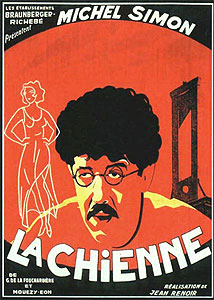
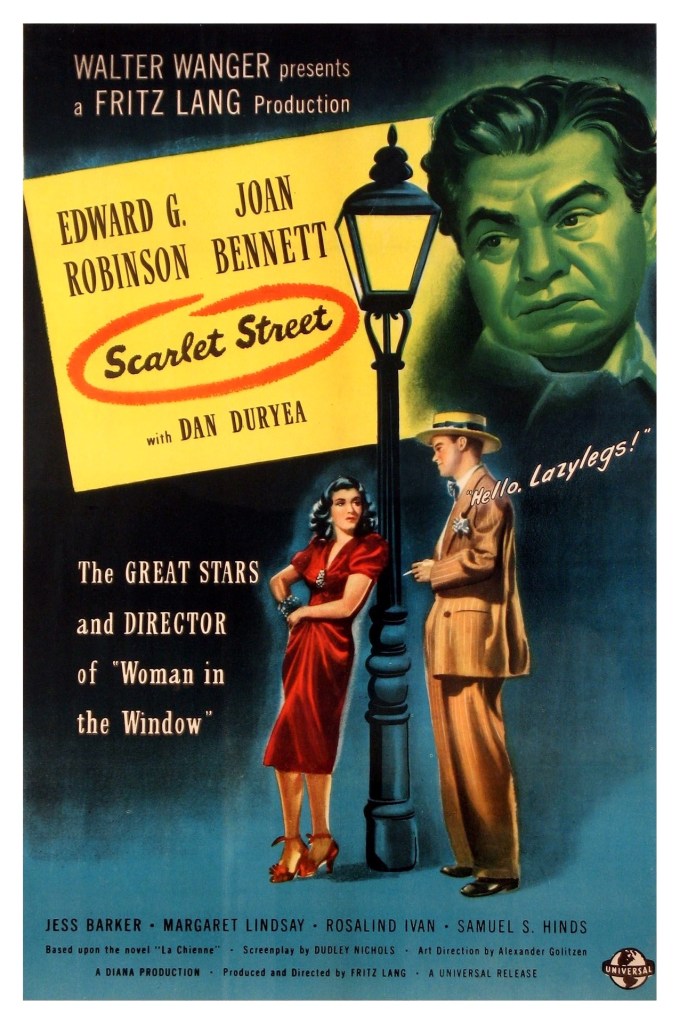
I am taking another film class this semester about American film noir. I wrote essays about two of the films we watched. The first is Scarlet Street (1945) which is based on the 1930 French novel La Chienne (the bitch). A 1931 French film preceded the American adaptation which was directed by Fritz Lang, one of my favorite directors! You can watch Scarlet Street free on Youtube here: https://www.youtube.com/watch?v=MNRSxu22NxU
Essay:
As discussed in the first chapter of Foster Hirsch’s The Dark Side of the Screen, film noir conveys a generally misogynistic attitude towards women who are portrayed as duplicitous and seductive. Fritz Lang’s Scarlet Street (1945) is certainly no exception.
Fritz Lang, from Mubi.com
Kitty (Joan Bennett) is a typical femme fatale in Scarlet Street. She manipulates a gullible cashier, Chris Cross (Edward G. Robinson), into stealing from his wife and his employer under false pretense of love. In addition, Kitty acts in a generally low-class and vulgar manner. For example, she reveals her ignorance of art by mispronouncing Cezanne’s name when discussing art with Chris. Furthermore, she is drunken and uncouth. Kitty stays out late drinking with lover Johnny Prince (Dan Duryea) and sleeps in until her friend Milly arrives the next morning to make amends. In the scene when Johnny convinces Kitty to extort Chris, Kitty also rudely spits out a piece of food. This vulgarity is followed by a telling closeup of a sink full of dirty dishes reveals that she is also a poor housekeeper (which would be seen a major failing for a woman in 1945). Kitty was unable or unwilling to maintain regular employment as a model (thus earning the nickname “Lazy Legs”). All of these elements would have persuaded viewers at the time that Kitty was a “failure” as a woman on several fronts.
From IMDB.com
Kitty also degrades herself by staying with Johnny who slaps Kitty on several occasions and takes money from her. He also insults Kitty, and her friend Milly (Margaret Lindsay) points out that Johnny has made Kitty into “a tramp.” Yet, despite these insults, Kitty clings to Johnny and doesn’t reject him in favor of Chris once Homer Higgins returns. The viewer would understand that Kitty is beyond redemption and refuses to even save herself. Kitty uses her sexuality to corrupt Chris. Even Johnny suggests that she is too sexual when he complained that she thought about nothing else. He told her to call a janitor if she needed more “heat” in the apartment since he could not accommodate Kitty’s lust!
Kitty and Chris from the Harvard Film Archive.
Hirsch attributes the misogyny of noir films to several factors, including anxiety about the social change and upheaval resulting from World War II. During the war, 6 million American women entered the workforce to replace men who had gone over seas to fight the Axis powers (“Watch Terrified Men”). Women became more independent which threatened the traditional patriarchal social structure. Released just after World War II had ended in 1945, Scarlet Street vividly captures the contemporary male anxiety. Although most female employees were fired so that returning veterans could reclaim their jobs, many men were clearly concerned that they had already let the cat out of the bag. Kitty, a modern/liberated woman, was the perfect scapegoat.
The other main female character, Adele Cross (Rosalind Ivan), is shown in a very negative light as well. Adele is an overbearing woman who dominates Chris to such a degree that their domestic rolls are “crisscrossed.” Adele berates Chris to do the dishes (which would typically be the wife’s job in 1945) until he meekly complies. Chris also wears a frilly feminine apron while preparing dinner. Ironically, Adele’s favorite radio program is called the “Happy Household Hour,” while the Cross’ domestic relationship is clearly upside down. Adele also belittles Chris’ art and forces him to take his canvases out of the apartment (and inadvertently pushes him into Kitty’s seductive embrace). Adele reveals that Chris was only able to propose marriage to her because she “put the words” in his mouth. Thus, even in the domestic sphere Chris allows himself to be dominated and bullied. Hapless Chris can’t even find refuge in the supposedly safe realm of his own household, where the man was supposed to rule as patriarch. The domineering Adele has usurped his role, thus reflecting the contemporary anxiety that men felt like they were under assault on all fronts.
Kitty’s friend, Milly (Margaret Lindsay), was the only positive or neutral female character in Scarlet Street. Milly acts as the voice of reason by trying to explain to Kitty how Johnny has mistreated her. When the two women argue, she is the first to make amends by offering a bottle of Scotch. Milly also warns Kitty that Johnny has made threats and is on his way back to her apartment to hurt her at the end of the film. Milly acts as a token example that not all women are bullies or seducers. Milly is also gainfully employed in contrast to Kitty. However, her role is very minimal, and she only offers a baseline for acceptable behavior. Milly’s modest behavior contrasts with Adele and Kitty only serves to make them more monstrous. Scarlet Street tells female viewers that they should toe the line and challenge men no further than Milly’s verbal sparring with Johnny.
Scarlet Street thus offers fertile ground for exploring the film noir trend towards misogyny. Shot during the later stages of World War II and released shortly after the fighting stopped, Scarlet Street affirms Hirsch’s thesis that film noir reflected male anxiety about potential gender roles becoming permanently “crisscrossed” as a result of the wartime labor crisis. Kitty was presented as a seductive woman who failed to uphold traditional gender expectations. Adele emasculated her husband and usurped the traditional patriarchal role as head of the household. Similar trends are evident in other films we’ve viewed so far, such as the predatory femme fatale Phyllis (Barbara Stanwyck) in Double Indemnity (1944) and the duplicitous Helen/Velma (Claire Trevor) in Murder, My Sweet (1944).
References
Hirsch, Foster. The Dark Side of the Screen: Film Noir. Cambridge: Da Capo Press, 1981.
Despite the uncertainly at the moment, Nataliya’s brother Michael told me he feels like the situation must be more difficult for Nataliya and I as we watch powerlessly from far. He lives in Kharkiv, one of Cincinnati’s sister cities, in eastern Ukraine, and the city has been under Russian bombardment for more than a week. Neither Nataliya nor I have been sleeping well. However, we have been doing what we can to support Ukraine and the 1 million refugees who have already fled as well as bolster our own spirits.
Protest at City Hall on Feb. 28, 2022.
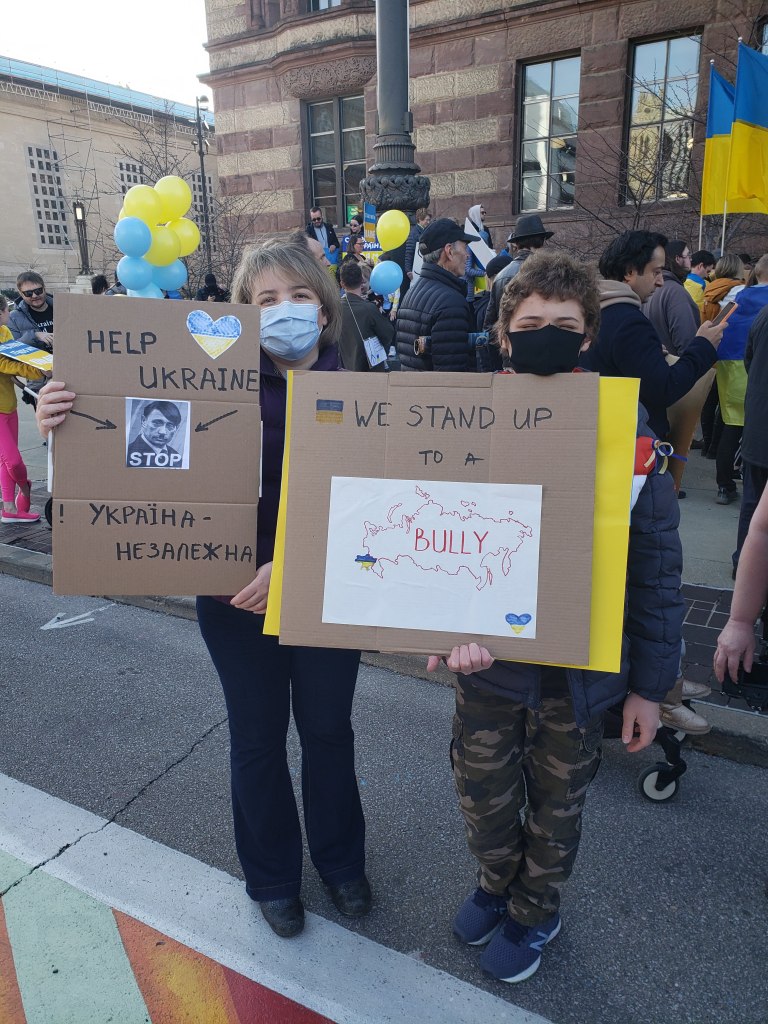
About 150-200 people attended a protest on Monday (Feb. 28) at city hall. There were many outrageous, poignant, and pointed signs. Protestors wore the national colors of blue and yellow and waved the national flag. I brought along some sunflowers which are the national flower. Cars honked their horn in support as they drove past. Mayor Aftab Purval spoke and pledged support to Kharkiv which is one of our sister cities. It felt great to be around so many other people who also cared so deeply about Ukraine. Several news outlets covered the event and Nataliya was mortified to later see her portrait in City Beat.
The slogans of Ukrainian resistance erupted loudly and frequently from the crowd:
Slava Ukraini (glory to Ukraine)!
Heroyam slava (glory to the heroes)! [This serves as a rejoinder]
An informal committee has been created at my employer, Humana. We had an initial meeting last week that generated more than 30 different ideas about how our company and coworkers can support the Ukrainian people. A second “shark tank” style meeting will turn the ideas into action later this week. Several of my ideas were selected, including a suggestion to divest from any funds or assets in Russia. Numerous other companies and funds have made a similar pledge; however, it may not even be relevant since I’m not sure Humana even has any assets in Russia. If we do, it won’t be feasible for the foreseeable future since MoEx (the Moscow stock market) will remain closed indefinitely due to the unprecedented sanctions that have been levied against Russia. (link) I’m not even sure how to send this suggestion up the corporate ladder or who would even make that decision aside from the board of directors.
5k participants at Corwin Nixon Park (Mason, OH) – March 5, 2022.
On Saturday (March 5th), I attended another protest and fundraiser in Mason. This time, it took the form of a 5k walk and fundraiser at Corwin Nixon Park. Turnout was again very strong with about 150 people participating. At first, we walked along Mason-Montgomery Road with many cars honking in support. Then, we walked across the park alongside a peaceful little stream. The weather was perfect – sunny and warm. I felt like maybe Michael and his family could live vicariously through me since they remain huddled in the apartment in Kharkiv.
Putin’s naked aggression has enraged me, and I will do everything I can to help. Because I’m not very busy at work currently, the war in Ukraine has given me new purpose. Nataliya and I urge everyone to act on their sympathy for Ukraine as well by donating to humanitarian organizations, writing a letter to Congress, attending rallies, or any other relevant activity. To stay up to date on local ways to support Ukraine, you can join the Stand with Ukraine in Cincinnati Facebook group.
The International Criminal Court has begun to investigate whether Putin has committed war crimes during the invasion of Ukraine. However, the evidence is obvious that he has. The Russians have used cluster bombs against the city, which drop a carpet of small bomblets over a wide area. (link) This is the definition of indiscriminate and exposes Putin’s lies about targeting only “military objects.”
On Tuesday (March 1st), Russian missiles destroyed Freedom Square in the city’s center, which housed local and regional government offices, as well as a concert hall and opera house. The city zoo is immediately adjacent to Freedom Square but does not seem to have been badly damaged. Nataliya took her son to the zoo on previous trips to visit his grandparents. However, the zookeepers were unable to evacuate the animals since the city is only 28 miles from the Russian border. The zookeepers have sedated the animals but say they only have 10 days of food left. Some animals have escaped but more than 4,000 remain. (link) I love animals, and they shouldn’t be overlooked. That’s not to downplay all the human suffering that’s occurring either. The European Zoo Association is accepting donations on behalf of all Ukrainian institutions (link).
I hope that one day I can see Kharkiv in all its peaceful splendor after Putin has been forced to rebuild it. Although I’m usually not a fan of jingoist slogans, I’ll sign off my blogs from now on with the following salute:
More than a week into the assault on Kharkiv, the people’s spirit remains unbroken. For the last 10 days, the Russian army has launched missiles, airstrikes and artillery against the city of 1.4 million residents – including my girlfriend Nataliya’s family. Dozens have been killed or injured and some parts of the city are without power, water, or heat. (link) Before the war, Kharkiv was a cultural and economic center renowned for its museums.
Her parents still live on the outskirts of the city and her brother Michael lives in the city itself with his wife Daria and young son Leo, who is autistic. There is some good news that Nataliya’s ex-husband, Vlad, managed to escape Kharkiv and should return to the US soon. He had been visiting his parents in Kharkiv when the war started.
Her parents have been hiding in their cellar to avoid nearby explosions that have caused their windows to rattle. However, the cellar is too cold for them to sleep in overnight. The pet cat and Nataliya’s father have been comforting each other during the bombardment and are inseparable. The power recently went out, but luckily their house is heated by gas.
“We pray every minute,” said Nataliya’s mother, Iryna, via text.
Thankfully, they live on the fringe of the city, so they have some chickens, rabbits, and a small garden. Otherwise, they haven’t been able to go shopping, but a truck delivered a few loaves of bread to the neighborhood one day. All the neighbors are working together to help each other survive. A younger resident goes to the pharmacy to obtain medication for older members of the community. People buy extra supplies and share with anyone who might be running out of essentials.
Michael and his family live in a large apartment building and half of the residents have already fled. They mostly stay indoors except for occasional brief excursions to a small park across the street when things seem quiet. Leo, who is non-verbal, has already started to crack under the stress, even though Michael tried to convince him the explosions were only fireworks. The family wants to stay together but avoids going down into the basement during air raids. Michael fears they might be trapped if the only exit is blocked by debris.
Despite all the difficulties, Michael remains grimly determined.
“There is no need to plan ahead,” he wrote via text message. “When you plan one day at a time, it’s sort of ok, no matter how horrible this sounds. There is joy when you wake up the next day and check for family and friends and you can hear from them. We have hope that…there’ll be enough spirit to break the Russians.”
Although the future remains uncertain, Michael says they plan to stay in Kharkiv since it seems more dangerous to travel by car, especially with a small child who has special needs. However, they do have a plan to evacuate, and their bags are already packed if the need to leave quickly. Daria, Nataliya’s sister in-law, has lived in the same neighborhood in Kharkiv her whole life, so it seems more difficult for her to admit they might need to leave.
I understand the reasoning and realize fleeing wouldn’t be easy. On the other hand, I’m very concerned that the situation could only get worse as Putin gets more desperate. Despite sustaining considerable losses (at least 500 killed, 200 captured, and hundreds of vehicles destroyed or captured) over the first week (link), Putin’s armies have only captured one major city, Kherson, along the Black Sea coast. Kherson is only the 13th largest Ukrainian city with about 280,000 residents before the war.
Although the Russians agreed to temporary local ceasefires in order to allow for civilian evacuations, the first such agreement in the port city of Mariupol collapsed after only a few hours (link). The Ukrainians say the Russians broke the agreement and continued to shell the city as civilians tried to leave.
I’m afraid civilians like Michael and his family will pay the price if Putin ratchets up the violence even more to eke out some meager victory. Putin set a precedent for brutality when he flattened the city of Grozny 20 years ago during the 2nd Chechen War. In doing so, he killed at least 5,000 civilians. (link) With the whole world watching, I hope Putin won’t dare to repeat the atrocity, but we can’t rule it out.
Only 45 km (28 miles) from the border with Russia, Kharkiv has been the scene of heavy fighting (link) since the beginning of the Russian invasion of Ukraine on Feb. 24 (Thursday). My girlfriend Nataliya and I have watched with anguish from afar as her homeland and hometown have been subjected to naked Russian aggression.
Nataliya has lived in the United States nearly 20 years, but all her family still lives in or near Kharkiv, including her brother (married with a young son with special needs) and her parents (both retired). Her brother lives on the east side of Kharkiv and says there has been fighting in nearby streets. Her mother and father live in a rural suburb on the west side of Kharkiv and say they can’t sleep at night because of all the explosions. Her mother, Iryna, says they don’t turn on the lights at night because they’re afraid to make themselves a target. Her ex-husband Vlad also returned to Ukraine only days before the fighting started to care for his mother and father who are both in poor health. His mother had surgery shortly before the invasion and was sent home prematurely to make room for anticipated casualties. Vlad has remarried and his wife and stepdaughter are very worried too since it looks like he won’t be returning to northern Kentucky anytime soon.
News reports indicate the Russians bombarded Kharkiv with missiles and artillery before sending in ground forces. A gas pipeline and the local airport were damaged. Fighting erupted throughout the city, but the Ukrainians claimed to have completely repulsed the attack by Feb. 27 (Sunday). But on Monday, Russian artillery has started to pound residential areas in Kharkiv (as seen in the video) killing dozens which flatly contradicts naked Russian lies that they target “only military objects.”
Kharkiv is a major cultural and economic hub and is the 2nd largest city in Ukraine. Founded in 1654, Kharkiv was the capital city before Kyiv rose to prominence in 1934.
Known for its beautiful churches and magnificent museums, Kharkiv is also a sister city of Cincinnati. Mayor Aftab Purval has offered assistance (link) to any Ukrainian refugees who may eventually arrive in Cincinnati. St. John’s Unitarian Universalist Church has already begun to raise funds to help as well. A rally is planned on Fountain Square at 3 p.m. Monday (Feb. 28) with Mayor Purval speaking at 4 p.m. More than 500,000 people have already fled the fighting in Ukraine. Please make a donation to any relevant humanitarian group if you are in a position to do so!
Kharkiv is 5,300 miles away and is separated from Cincinnati by 7 time zones, so the flow of information has been very slow. I had started to sleep much better in recent months after suffering from COVID-somnia but have had very little sleep the last few nights.
Nataliya and I had been planning a visit to Ukraine to spend time with her family in Kharkiv. I only met Nataliya’s mother briefly when she visited Cincinnati in 2019, but I say a few words whenever Nataliya chats with her over Facetime. I’ve been taking some rudimentary Russian language classes through the Babel app. Being so close to the border with Russia, Kharkiv is one of the regions in Ukraine where Russian is more common. Ukrainian and Russian are very similar (link), and both use the Cyrillic alphabet; as a result, many Ukrainians are bi-lingual. About 68% of the population primarily speaks Ukrainian while 30% speak Russian and the remainder speak other languages.
Nataliya’s son Alex speaks Russian at home and usually visits both sets of his grandparents every summer. Alex doesn’t understand the scope of the war and, in his youthful naivete, expects to return this year as soon as the shooting stops! Nataliya’s parents live on the more rural edge of Kharkiv, so they have a little garden, some chickens, and rabbits whom Alex loves! He was heartbroken when the furry matriarch recently died.
I have been awed by the dogged Ukrainian resistance in the face of nearly 200,000 Russian troops. But, there are suspicions that Belarus (a close ally of Russia) might send troops to fight alongside Russia (link) in Ukraine. So far, Belarus has only facilitated the invasion by allowing Russian troops to cross through Belarus in order to attack Ukraine.
My first interest in history arose was based in military history and especially World War II. That background makes me painfully aware of the suffering this war is causing. Therefore, I am an advocate for peace, which is one of the seven principles of Unitarian Universalism (link). So, I feel guilty when I take smug satisfaction after seeing videos of burned-out Russian tanks and armored vehicles on the streets of Ukraine. However, I realize this is Putin’s war and not a war the Russian people wanted.
As shown by recent massive peace protests in 48 Russian cities (link), many Russian people abhor war. Especially when thousands or perhaps tens of thousands of young Russians will die as result of an illegal and unjust war that Putin unleashed.
No major Ukrainian city has been captured yet and the tyrant Putin agreed to negotiate with Ukraine. I doubt that the diplomatic talks will lead to much progress, especially while Russian troops are still killing innocent civilians in Ukraine. It seems unlikely that domestic protests or international sanctions will topple Putin either, since he has weathered both before. Perhaps this situation is different?
Five years after being diagnosed with cancer, and I am still on the treatment “treadmill.” I was originally diagnosed with Stage 4 non-small cell ALK-positive lung cancer shortly after Christmas 2016.
This 5-year status update for my “cancerversary” is a little overdue because the results of my MRI scan in November of last year were ambiguous. I had another scan in January and was hoping for a little more clarity, but the results were still not clear-cut. I decided to provide an update anyway. The combination of targeted daily medication and several rounds of radiation therapy have kept things mostly stable for the last several years.
The MRI from November 2021 was a scan of my head and spine since I had two small metastatic tumors in my brain that were successfully treated via proton therapy when I was initially diagnosed. I also have a small lesion on my spine as well that has persisted despite all the treatment. My November 2021 MRI showed that the spine lesion had grown about 5mm compared to a scan 12 months prior. However, the lesion was basically unchanged compared to the most recent MRI 6 months prior. Although not alarming, 5mm growth over 12 months is somewhat concerning since I would prefer to have no growth at all!
In addition, the MRI showed some possible growth of the small lesion in my brain that had been treated 5 years ago. My radiation oncologist consulted with the tumor board and the initial assessment was that a new separate tumor had appeared. The radiation oncologist ordered another MRI in January to get a better idea if anything was actually growing since the change seemed to be so minimal.
I left this unappetizing morsel of information to simmer on the back burner for the next two months. I have had a lot of experience with similar situations during the last 5 years, so I only had a small meltdown around Thanksgiving. But that was mostly due to exhaustion from my ongoing insomnia.
I had another MRI in January, and the radiologist eventually judged that the brain tumor had increased “slightly.” The spine tumor was unchanged compared to the November scan but still about 5mm larger than it was a year ago. I was a little anxious, but at the same time it wasn’t entirely bad news either.
Can there be too many cooks in the kitchen?
The matter is further complicated by the fact that the initial radiation oncologist only deals with my brain tumors while I have a second radiation oncologist who is responsible for treating my original lung tumor and spine. Plus, I have a general oncologist who is the closest to being the “captain” of my treatment team. I would rather have 3 experts who are hyper-specialized rather than 1 or 2 generalists that try to do everything. But it still isn’t easy to get 3 doctors to agree on anything, especially something where the evidence is so marginal!
My brain oncologist was more concerned about the possible growth than my lung or general oncologists. I am not panicked about it, but I will remain vigilant. There are possible side-effects from using radiation to treat my spine, such as possible bone fractures, so I don’t want to jump the gun. But at the same time, I don’t want to let the cancer gain any ground. After further discussions, I told my doctors I would hold off from treatment from now, but that I want to pull the trigger if it continues to grow. If I do need more treatment, the doctors said it would be quick and uncomplicated since the bone of my spinal discs provides an additional “buffer” zone. Proton therapy can target the tumors very precisely without damaging any nearby tissue. If I do need more radiation in the future, that will be my third round after my initial treatment in early 2017 and a second round in 2020 to treat my primary lung tumor.
After 5 years, the treadmill of treatment continues. I still get MRI scans every 6 months and CT scans every 3 months that show my lung tumor has responded well to treatment. I take a pill every day and get my blood drawn every month (the results have been stable recently). The routine never lets me forget that I am merely mortal. Five years later, I still need to perform daily vocal exercises after the cancer partially paralyzed my vocal cords. Every time I shave, I still carefully maneuver around the concave scar on my neck that resulted from surgery to repair my vocal cords. The fact that I’m still in treatment probably seems outlandish compared to the average length of chemotherapy treatment of approximately 3 – 6 months.
I still attend a monthly young adult cancer support group. There’s another person whose cancer experience continues to be a years-long marathon like mine, but most of the other members talk about readjusting to the “new normal” of post-treatment life.
I often lament that it would a nice problem to have! However, there currently is no cure for ALK+ cancer – only treatment that hopefully continues to control it. Nevertheless, the average survival rate is still slightly under 7 years even on medication, and only 2 years remain before I hit that milestone. Research continues to seek new treatment options – especially for ways to tackle ALK+ cancer when it develops mutations that circumvent the current medications. The good news is that clinical trials are already underway in case I should ever need new medication. Thanks to everyone who donates to my annual fundraiser!
I can still hear clock ticking, and feel the last 5 years have been borrowed time. Unfortunately, COVID-19 has also side-tracked the last 2 years, but hopefully the situation will finally settle down into another “new normal” as well. The combination of COVID-19 and stage 4 cancer was particularly terrifying before the vaccine was distributed. These two factors were undoubtedly the cause of my “COVID-somnia” which suddenly appeared in 2020. Despite my 20-year history of sleep apnea, I never really had a problem staying asleep until COVID arrived. But, for the last two years, I’ve been unable to fall back asleep if I wake up during the night (which I almost always do). Only now is my sleep quality approaching a “new normal,” although I still have periods of insomnia and extreme fatigue.
Despite the uncertainty, I have been blessed with many positive opportunities as well during the last 5 years. In 2018, I finally returned to Paris with my family after first visiting nearly 20 years prior. I had dreamt about it for years and finally made it come true. We plan to visit again in the fall of 2022 (a birthday present for myself to celebrate my 40th) after COVID delayed us for two years. I also visited New Orleans with my dad and uncle. Nataliya has been a supportive and loving partner for the last 3 years! We are looking forward to finally getting on the road again together this spring and summer as well! More recently, I have been refreshing my French conversation skills and acting as “game master” for several role-playing games. I am also lucky to have a good job and excellent insurance (which covers the insanely criminal $17,000 monthly cost of my medication). I’ve even found a few truly 0% ABV “beers” that are a reasonable approximation of beer, such as Hairless Dog Brewing and Heineken 0.0, since I still can’t drink real beer (a side-effect of my medication). It’s been so long I don’t even miss the real thing any more!
The last 5 years have been a gift, and with any luck there will be many more!
During the late 19th century, Germany became an imperial power with colonies in Africa and the Pacific Ocean that attracted settlers, merchants, soldiers and administrators. Their presence influenced the native cultures in several ways, including architecture, linguistics and foodways. However, Germany lost its overseas colonies after being defeated in World War I; as a result, this relatively brief period of imperial control has been overlooked or forgotten in many former German colonies.[1] In total, an estimated 6 million Germans departed their homeland between 1820 CE and 1920 CE in search of economic opportunity and, after the Revolutions of 1848 CE, political freedom. [2] Although most German migrants eventually settled in Europe or the United States, significant numbers also migrated to the Americas, including Canada, Mexico, Brazil, Chile and Argentina, as well as the Pacific, such as Australia and New Zealand. Although brief, Germany’s imperial legacy still influences the brewing industries and beer consumption patterns of several former German colonies, including the Chinese region of Tsingtao and the former African colonies of Namibia and Tanzania. Analyzing the brewing industries of these aforementioned regions reveals the German preference for lager continues to influence many brewers and millions of drinkers around the world today, even if the impact is often subtle.
Map of the German colonial empire c.1914 (copied from the New World Encyclopedia).
German Jesuit priests had traveled to China as early as the 17th century; however, Germany did not exert significant influence in China until the end of the 19th century. In 1897 CE, German warships occupied Tsingtao, a coastal city in Shandong province, in retaliation for the murder of two German missionaries.[3] After World War I erupted in Europe in 1914 CE, Japan, a member of the Allied powers, attacked the German forces in Tsingtao, which numbered only a few thousand men. The German presence left a small footprint and lasted only a short time. However, the Tsingtao Brewery continues to produce a pale lager that is available in the USA. The firm, originally named the Germania Brewery, was founded in 1903 CE, six years after the German occupation began, and key personnel were German, including the directors, brewmaster and cellar master.[4] In addition, numerous other Chinese breweries also produce lager beer today, and Snow Beer is the most popular with an annual production of about 113 million liters in 2018 CE.[5] Although the German occupation lasted less than 20 years, their preference for lager has had a significant influence on Chinese consumption. On the other hand, few people in China trace their heritage to Germany, and the 2010 CE Chinese census recorded only 14,400 Germans.[6] I did not find any evidence of German heritage associations in Tsingtao or any other part of China.
The German Empire also included territories in Africa, including Tanzania (part of German East Africa) and Namibia (formerly German South West Africa). German officials signed treaties with local chieftains to create the colony of East Africa in 1885 CE. As in other colonies, the German occupation force was small and less than 1% of Tanzanians today are of European descent.[7] I could not locate any German heritage associations in Tanzania either. However, the German preference for lager continues to exert a strong influence on the contemporary Tanzanian brewing industry. Tanzania Breweries Limited (TBL), located in the coastal capital of Dar es Salaam, is the largest producer with about 70% of market.[8] TBL was founded in 1933 CE, under the name Tanganyika Breweries, which is 15 years after the German occupation had ended. Killimanjaro premium lager is TBL’s most popular brew, and lagers, pale lagers or pilsners are the most common choices for Tanzania beer drinkers.[9] It does not appear that any Tanzanian beer is readily available in the USA.
In contrast to Tanzania, Namibia exhibits a stronger connection to its German colonial legacy. German warships landed troops there in 1884 CE, but the occupation force numbered only 14,000 by 1913 CE.[10] In 2011 CE, the Namibian census reported that only 4,300 households, less than 1% of the total, spoke German as their main language.[11] The Swakopmunder Brauerei may have been the first commercial brewery in the colony when it began operations in early 1900 CE, 16 years after the colony was formed, in the coastal city of Swakopmund.[12] It produced Berliner Weissbier and Dunkel Bier. Today, the leading brewery is Namibia Breweries Limited (NBL), founded in 1920 CE in the central capital of Windhoek. NBL’s annual production is more than 200 million liters with Tafel lager being the most common brew.[13] In general, lager and pilsner are popular styles with Namibian beer drinkers.[14] It does not appear that any Namibian beer is available in the USA. While I did not find any German heritage associations in Namibia, I did discover an annual German festival called Wika (sponsored by NBL) which began in 1952 CE. In addition, Windhoek hosts an Oktoberfest celebration; but both events were postponed this year due to COVID-19.[15] In addition, Namibia is the only African country with a daily German-language newspaper.[16] However, the Namibian government has also started to challenge the reverence for its German colonial heritage in recent years by removing a controversial statue dedicated to German soldiers killed while waging a genocidal war against native peoples.[17] Perhaps the reckoning has been delayed by a desire to placate German tourists who spend money in Namibia.[18] Regardless, the Namibian preference for lager has thus far escaped controversy.
Although the German Empire did not incorporate any colonies in the Americas, numerous Germans migrated to Canada, Mexico, Brazil, Chile and Argentina. Germans first traveled to South America in the 16th century, but they were few in number. Migration intensified during the 19th century, especially after the failed Revolutions of 1848 CE. Another wave of migration occurred after World War II as displaced Germans fled the destruction of their homeland. Alleged Nazi war criminals tried to evade justice by hiding in South America as well.[19]
About 7,000 Germans colonists and mercenaries initially settled in Brazil in the 1820s after being recruited to fight for Brazil to retain Uruguay, which was in the process of obtaining its independence from Brazil.[20] Immigration continued throughout the 19th and 20th centuries with about 220,000 Germans arriving by 1972 CE.[21] German immigrants probably brewed beer on a domestic scale, and it took about 30 years for the first commercial brewery to appear in 1853 CE in the city of Petropolis (not far from the coastal capital of Rio de Janeiro).[22] Pilsner is the most popular beer in Brazil with American-style lagers in second place.[23] Skol, an American-style lager produced by brewing giant InBev, is the single most popular brew in Brazil.[24] Xingu, a black lager, is available in the USA.[25] Many Brazilians trace their heritage to German immigrants and some 3 million Brazilians still speak some form of German.[26] Although I could not locate any German heritage associations, it seems plausible that one or more exists, but without many English-language references. However, Brazil does claim to host the second largest Oktoberfest celebration in the world in the south-eastern city of Blumenau (which is also the home of a beer museum).[27]
Blumenau, Brazil, claims the title of the 2nd largest Oktoberfest celebration in the world. Photo from TripAdvisor.com. Cincinnati is only the 4th!
The first significant group of German settlers arrived in the Patagonia region of Argentina in 1853 CE. By 1895 CE, about 25,000 Germans had migrated to Argentina[28] with another 72,000 arriving between 1919 CE and 1932 CE.[29] Today, about 500,000 Argentinians still speak German.[30] However, I could not locate any German heritage associations in Argentina, but again, that could be due to a lack of reference material in English (as opposed to an absence of such organizations). Nevertheless, the German preference for lager beer continues to influence the Argentinian brewing industry and consumer preferences. Quilmes is the leading brand in Argentina with a 67% market share.[31] The top seller for Quilmes is Cristal lager and other breweries compete by producing their own light lagers and pale lagers.[32] Quilmes was founded in 1880 CE by Otto Bemberg, a German immigrant, in the coastal city that is the brewery’s namesake (near the capital Buenos Aires). Quilmes is available in the USA.
German migration to Chile began in the late 1840s and at least 30,000 had arrived before World War I.[33] Today, only an estimated 500,000 Chileans are of German descent.[34] In addition, there are several German language schools and a weekly German newspaper in Chile, although I did not locate any German heritage associations (again possibly due to a lack of English language references). German influence in the Chilean brewing industry also remains strong. One of oldest Chilean commercial breweries is Austral which was founded in 1896 CE by Jose Fischer, a German immigrant, in Punta Arenas (a small and remote coastal town at the southern tip of Chile).[35] However, Austral’s production only amounts to 1% of the Chilean market,[36] and the Compania Cervecerias Unidas (CCU), incorporated in 1902 CE, is the leading brewer with about 77% of the market.[37] CCU Cristal, another pale lager, accounts for 60% of CCU’s sales. [38] CCU exports to the USA, and overall Chilean beer exports experienced rapid growth in recent years from a paltry $4 million in 2002 CE to more than $113 million in 2013 CE.[39]Kunstmann, a Chilean craft brewery, is an obvious example of German cultural influence. Kunstmann brews in accordance with the 1516 Reinheitsgebot and features many different iconic German beer styles, including lager, bock and Weissbier.[40] Kunstmann began exporting to the USA more than 20 years ago and hosts the largest annual beer festival in Chile (which was also cancelled this year due to COVID-19).[41] Kunstmann is based in the town of Valdivia. A German immigrant had opened a commercial brewery in Valdivia in 1851 CE (only a few years after the first Germans arrived in Chile), but the business did not recover from a destructive earthquake in 1960 CE. Kunstmann pays homage to their German brewing heritage on their website.[42]
Individual Germans first arrived in Mexico in the 1820s, but the first wave of significant migration did not begin until the 1840s.[43] In the 1920s, about 16,000 German Mennonites from Canada migrated to Mexico.[44] Today, there are about 30,000 self-identified Germans living in Mexico,[45] although up to 20% of the overall population could have German ancestry.[46] Spaniards had created the first commercial brewery in Mexico in the 1540s, but it was a failure.[47] The first successful commercial brewery was Cerveceria Cuauhtemoc which opened in 1891 CE in Monterrey (about 50 years after the first Germans arrived).[48] Cuauhtemoc is best known for its Czech-style pilsner called Bohemia, although Mexicans also enjoy Vienna style lagers due to the influence of the Hapsburg emperor Maximilian I who came from Vienna to rule Mexico briefly in the 1860s.[49] However, Mexican consumers tend to prefer lighter lagers and pilsners. The best-known Mexican light lager is Corona Extra, produced by Cuauhtemoc’s rival Grupo Modelo, which is available in the USA. Other common Mexican export beers include Dos Equis Amber (Vienna lager), Tecate (lager) and Modelo Especial (lager/pilsner).[50] I could not locate any German heritage associations in Mexico, but several cities host Oktoberfest celebrations. Furthermore, the city of San Luis Potosi funds a German Cultural Center that offers language classes and cultural programs.
Aside from introducing Vienna Lager to Mexico, Maximilian’s reign was so unpopular that he was overthrown and executed. Painting by Edouard Manet (1867-69).
While the United States attracted the most German immigrants, Canada also attracted a few settlers. However, a lack of direct transportation and a shortage of available land in Canada discouraged more Germans from settling there. Between 1871 CE and 1914 CE, only about 40,000 German migrants had arrived in Canada.[51] Approximately 290,000 Germans also fled to Canada after World War II.[52] In 1971 CE, an estimated 1.3 million Canadians had German heritage which amounted to 6.1% of the total population.[53] There are a plethora of German heritage groups in Canada, including regional clubs, a historical association and a German-Canadian museum in Mississuaga, Ontario (only open on Sunday afternoons or by appointment). In addition, Canada celebrates German heritage month every October to correspond with Octoberfest and Canadian Thanksgiving.
When it comes to beer, Canadians prefer light lagers.[54] The first commercial breweries in Canada opened in the 17th century while it was still a French colony, but these endeavors were not successful. The oldest surviving Canadian brewery, Molson, was founded by John Molson in 1786 CE in Montreal.[55] That predates, by several decades, any large-scale German immigration which did not begin until the 19th century. Molson’s top-selling beer is the Molson Canadian lager, although American-style light lagers, such as Budweiser, are also popular. Many Canadian lagers, including Molson, Labatt Blue and Moosehead, are easily available in the USA. Canadian brewers also contributed their own seemingly innovative version of lager beer, “ice beer,” where the brew is partially frozen after fermentation. However, this apparently novel idea is based upon the same concept as the German eisbock where ice is removed from a frozen beer in order to produce a brew with higher alcohol content.[56] Although Canada was originally a French colony later conquered by the British, German influence in the Canadian brewing industry has been significant.
German migrants also settled in other British colonies, including Australia and New Zealand. The first wave of German immigrants arrived in Australia in 1838 CE primarily for religious reasons.[57] By 1900 CE, 38,000 German immigrants were residing in Australia.[58] However, it wasn’t until 1885 CE, nearly 50 years after the first German immigrants arrived, that Australia began producing lager which accounts for 95% of Australian beer consumption today.[59] Great Northern Brewing, Victoria Bitter and Carlton Draught, all lagers, are the leading beers in Australia.[60] Founded in 1822 CE, Cascade Brewery, located on the southern island of Tasmania, is Australia’s oldest brewer which predates significant German immigration.[61] Foster’s Lager is the biggest Australian export beer and is widely available in the USA, although it is not a top seller in the domestic market.[62] However, even smaller Australian craft brewers are exporting beer, including pilsner, to the American market.[63] Incidentally, German immigrants in the 19th century are also credited with creating the Australian wine industry.[64]
Despite the advertising, Foster’s is not very popular in Australia.
In addition to affecting the contemporary Australian brewing industry, German influence has also had other impacts on Australian culture. In the 2016 CE Australian census, 4.5% of the population claimed German heritage.[65] Australia has a Wendish Heritage Society and the German-Australian Genealogy and History Alliance, as well as Die Woche Australien – a weekly German language newspaper. The Goethe Institut, a cultural organization, also has offices in Melbourne and Sydney where language classes and cultural programs are hosted.
Finally, approximately 10,000 German immigrants settled in New Zealand between 1843 CE and 1914 CE. [66] Explorer Captain James Cook brewed the first batch of beer in New Zealand in 1773 CE. He used rimu twigs and manuka leaves to brew up a concoction that would ward off scurvy.[67] The first commercial brewery opened in 1835 CE, which also predates significant German migration, in the region called the Bay of Islands.[68] Today, the most popular beer in New Zealand is the New Zealand Draught, with DB Draught, Lion Red and Speight’s Gold Medal Ale being to the top brands. Although the exact origins of the New Zealand Draught style are unclear, it is actually a lager.[69] However, none of the leading brands appear to be available in the USA. Today, approximately 200,000 New Zealanders trace their heritage to Germany.[70] German cultural influence persists today through an office of the Goethe Institut in Wellington and the German Bohemian Heritage Society.
In conclusion, German immigrants brought their love of beer with them when they settled in various regions around the world. The German Empire, although short-lived, helped facilitate the spread of German culture, including foodways, in the colonies of Tsingtao in China, Namibia (former German South West Africa) and Tanzania (formerly part of German East Africa). Although the German Empire did not incorporate any colonies in the Americas, numerous German immigrants settled in Mexico, Chile, Brazil and Argentina. German migrants also chose to start a new life in former British colonies, including Canada, New Zealand and Australia. In most of these countries, the preference for lagers or pilsners, as well as other variants such as pale lager, can likely be attributed to the cultural influence of German immigrants who played a key role in the nascent brewing industries (as well as the Australian wine sector). Some breweries, such as Kunstmann in Chile, overtly acknowledge their German heritage and even go so far as to brew according to the Reinheitsgebot. German influence is also evident in other cultural areas as well, including the arts and media. Although I was unable to locate German heritage associations in many of the South American regions, they may exist – especially in places like Argentina and Brazil where large parts of the population claim German heritage. The problem may have been that I can’t read Spanish and thus relied on English language online references which were obviously more plentiful in former British colonies. Despite this limitation, it is clear that German immigrants have had an enduring impact around the world.
[7] George Thomas Kurian, “Tanzania – Ethnic Groups,” upenn.edu, African Studies Center at the University of Pennsylvania, n.d. published, accessed 12/21/2020, https://www.africa.upenn.edu/NEH/tethnic.htm
[21] Maria Stella Ferreira Levy, “O papel da migracao internacional na evolucao da populacao brasileira (1872 a 1972),” scielo.br, Scientific Electronic Online Library, published June 1974, accessed 12/22/2020, http://ref.scielo.org/2c8fkv
[29] Stefan Rinke, “German Migration to Latin America,” in Germany and the Americas: Culture, Politics, and History, eds. Thomas Adam and William Kaufman (Santa Barbara: ABC-Clio, 2005), 30.
[44] J. Winfield Fretz and H. Leonard Sawatz, “Mexico,” gameo.org, Global Anabaptist Mennonite Encyclopedia Online, published November 2010, accessed 12/22/2020, https://gameo.org/index.php?title=Mexico
[45] Ingrid Dobler, Maren von Groll and Alois Moosmuller, “The Importance of the Diaspora Community for Business in Mexico: A Comparison of German and U.S. American Staff Members Posted Abroad,” in Area Studies, Business and Culture: Results of the Bavarian Research Network Forarea, ed. Horst Kopp (Munster: LIT Verlag, 2003), 318.
[64] Paul Keating, “Speech by the Prime Minister, the Hon. PJ Keating, MP Luncheon the His Excellency Dr. von Weizsaecrer, President of the Federal Republic of Germany Parliament House, Canberra, 6 September 1993,” pmc.gov.au, Department of the Prime Minister and Cabinet, published 09/06/1993, accessed 12/23/2020, https://pmtranscripts.pmc.gov.au/release/transcript-8956
Both Portrait de la jeune fille en feu (2019) and La Mort de Louis XIV (2016) use silence to enhance viewer’s immersion in the world they are experiencing. In Portrait, the absence of a soundtrack enhances the quietude of Héloïse (Adele Haenel) and Marianne’s (Noemie Merlant) world where the crackling of the fire and the crashing of the waves are the major audio landmarks. The silence and slow pacing also enhance the impact of the Latin chant in the climatic bonfire scene. Albert Serra’s La Mort also used music sparingly in a similar manner, but in a way that was more effective in my opinion since it was period appropriate.
When you’re so in love that you don’t even notice your dress caught on fire.
The Latin chant, “Portrait de la jeune fille en feu,” was composed by Para One (Jean-Baptiste de Laubier), who is an electronic dance music producer. Writer/director Céline Sciamma claims she searched for a historical piece that fit the scene but was unable to find a suitable song (O’Falt). As a result, the chant has a modern beat to it that feels somewhat jarring and out of place since the rest of the film has only a few sparse examples of period appropriate diegetic music. The chant was inspired by György Ligeti’s “Requiem” which was made famous by 2001: A Space Odyssey which also provides a more modern feel that is incongruous. Critics describe the climatic chant as “beautiful” and “rapturous” (Dessem) as well as “skin tingling” (Johnson). Johnson also critiqued the music as “strange” and “utterly shocking”. I tend to agree with Johnson that the music was not totally suited for the scene. It also seems implausible that the women, who appear to be commoners, attending the feast would understand the significance of the Latin lyrics.
While I have no doubt that Sciamma had trouble finding an appropriate historical piece, music commissioned for this pivotal scene should have been more period appropriate as to be less distracting. Otherwise, the Latin chant stands out as an anachronism amid an otherwise immersive 18th century portrait. On the other hand, Serra’s use of classical music with angelic vocals in La Mort fit seamlessly with the scene.
Portrait de la jeune fille en feu. Directed by Céline Sciamma, performances by Noémie Merlant and Aèdele Haenel. Lilies Films, Arte, and Hold Up Films, 2019.
Maison Close (2010-13) and Jeanne Dielman, 23 Quai du Commerce, 1080 Bruxelles (1975) offer contrasting approaches to addressing the issue of prostitution (albeit in different time periods). Although director Chantal Akerman presented an innovative perspective on the daily routine of Jeanne Dielman during the 1970s, the film does not appear to have had much commercial success.[i] On the other hand, Maison Close used a more conventional approach to depict the women of the Le Paradis brothel in the early 1870s. Maison Close attracted enough attention to only last two seasons on French TV.[ii]
Delphine Seyring plays the titular housewife whose daily routine falls apart in Jeanne Dielman.
Akerman shot Jeanne Dielman in a hyper-realist style with no musical soundtrack and a focus on real-time activity. On the other hand, the movie also elides the details of Jeanne’s prostitution until the very end in contrast to the frequent explicit and more erotic sex scenes in Maison Close. Although Jeanne Dielman is not an easy or short watch ( nearly 3.5 hours) with numerous “unwatchable dull moments,” it also received critical acclaim.[iii]Jeanne Dielman has experienced a slight renaissance in recent years after being released on DVD and in conjunction with the COVID 19 pandemic.[iv]
Clearly, Maison Close was intended to titillate more than provoke.
On the other hand, Maison Close told the stories of 19th century prostitutes with a more modern style. The series includes a soundtrack featuring modern music (as opposed to songs from the late 1800s) with some lyrics inexplicably in English. The show has several gritty and realistic moments (such as the brutal rape of Rose) but also glamorizes the story as well with more explicit sex scenes (such as the introduction to the 1st episode or the orgy in episode 2). Maison Close apparently did not offer enough to keep viewers watching and was not renewed for a third season on French TV. HBO had also planned to remake Maison Close for an American audience, but the project seems to be dead in the water.[v]
However, I think critics and professors will still be discussing Jeanne Dielman for years to come because Akerman dared to create something bold and innovative. On the other hand, Maison Close will probably not stand the test of time since it did not distinguish itself from other costume dramas. Akerman challenged the viewer while Maison Close did not.
[i] Lim, Dennis. “Then as Now, the Terrors of the Routine.” New York Times, Jan. 16, 2009.
I thought La Haine (Hatred) was quite remarkable when I first saw it about 20 years ago. After watching it again, I particularly enjoyed Mathieu Kassovitz’ use of space, especially the 360-degree shots that rotated around the characters. These shots really helped immerse the audience in the world of three young men, Vinz (Vincent Kassel), Saïd (Saïd Taghmaoui) and Hubert (Hubert Konde), who live in the poor suburbs of Paris. The panning shots helped contribute to the sense of realism Kassovitz was trying to create in the aftermath of the recent riots there (on screen and in real-life). In addition, I felt like Kassovitz also made good use of lingering shots when the main characters exited a scene to add both levity and weight to the film.
Hubert, Said and Vinz (left to right)
In the Parisian bathroom scene, Kassovitz continues to focus the camera on the bathroom doors as they gradually cease swinging back and forth. This provides a momentum of quietude as a respite from the swirling chaos and energy that surrounds the trio. It also offers a moment of levity as another previously unseen man pokes his head out and looks around in shock at what he had just overheard.
Kassovitz also uses a lingering departure shot to humorous effect when the trio leave the Parisian rooftop where they had tried to extinguish the lights on the Eiffel tower. A few moments after the trio exit the shot, the lights on the tower go out. One of the characters complains that kind of perfect timing only happens in the movies!
The characters’ departure also had humorous effect, perhaps unbeknownst to them, when they confronted the armored policeman in the abandoned building. After Hubert punched the officer, the trio escaped through a small doorway. Vinz paused to taunt the police before turning around and letting the door close. The camera remains focused on the side facing the audience to reveal that it was covered in obscene graffiti. The image adds a parting insult to the officer’s injuries.
The ending to La Haine is intentionally ambiguous.
In addition to providing some levity, departures also serve to add foreshadowing and a more serious tone. The visual and thematic emphasis on departures seems to be a way to psychologically prepare the audience to accept Vinz’s death and final departure (as well as possibly Hubert’s). It forces the audience to realize that the world will continue to move forward in the absence of Vinz and/or Hubert. The use of lingering departure shots is a distinctive method that helps make La Haine so powerful.
References
La Haine. Directed by Mathieu Kassovitz, performances by Vincent Cassel, Hubert Koundé and Saïd Taghmaoui. Canal+, 1995.
Therefore, it made an interesting exercise to contrast it against the minimal musical presence in Albert Serra’sLa Mort de Louis XIV (2016). Serra’s film has very limited music which leaves the focus on Jean-Pierre Léaud’s performance as the dying king (r. 1643-1715). The sparsity of music also heightens its intensity when it is used.
The opening scene where Louis salutes the ladies at the party has some very quiet background music (possibly Domenico Gallo’s “Trio Sonata No. 1 in G – Moderato, according to the IMDB). The next piece of music does not appear until about 50 minutes later when some faint notes begin to intrude from outside. The valet confirms that the music is in celebration of St. Louis’ Day (August 25) which is the king’s namesake. The valet smiles and Louis XIV lifts himself off his pillows. The film’s relatively quiet tone accentuates the impact of the music since it’s so rare. For a moment, the music helps lift the audience’s spirits, and seems as if the king might recover (despite the name of the film).
Jean Pierre Leaud and his amazing wig.
The pinnacle comes at about 1 hour 21 minutes while the king is taking small sips of wine and eating small morsels of biscotin. The relative quiet of the film means the music is actually a little jarring when it begins, but the angelic vocals underline that the king’s demise approaches. Louis’ activity gradually slows during the music, and, by the time it ends, it’s hard to tell if the king is still alive. He is very still and barely breathing. There is a long pause before the dialogue resumes which makes the audience to concentrate on Louis’ stillness and frailty. The piece was composed by Marc Verdaguer and is titled “Es fa de nit” (which means “it’s getting dark” in Catalan, Serra’s native tongue). Verdaguer seems to work exclusively with Serra.
Music resumes after the credits have started rolling. This time it’s Mozart’s “Mass in C Minor, K.427,” which has been described as “impressive” and “monumental” (Baerenreiter.com). It provides a suitably emotional accompaniment as the audience is left to reflect on their own mortality. Serra’s minimalist approach towards the soundtrack for La Mort de Louis XIV was effective because it forced the audience to sit alongside the king, without any distractions, as he slowly succumbed to gangrene over the course of 2 hours. It also made the few instances of extradiegetic music standout due to the overall lack thereof. The very slow pacing and lack of music present an interesting challenge to the viewer, but one that’s well worth it in my opinion.


















 Freelance Writer Paul Glasser