
For my French film class, I presented a quest lecture on the role of music in the 2006 film Indigènes.
Therefore, it made an interesting exercise to contrast it against the minimal musical presence in Albert Serra’s La Mort de Louis XIV (2016). Serra’s film has very limited music which leaves the focus on Jean-Pierre Léaud’s performance as the dying king (r. 1643-1715). The sparsity of music also heightens its intensity when it is used.
The opening scene where Louis salutes the ladies at the party has some very quiet background music (possibly Domenico Gallo’s “Trio Sonata No. 1 in G – Moderato, according to the IMDB). The next piece of music does not appear until about 50 minutes later when some faint notes begin to intrude from outside. The valet confirms that the music is in celebration of St. Louis’ Day (August 25) which is the king’s namesake. The valet smiles and Louis XIV lifts himself off his pillows. The film’s relatively quiet tone accentuates the impact of the music since it’s so rare. For a moment, the music helps lift the audience’s spirits, and seems as if the king might recover (despite the name of the film).
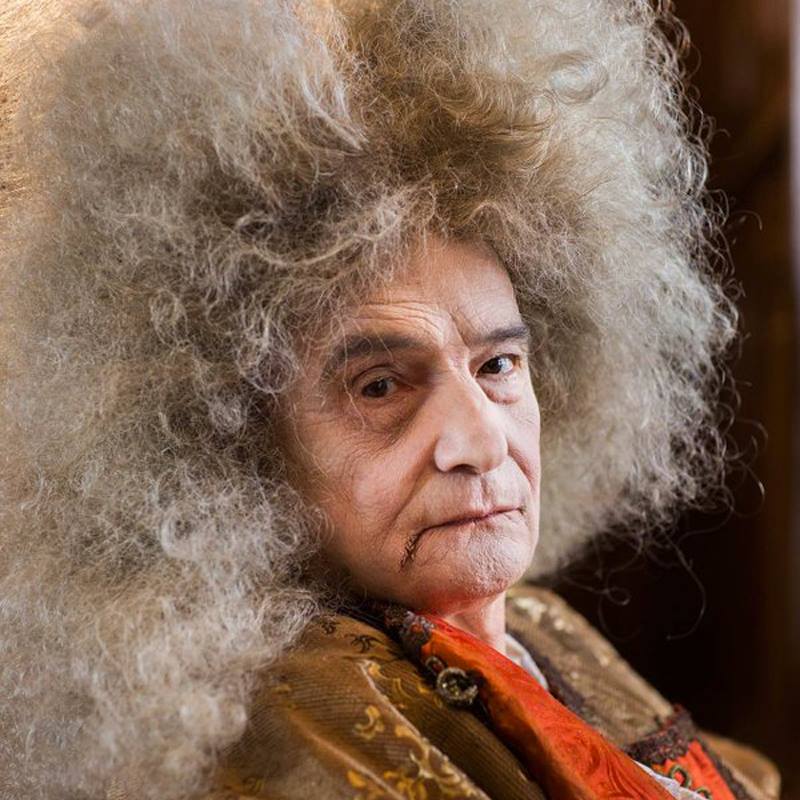
The pinnacle comes at about 1 hour 21 minutes while the king is taking small sips of wine and eating small morsels of biscotin. The relative quiet of the film means the music is actually a little jarring when it begins, but the angelic vocals underline that the king’s demise approaches. Louis’ activity gradually slows during the music, and, by the time it ends, it’s hard to tell if the king is still alive. He is very still and barely breathing. There is a long pause before the dialogue resumes which makes the audience to concentrate on Louis’ stillness and frailty. The piece was composed by Marc Verdaguer and is titled “Es fa de nit” (which means “it’s getting dark” in Catalan, Serra’s native tongue). Verdaguer seems to work exclusively with Serra.
Music resumes after the credits have started rolling. This time it’s Mozart’s “Mass in C Minor, K.427,” which has been described as “impressive” and “monumental” (Baerenreiter.com). It provides a suitably emotional accompaniment as the audience is left to reflect on their own mortality. Serra’s minimalist approach towards the soundtrack for La Mort de Louis XIV was effective because it forced the audience to sit alongside the king, without any distractions, as he slowly succumbed to gangrene over the course of 2 hours. It also made the few instances of extradiegetic music standout due to the overall lack thereof. The very slow pacing and lack of music present an interesting challenge to the viewer, but one that’s well worth it in my opinion.
References
“Mass in C minor K.427.” Bärenreiter, https://www.baerenreiter.com/en/shop/product/details/BA9188/. Accessed September 24, 2021.
La Mort de Louis XIV. Directed by Albert Serra, performances by Jean-Pierre Léaud, Patrick d’Assumçao, and Marc Susini. Capricci Films, 2016.
“Soundtrack Credits.” Internet Movie Database, https://www.imdb.com/title/tt5129510/soundtrack. Accessed September 24, 2021.

 Freelance Writer Paul Glasser