
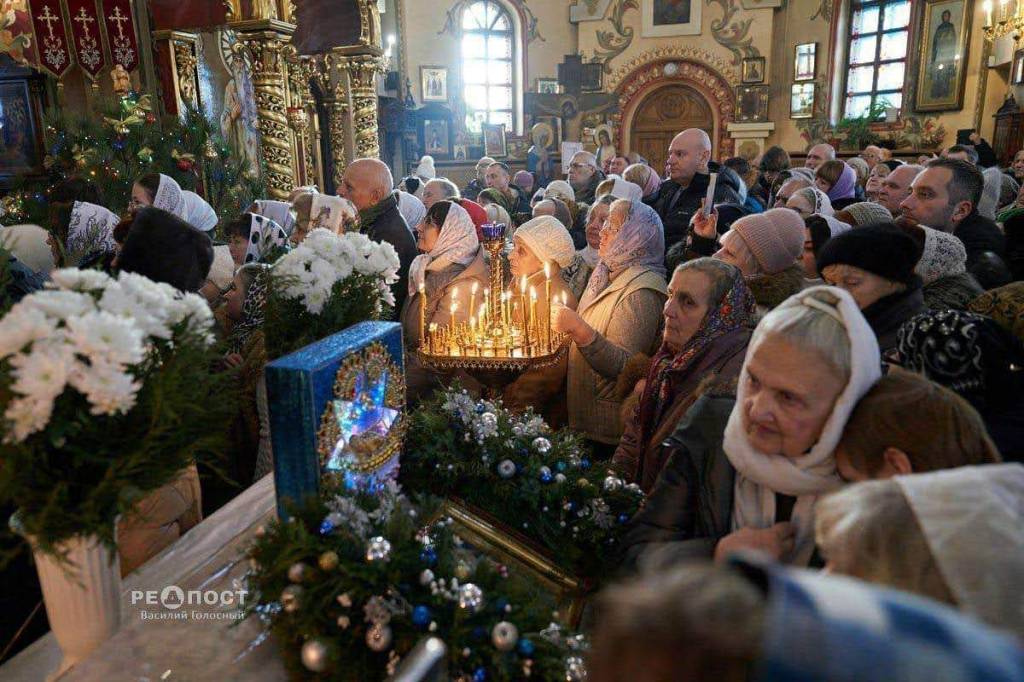
Alas, there has been no Christmas miracle during the Russo-Ukraine War despite having two opportunities for an occurrence. Vladimir Putin declared a temporary cease-fire during the Orthodox Christmas celebration on January 7th which is the traditional holiday according to the Julian calendar. However, Ukrainian president Zelensky denounced it as a propaganda stunt that would allow Russia to reinforce and resupply its troops. In addition, Russia had violated numerous prior cease-fire agreements. Regardless, the ceasefire had little or no effect on the ground and fighting continued despite sub-freezing temperatures.
Nataliya’s parents still live in a village on the outskirts of Kharkiv and did not celebrate in the usual manner this year since there are still sporadic missile or artillery attacks. The temperature has dropped to the low single-digits in degree Fahrenheit, and the electric power grid has been pummeled by Russian attacks. Although power is being rationed with frequent brownouts, the Nataliya can still communicate regularly with her parents. Nataliya’s parents still plan to stay since they have a larder of preserved food from their small garden, gas furnace, and a wood-burning stove for supplemental warmth. However, they have been using the gas heat sparingly in order to save money since fuel prices remain high.
After 10 months of war, the Ukrainian spirit remains resolute (both at home and abroad), and millions of Ukrainians on the front lines or around the world maintained their holiday traditions as best they can.
During the last three years, I’ve learned a little about the Ukrainian holiday traditions which Nataliya maintained in her home. Historically, the Ukrainians follow the Julian/Orthodox calendar which is two weeks behind the Gregorian/Western system. Recently, the Orthodox Church of Ukraine (which is independent from Moscow) gave permission to each congregation to decide whether to celebrate Christmas on December 25 or January 7. Since the Russian Orthodox Church is closely allied with Putin, many Ukrainians have opted to celebrate on December 25 since that aligns with Western Europe and the United States.
Nataliya hails from Kharkiv which is only 30 miles from the Russian border, so the region has a long history of Russian cultural influence. Although they have always spoken Russian at home, Nataliya says she wants her son Alex to learn Ukrainian to avoid incurring any suspicion when they visit in the future. Any sort of Russian influence has become toxic since the wars started.
Since arriving in the United States nearly 20 years ago, Nataliya primarily celebrates Christmas in her home on December 25 and New Years on January 1st, according to the Gregorian/Western calendar. We might have a special dinner or a few small treats for the Julian/Orthodox holidays two weeks later, but it is not the primary holiday. However, Nataliya has mixed feelings about the Ukrainian homeland shifting away from the traditional celebration towards the Western preference.
“Christmas on December 25th is all about gifts,” Nataliya said. “It doesn’t hold the same meaning.”
Although she is not very religious, Nataliya said she still wants to have the option to celebrate the traditional January 7th holiday if she chooses to do so (as she did while growing up in Ukraine).
In addition, Slavic traditions feature Ded Moroz (Grandfather Frost) – a mythical winter wizard who is frequently compared to Santa Claus or St. Nicholas. While Santa Claus has his elves and reindeer, Ded Moroz is assisted by his granddaughter Snegurochka (Snow Maiden) and horses pull his sleigh. But in 1928, the Soviets outlawed Ded Moroz for being too closely associated with the church, bourgeois, and other enemies of the revolution. The exile only lasted seven years, and Ded Moroz was rehabilitated in 1935 by none other than Joseph Stalin. Even though the Soviets banned religious services, Stalin needed to bolster his support in the wake of the disastrous famine of 1930-33. In recent decades, Ded Moroz has faced stiff competition from Santa Claus as Western influence has increased in the former USSR since the fall of Communism in 1989. A large Ded Moroz doll dressed in silver resides near the Christmas tree each year.

When it came to actual celebrations, Ukrainians also sing Christmas carols, called Koliadka. Nataliya recalls that youngsters would sing songs for their neighbors who gave them candy, fruit, or a few small coins (the rarest and most desirable reward). She says the tradition also shares some similarities with Halloween in that respect.
Faithful members of the Orthodox church fasted for 40 days before Christmas and ate little besides fish and vegetables. The first meal to break the fast on Christmas Eve started when the first star was visible and began with a traditional grain and berry pudding called kutya, which included sweet syrup, honey, nuts, dried fruit and either rice, wheat, or barley depending on regional traditions. A feast of sausages and other dishes followed the kutya.


Nataliya grew up during the economic instability of the late 1980s as Communism began to unravel in the USSR and the 1990s during the chaotic transition to capitalism. Inflation was more than 200% a month unemployment as high as 13%. Nataliya’s parents were both paid irregularly during this period, sometimes months or even years in arrears! As a result, Nataliya usually only received on Christmas Day a small bag of candy, nuts, and an orange (a rare commodity in post-Soviet Ukraine). Today, she limits Christmas to three gifts and a few stocking stuffers per person. In Ukraine, the rest of Christmas Day was spent visiting family and relaxing. It was considered bad luck to do any sort of housework, even cooking or washing laundry.
This contrasts sharply with my family’s Christmas traditions, so we have been harmonizing our different expectations during the last several years. For example, I grew up experiencing Christmas as a day-long marathon since both sets of my grandparents also lived in Cincinnati. Occasionally, we would visit both on Christmas Day after unwrapping numerous presents at my parents’ house. On the other hand, Christmas at Nataliya’s house is usually over in a few minutes since each person only had a few presents.

Nataliya also grew up with some unique traditions for the New Year, but we haven’t retained them. The “old” New Year’s Eve (January 13) was another time for family to gather for a large feast but without kutya since that was specific to Christmas. Children and teenagers would also sing carols, called shchedrivka, on New Year’s Eve too. On New Year’s Day (January 14), Ukrainians have a traditional method (called malanka) of welcoming the New Year. To bring luck in the New Year, a male relative or neighbor must be the first person to visit each house while carrying grain in their pockets or in a small sack. Nataliya’s extended family lived on a plot of land together so her paternal grandfather would usually have the duty of visiting everyone. To have a woman visit first would instead bring bad luck, according to tradition.
Unfortunately, there don’t seem to be indications of a Ukrainian victory on the horizon in 2023. Nevertheless, Zelensky and the Ukrainian populace are maintaining their resolve. In addition, the Ukrainian diaspora around the world (including Cincinnati) continues to raise money and donate supplies to sustain the defense of their homeland. The local chapter of the Ukrainian Women’s League of America also hosted a Christmas celebration on the traditional date of January 8 at the Fleming Road United Church of Christ. The event included a potluck, Koliadka, a nativity performance, and an appearance by St. Nick which attracted a strong turnout.
$24,000 for a hospital in the Sumy region of northeastern Ukraine. The event included a showcase of different performances from around the world including ballet dancers and an opera singer. The event also included hors d’oeuvres and several raffle drawings. The concert ended with a dramatic and emotional unveiling of the Ukrainian flag!
Other fundraisers last year include the two food festivals which raised a combined $82,000. I am surprised and relieved by Cincinnati’s continued support for its sister city Kharkiv. I hope that the momentum continues for as long as necessary in 2023.
Slava Ukraini! (Glory to Ukraine!)

 Freelance Writer Paul Glasser