Bande Dessinée: An Introduction

tintin

Asterix and Tintin are the most famous examples of bande dessinée (French for “drawn strips”), however, the world of Franco-Belgian comics is much richer than just these two icons. Although I am a fan of Franco-Belgian comics, I’ve never actually read either of these massive best bestsellers. In the same vein, I’m not a fan of mainstream Anglo graphic novel superheroes, such as Batman and Superman. World War II is my favorite comics genre, whether in English or French, and that will be the focus of my upcoming bande dessinée (BD) reviews.

First, I’d like to provide a general historical and cultural introduction to the art of bande dessinée. Some readers may already be familiar with BD, but others may not know much about comics in either English or French. Hopefully, both novices and experts will find something useful in this blog post, which draws heavily from Dr. Laurence Grove’s monograph “Comics in French The European Bande Dessinée in Context.”

Grove provides a straightforward definition of bande dessinée as a French language mixture of images and written text that form a narrative (pg. 16). Grove places Franco-Belgian comics in the broad French tradition of visual cultural that can be traced back to medieval illuminated manuscripts. He analyses BD primarily through the lens of cultural studies.

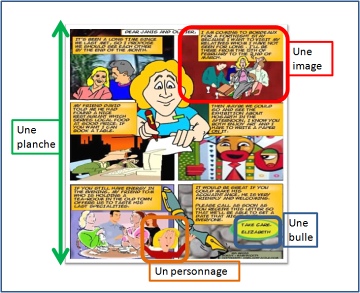
Grove begins by defining a number of basic terms, although he later warns against the obsession of defining BD. For example, a one-shot BD tells a unique self-contained story, which contrasts with an ongoing story told across several published works. BD can be serialized in a journal or can be published in book form (an album). A planche is a single page and most BD are published in the 48CC format. 48 represents the number of pages and CC denotes being published with cardboard covers (cartonnée) and in color (couleur). On each page, there are usually three rows (bandes) that each contain four individual images (cases) which are read from left to right. Of course, many BD creators break these rules from time to time. For example, the “Garage Hermétiqueseries by Jean Giruad, pen name “Moebius,” could often be read from left to right, top to bottom, or vice versa. The cadre is the boundary around each case. Speech bubbles are known as bulles or ballons. The gouttière is the gap between each case and is used to denote the passage of time. A wider gouttière represents more time (pg. 21-32).

42143

(Image from tolearnfrench.com)

In addition, Grove examines how literary elements have influenced bande dessinée. For example, the voix de narrateur is presented in a special block of text known as the récitatif (pg. 32). Grove also explains that cinematic styles have had a major impact on BD. Examples include the use of wide-angel shots (plan general), low-angle shots (contre plongée), and high-angle shots (plongée) (pg. 35).

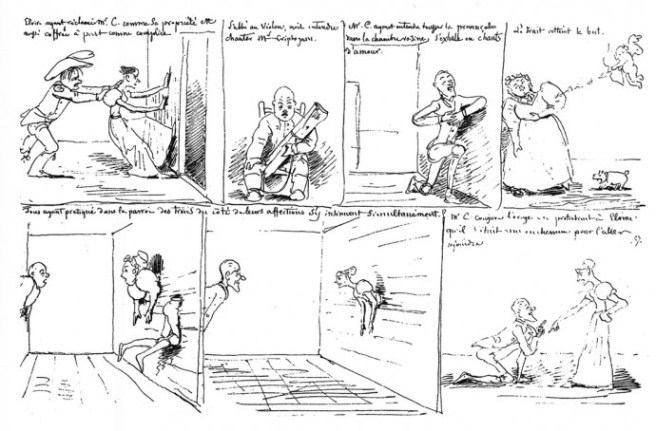
Furthermore, Grove refutes the chronological approach that is traditionally used to describe the history of Franco-Belgian comics. Rodolphe Töpffer, a Swiss teacher, is often credited with creating the first bande dessinée in the 1830s. However, Grove argues that there is a rich history of interaction between text and image in French culture. He asserts that focusing on Töpffer ignores how the emphasis shifted from the text to the images during the Industrial Revolution (pg. 88). I tend to agree with Grove’s thesis because it smacks of the “great man” theory of history, which emphasizes the importance of a single individual and ignores greater social and cultural trends.

topffer-manuscrit-cryptogame-690x454

(Image from Töpffer’s Histoire M. Cryptogame, 1840 – http://www.topfferiana.fr)

Grove asserts many similar proto-bande dessinée works were published around the same time, because the introduction of new lithography technology made it easier to mass produce images. He also argues that by the end of the 1800s, the image began to take a leading role. The growth of photography and the birth of motion pictures helped give birth to the modern BD (pg. 110). Grove claims that the interwar years was the golden age for bande dessinée and that BD became a distinctly French art form after World War II. In fact, BD has since become known as the “ninth art,” which puts it on equal footing with classical arts including architecture, painting, and sculpture.

Since the 1990s, more scholars have been writing about BD in English. Academic conferences have been organized to discuss Franco-Belgian comics and graduate students have published dissertations on bande dessinée in increasing numbers.

BD has become a big business with more than 4,000 new titles published in 2008. Five publishers control more than 75 percent of the market with sales totaling several hundred million euro. Bande dessinée also inspire television and film adaptations, along with merchandising and amusement parks.

On the other hand, independent publishers, such as l’Association, print works that encourage stylistic and narrative experimentation. Grove acknowledges that bande dessinée can also be analyzed through the lens of art history, linguistics, and psychoanalysis. He briefly mentions how male artists dominate the ninth art, and I would like to have read more criticism about the role of gender in Franco-Belgian comics.

Overall, Grove’s book provides a good overview of bande dessinée for both novice readers and experts looking for a more critical analysis. Now that we have a sound understanding of Franco-Belgian comics, I’ll post my first BD review in a few days.

Paul Glasser: Francophile

I’ve decided to start adding some original content to this blog, rather than just reposting some of my journalistic clips. I’m a Francophile and a graphic novel enthusiast, so I’ll combine these interests by discussing and reviewing bande dessinée (Franco-Belgian comics).

I first became interested in French culture and history at about age 12 or 13 when I read “A Year in Provence,” a memoir by British expatriate Peter Mayle. I attended Madeira Jr./Sr. High School in Cincinnati and we only had three options when it came to studying foreign language: French, Spanish, and Latin. I chose French and I took classes all the way up to Advanced Placement level as a senior. After graduating, I spent a few weeks in France as part of a group with other French students from Madeira.

I hate flying, and I took a bunch of Xanax to control my anxiety during the flight. We landed in Charles de Gaulle Airport and then took a bus tour around Paris. The bus was not air conditioned, and I had not slept well on the flight over. I got up and started walking towards the back of the bus with the hope that I could lay down and try to rest. But, about half way down the aisle I threw up everywhere. I blame it on the fact that I probably took too much Xanax. The first stop on the tour was the Louvre, and while everyone else in the group was checking out Mona Lisa, I was lying on a bench drinking water outside the museum.

We stayed with a local family outside of Paris and the first night we had egg salad for dinner. I hate egg salad, but I was pretty tired and hungry so I did my best to eat some. I went to the bathroom and promptly threw up again. The mom cleaned everything up and I was mortified.

After that first day, the rest of the trip was amazing. We went to Notre Dame and Versailles before visiting Château de Chenonceau and Château de Chambord in the Loire Valley. Our last stop was a few days in Nice. I hope to go back some day soon!

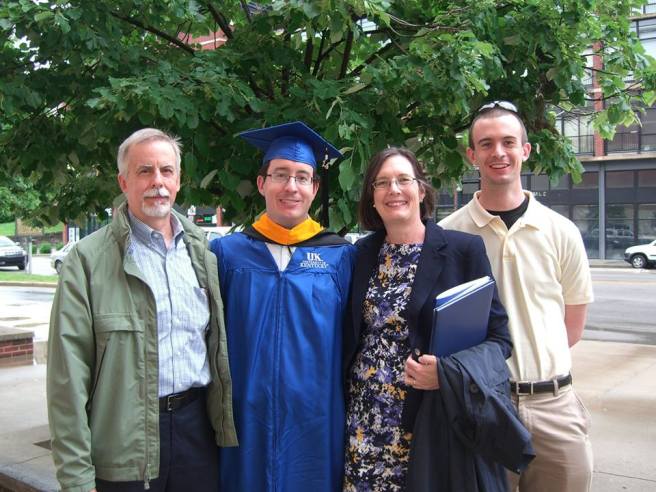
After returning home, I began my undergraduate studies at Purdue University. I took a class on French history and several more conversational courses. I also love French films, and Charles de Gaulle, leader of the Free French during World War II, is my favorite historical figure. I graduated in 2004, but let my interest in French languish until I started my master’s degree in French cultural history at the University of Kentucky in 2011.

I was always fascinated by the heroic mystique of the French résistance during World War II, so I studied the memoirs of men and women who had fought against the German occupation. Reading their memoirs forced me to revive my language comprehension skills.

Before I completed my master’s degree in 2014, I also rediscovered my interest in graphic novels. As a youngster, I had occasionally bought a few Transformers or Teenage Mutant Ninja Turtles titles. At the University of Kentucky, I started visiting local comic shops regularly with a particular eye for anything related to World War II.

graduation

During a trip to Louisville in 2010 or 2011, I stopped at The Great Escape, a comics and music store. I browsed the graphic novel section and found a story called “The Final Flight” (French title “Le Dernier Envol”). It was actually one of the few books from the French bande dessinée publisher Paquet that had been translated into English. This collection of short stories told the interconnected tales of four pilots during World War II. I loved how the stories were woven together, but the incredibly detailed and lavish artwork also stunned me. It was like nothing I had ever seen from an American graphic novel. Each panel could have been its own work of art. For example, in the following image, the artist Romain Hugault, captures the wear that has peeled off the paint from the fuselage. After finishing “The Final Flight,” I knew I had to have more. The book was part of Pacquet’s “Cockpit” series, which focuses on aeronautical tales from World War I to the contemporary era.

finalflight

I setup an account on amazon.fr and ordered the “Le Grand Duc” series, which focuses on a love story between a German and Soviet pilot during World War II. Since then, I’ve purchased a number of other World War II stories from the “Cockpit” collection. Over the coming weeks and months, I’ll publish reviews of “Le Grand Duc” and many others. However, the next installment in my bande dessinée blog posts will be an overview of the historical and artistic development of Franco-Belgian comics.

JulieMarn_wTuftedTitmouse.JPG

Published by IN Community Magazines – West Jefferson Hills Fall 2016

PITTSBURGH – In addition to providing vital information on bird populations in Pittsburgh, the National Aviary’s Neighborhood Nestwatch program has also sparked an interest in birds among children and adults.

Several families in the West Jefferson Hills area are among the 160 households that participated in the program this year. That’s up from 35 homes when the program began in Pittsburgh in 2013. The families work with Bob Mulvihill, an ornithologist at the National Aviary, to help capture, measure, tag and release birds between May and August. Families also monitor bird nests during the nesting season and throughout the year track birds tagged during the program.

The Neighborhood Nestwatch program is a citizen science effort that began at the Smithsonian Migratory Bird Center in Washington D.C. The concept of citizen science has become increasingly popular in recent years as experts look for ways to collect lots of data quickly and accurately without spending large amounts of money, Mulvihill says.

“Even without scientific training, human beings are excellent observers with all of their sensory apparatus,” he says. “Citizen science makes it possible to collect large quantities of data that can address questions that are virtually impossible to address otherwise.”

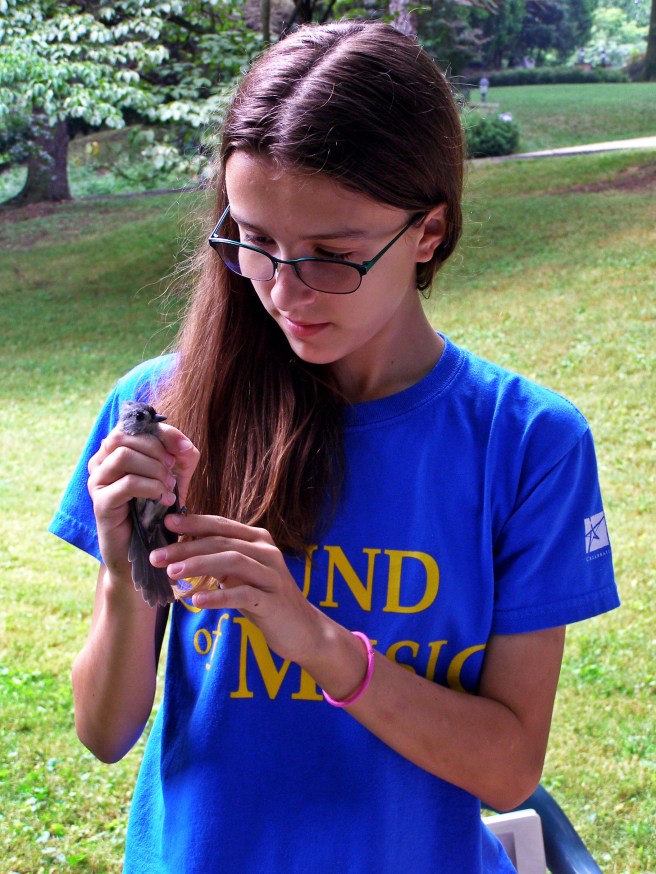
For example, very little is known about bird ecology in urban areas, Mulvihill says. The Neighborhood Nestwatch program tries to provide answers to that question by collecting data on the population of eight bird species within a 50-mile radius of Point State Park. Mulvihill and his assistants visit the homes of families that have volunteered to participate in the program. The ornithologists spend several hours at each home and setup a large net made from fine nylon threads. Mulvihill uses an amplifier to broadcast a call for each specific species of bird. If any are in the area, the birds fly towards sound in order to investigate and get caught in the large net. Mulvihill and his assistants take the birds out of the net and then examine them. He records each bird’s weight, age, sex, wing length and tail length. Last year Mulvihill collected data on 1,200 birds and estimates that number will increase to 1,500 this year.

Collecting this information is an excellent way to get children involved, he says, allowing them to help take measurements and record the data. Then, Mulvihill shows the family how to hold the bird without injuring it and lets them release it.

“It’s an exercise in connecting people with birds,” Mulvihill says. “They absorb the experience and become more engaged in their own backyards. I know it has a multiplicative effect and that people talk about it with their neighbors, but it’s hard to keep track of the ripple effect this project has.”

One of the most memorable experiences Mulvihill had was when he captured a hummingbird and let the host family listen to the bird’s heart beat 1,000 times per minute. The children and adults were all shocked.

“You could hear it in their voices and see it in their eyes,” Mulvihill recalls. “There are not too many ways you can get that kind of reaction from people. People who participate become advocates. It inspires them to take a stand and make personal changes in their lives.”

Since he often revisits the same homes every year, Mulvihill sees how children’s interest in birds and the environment develop over time. Often, young children will show Mulvihill different projects or presentations they completed at school since the last time he visited. The Neighborhood Nestwatch has encouraged children to study math and science and participate in other environmental events. One of Mulvihill’s assistants has also gone on to study wildlife ecology at the University of Delaware.

After each birds’ measurements are recorded, Mulvihill and his assistants attach colored plastic bands to its legs to identify it. Each household keeps a record each time they spot the bird in their yard. The volunteers are also asked to monitor any bird nests they find in their yards and Mulvihill provides instructions on how to do so without disturbing the nest. This will provide information on bird population survival and nesting rates, which can serve as an early warning indicator for environmental problems.

“Birds make excellent bioindicators because they have a high metabolic rate, a unique respiratory system, and they are found all over the world,” Mulvihill says. “Birds are more sensitive and will show signs of environmental contamination or degradation that we might not feel as humans. Birds are sentinels for the quality of the environment.”

This year, Mulvihill is also asking volunteers to record the number of times birds collide with glass windows in their home. These collisions can kill or injure birds and Mulvihill wants to find ways to reduce this threat. He’ll ask families to install special tape on any windows with which birds collide frequently. The tape reflects ultraviolet light, which birds can see, and will hopefully discourage them from trying to fly through the window. The tape doesn’t block the view from the window or obstruct the light. Mulvihill also suggests that families keep pet cats inside since they are natural predators. Replacing non-native plants or trees with native species will also create a better environment for birds, he says. That’s because native plants attract more insects and birds will have more food.

“The program shows people how even their own personal backyard can impact birds and nature either positively or negatively,” Mulvihill says.

About 160 households participated in the Neighborhood Nestwatch program this year, and Mulvihill says there is a waiting list for new volunteers. He would like to add more homes to the program but has to secure more funding before he can do that.

“I’d love to say yes to everybody who wants to participate but we have to be strategic,” Mulvihill says.

Mulvihill is completing an analysis of the data he recorded in this year’s survey and says the results since 2013 show that the bird population in Pittsburgh is generally pretty healthy.

“I think Pittsburgh qualifies as a pretty bird friendly city on several standpoints,” he says. “We’ve got a nice infrastructure of green spaces and parks. We have a population of people that seem to have a high degree of interest in birds.”

Mulvihill thinks Pittsburgh could even become a destination for bird lovers. In fact, Pittsburgh recently received federal grant money to fund several bird conservation projects.

“I think Pittsburgh is emerging as a very bird-aware city,” Mulvihill says. “I think we will start seeing more birding trails. I think birds will always be the primary way people connect with nature.”

Zipping to Greatness

unnamed

Published by IN Community Magazines – Penn Hills Winter 2016

PITTSBURGH – When Marc Alexander plays soccer for the University of Akron in 2017, he won’t be the best player on the field like he is now.

“Everyone will be better than me,” he says. “Mentally, I will have to change the way I play.”

Marc is currently a senior at Kiski School and is a center back on the soccer team. He says he was surprised to receive a full scholarship to the University of Akron, because such opportunities are rare. The university made the offer after Marc participated in a camp in Akron in July. He played against the current UA Zips team and says he was impressed by the skill and speed of the players: “It was a totally new level that I’ve never seen before.”

Marc is a little nervous about making the transition to play for the Zips because the team has a good reputation. He’ll work on improving his strength and agility before then.

“Only players who want to go pro go through the program,” he explains. “I’ll have to play smarter, faster, and quicker.”

He was also very impressed by the close relationships between players on the Zips team.

“It felt a family and that’s somewhere I want to be,” he says.

For aspiring young players, Marc advises them to make sure they maintain their grades while also working hard at practice.

“You have to go all out,” he says. “Every piece matters. Coaches are watching you at all times.”

Players also have to avoid giving up mentally, even when the situation may seem hopeless. Marc recalls one example when he played on the Century United soccer team three years ago, in a game where team was down by two goals. They came back to tie the game, and the team went on to win the tournament.

“We had to keep going and I had to keep the entire team together,” Marc says.

He credits Jeremy Gillespie, a former coach with Century United team, with helping him reach his full potential as a player: “He helped me get to where I’m at now.”

Marc will study engineering at Akron and would like to become a professional soccer player. His favorite team is Manchester City and his favorite player is Sergio Aguero.

Marc started playing soccer at age six but also played other sports, including basketball, football and baseball. He decided to focus on soccer and played as a forward before he became a defender. He enjoyed playing as a striker because it gave him the opportunity to score goals.

“Everyone wants to be the guy scoring goals with all the glory,” he says.

However, being a center back is also a good fit because Marc is so athletic.

“Now, I can lock down basically whoever I want to on the field at any time,” he says.

In 2013, Marc joined the Olympic Development Program soccer team and played in Zagreb, Croatia, and Venice, Italy. The team came in fifth place.

People often complain that soccer is boring, but according to Marc, playing the game or watching it in person is very different from seeing it on television.

“When you watch it on TV it looks like there’s a lot of space and it’s slow,” he says. “But in person you can see the speed of the game and how difficult it is to play. Everything is very quick.”

Mission of Love

cwvDm9asA_Lw9YsGTQNy8vWzhk4.jpeg

Publish by IN Community Magazines – South Fayette Summer 2016

PITTSBURGH – A group of 13 volunteers will soon depart for a mission trip to Haiti where they will help build an open-air school for orphans and organize a soccer camp.

The Yahve-Jire Children’s Foundation organized the trip, which will depart on July 2 and return on July 8. The organization’s name means “God provides,” and the foundation supports about 25 children who were orphaned or abandoned by their parents. The mission trip includes two seniors from South Fayette High School.

The foundation was organized as a 501c3 non-profit in 2013 but Dan Raeder, president of Yahve-Jire, says he and several other volunteers first began working in Haiti on an informal basis in 2011. Raeder and four others went to Haiti to help rebuild in the wake of 2010 earthquake which killed 200,000 Haitians and left more than 1.5 million homeless.

Raeder and the other volunteers began working with an orphanage a few miles outside of the capital, Port au Prince, which housed about 20 children in a building with three rooms and one bathroom. The earthquake had damaged the orphanage and Raeder and the other volunteers wanted to construct a new building to replace it. A local man named Chedlin Justinvil runs the orphanage and had purchased about 4 acres of land shortly before the earthquake devastated Haiti. In 2011, Raeder and the other volunteers carried cement blocks in 100-degree heat in order to build a wall around the new location.

Construction of the new orphanage was recently completed and it includes dormitories, a kitchen, and bathrooms. The dormitories are dome-like structures that are more resistant to earthquakes, Raeder says. The upcoming mission trip will build an open-air school so that the children can continue their education. They had previously been attending a school in Port au Prince which is only eight miles away. However, the roads are in poor condition and the journey could take several hours, so Justinvil and the foundation’s board members decided to build an open-air classroom adjacent to the orphanage.

The mission trip will also host a soccer camp for the orphanage as well as other local children. Previously, the South Fayette High School soccer team donated uniforms, cleats and shin guards. The soccer camp will include drills and a scrimmage between the Haiti children and the mission trip volunteers.

“It gives them a chance to be normal kids,” Raeder says.

For several years, the foundation has sent another mission trip in the spring, which provides educational and medical services. An oral surgeon from Mt. Lebanon and several residents from Allegheny General Hospital helped extract more than 300 teeth earlier this year. Robert Morris University and South Fayette Middle School also donated several hundred hygiene kits, which included toothbrushes, toothpaste and soap, which were distributed. Denise Ford, of South Fayette, is a member of the foundation’s board and has taken two of her daughters on the spring mission trip several times.

“These teeth are black and rotted,” Ford says. “Pulling teeth avoids infections so people live.”

This year, the summer mission trip also included a vision clinic and volunteers distributed donated prescription eyeglasses, reading lenses and sunglasses to several hundred patients.

“It was difficult at first but with much laughter we figured it out and measured each person,” Ford says.

Ford and her daughters also provided English and French lessons when they visited in the spring. Most of the orphans speak creole, which is a blend of French, Spanish and African influences, but French and English are the languages of business and politics.

“There is a craving to learn English and French,” Ford says.

Other priorities include providing a reliable source of electricity to the orphanage, because there have been frequent power outages in Haiti. Raeder says the foundation will either purchase a generator or install solar panels. Recently, the orphanage went a week without power.

The orphanage is also trying to become more self-sufficient, Raeder says. The orphanage has a herd of about 15 to 20 goats, which are sold or consumed. Raeder says the orphanage is also exploring microfinance options and experimental agricultural projects. The foundation hosts an event every October, which is the group’s major annual fundraiser. The new orphanage can house up to 50 and Raeder says he hopes the foundation can secure enough funding to accommodate more children.

Raeder says there is still tremendous need for help because Haiti still faces a number of obstacles, including an ongoing drought that began last year. That has caused food prices to skyrocket, and starvation has increased, Raeder says. In addition, Raeder says the Haitian government is completely ineffective because the president stepped down in February but no successor has been selected. All this has led to more desperation and Haiti is becoming more dangerous, Raeder says. Every year Haitian mothers beg the mission trip volunteers to take their children back to the United States.

“I think Haiti has been forgotten,” Raeder says.

In addition, Haiti is one of the most corrupt nations in the world, so the mission trip volunteers each take 100 pounds of supplies with them on the plane to avoid theft. The foundation has no overhead or administrative costs so every dollar goes to the orphans, Raeder says.

“Our measurables are our kids,” he says.

Despite all these obstacles, Raeder says the foundation is committed to making a difference in Haiti.

“This is personal,” he says. “We know these children. This is never going away for us. We watched these kids grow up.”

Ford agrees and says she will never give up. Despite all the hardships they face, Ford says the orphans and Haitians in general remain joyful.

“We are blessed and privileged to be with the children,” she says. “They are not blessed to be with me.”

The foundation has also pledged to help the children at the orphanage obtain college degrees and several of them want to become doctors, engineers or nurses.

“They can become strong Haitian people who can help their country,” Ford says.

Raeder agrees and asks “If we can do that, can you imagine what would happen?”

For more information visit: http://yj-haitiorphans.org/

K9 Crusader

IMG_20150808_225343.jpg

Published by IN Community Magazines – South Fayette Fall 2016

PITTSBURGH – After Pittsburgh Police K-9 Officer Rocco died in the line of duty in 2014, Noah Magdich wanted to do what he could to prevent a similar tragedy from occurring again. The man who stabbed Rocco was sentenced to serve between three and a half and seven years in prison.

“I have always been a dog person,” says Noah, whose family has a 2-year-old boxer-greyhound mix named Banjo. “It really affected me to see Rocco killed.”

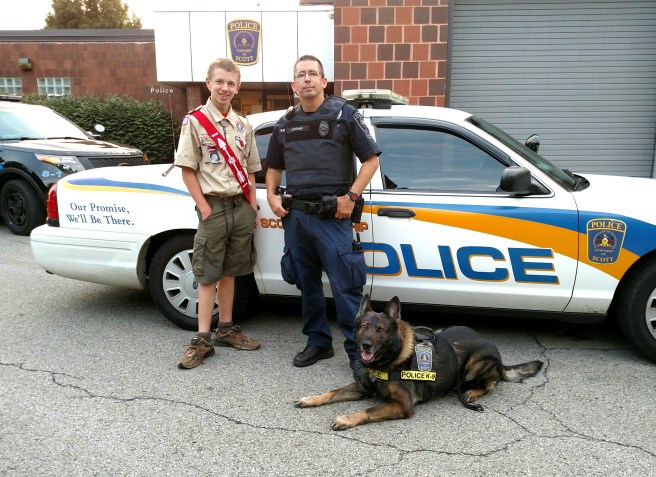
A junior at South Fayette High School, Noah is a member of Boy Scout Troop 248 in Oakdale and last year he organized a fundraiser as part of his Eagle Scout project. He collected more than $5,000 and used the money to purchase a protective vest for Lord, a K-9 officer at the Scott Township Police Department. Lord is an 8-year-old German shepherd who is trained to detect narcotics. The vest only cost about $800 so Noah also purchased a temperature control unit for about $2,100 that will alert Lord’s partner, Officer Shane McGrath, when it gets too hot in the patrol car. McGrath’s cruiser already had a control system, but the new equipment was an upgrade because it will send a text to McGrath’s cell phone and open the doors so that Lord can get out in an emergency. Even after buying the additional equipment, Noah still had about $2,200 left over, which he donated to the Scott Township Police Department to make additional K-9 equipment purchases in the future.

It took about a year to complete the project. The temperature control unit was installed in March, and in May, Lord received the vest, which will help protect him from being stabbed or shot. Noah hosted a pancake breakfast at St. Barbara Roman Catholic Church in Bridgeville last year and recruited volunteers to help cook pancakes. About 250 people attended and the event collected about $2,700. He raised the rest of the money by creating an online fundraiser at gofundme.com. He also posted fliers advertising his fundraiser at his church and other locations.

“I was expecting some support, but not this much,” Noah says.

He has stayed in contact with Lord and McGrath and says Lord wears the protective vest whenever he enters a dangerous situation. Noah also participated in the Scott Township Public Safety Day in June and helped demonstrate how K-9 officers neutralize suspects. He wore a bulky suit, which was hot and heavy, but protected him from Lord’s powerful bite.

“I was very nervous but excited,” he says. “Officer McGrath knows grown men who wouldn’t put the bite suit on. When Lord latched on, I could feel the pressure of his bite on my arm but no pain.”

Noah expects to complete all the requirements to become an Eagle Scout by October. He became a Boy Scout in the first grade and has wanted to become an Eagle Scout since he watched a friend’s induction several years ago. Scouting has taught him a lot of practical skills, such as survival and automotive maintenance. Noah also served as senior patrol leader and learned how to be patient when he was supervising younger scouts.

“Scouting is very beneficial for helping you learn and grow,” Noah says.

In addition to his passion for scouting, he is also interested in martial arts and being a firefighter. He’s been studying at the House of Martial Arts Karate Academy in Oakdale for two years and recently became a second-degree green belt. He plans to join the Marine Corps after graduating high school and wants to become a black belt before enlisting, then become a martial arts instructor in the Marine Corps.

Noah would also like to continue the family legacy of working as a firefighter after his enlistment in the Marine Corps is over. In April, he became a junior firefighter at the Presto Volunteer Fire Department. His great-grandfather helped found the department in 1947, his father is a captain and his uncle is an assistant chief. As a junior firefighter, he has attended more than a dozen calls, including a two-car accident near Trader Jack’s Flea Market on July 4. Noah helped direct traffic, carry tools and clean up debris.

“It’s an amazing rush when you get that call and you are going down the road with blue lights and everyone is moving out of the way,” he says. “You know you are going to help someone. It’s something I’ve wanted to do since I was six years old.”

Dreams of Gold

67487122-DUT_2028-90.jpg

Published in IN Community Magazines – Moon Township Winter 2016

PITTSBURGH – Grace Howard, a sixth grade student at South Fayette Middle School, hopes to compete at the 2024 summer Olympics.

Grace has already started on her path to the Olympics by winning her third medal at the Junior Olympics in Sacramento in July. More than 7,500 youngsters from across the country competed in a variety of events. Grace won sixth place in the high jump competition for girls age 11-12 with a jump of 4 feet, 11 inches. She says she excels at the high jump because she 5 feet, 3 inches tall and has long legs.

“It’s almost like you are floating in the air,” Grace says.

She was nervous before she competed but used tips from her coaches to take her mind off of the task at hand. Grace likes cupcakes, so she pretends there is a cupcake tree over the bar.

“If you don’t think about it too hard, it comes more naturally,” Grace says. “My coaches are a big part of this, because without them I wouldn’t have gone to the Junior Olympics in the first place.”

Grace hoped to do better in the high jump event because she tied for second place at the 2014 Junior Olympics. She also won sixth place in 2015.

“After I thought about it, I realized that a lot of people would have been happy to take my sixth place spot,” Grace says. “I will definitely be back next year.”

Grace qualified for the 200-meter sprint but decided to focus on the hurdles and high jump instead. She also competed in the 80 meter hurdles and achieved a personal record of 14.52 seconds.

“Running with the wind blowing in your face is really fun,” Grace says.

She was inspired by watching the 2016 Olympics on television after returning home from Sacramento. Allyson Felix is Grace’s favorite runner and she won gold in the women’s 4×100 and 4×400 meter relays and silver in the women’s 400-meter sprint.

“She’s very relaxed when she runs, and her reaction at the start is very good,” Grace says. “She smiles at the end too, which is very nice.”

Felix ran from lane four which is now Grace’s favorite starting position. Grace says she wants to improve her reaction time because she noticed many other runners at the Junior Olympics hesitated when the starting shot was fired.

“My goal is to be the first one out of the blocks,” Grace says.

Grace started running when she was six years old. She was living in Texas as the time and she beat older boys in the neighborhood in several races.

“It was the first clue she had a natural running ability,” says her mother Yvette.

Grace runs on the Wings of Moon team. Her mother says she will support her dream to compete in the Olympics but says her daughter will have to put in a lot of hard work and make sacrifices. However, she says she won’t pressure her daughter to aim for the Olympics either.

“We will support her in the sport she loves and excels at,” Yvette said. “The future is the future.”


Hollywood Theater Celebrates 90 Years of History

Hollywood_Theater.png

Published in IN Community Magazines – Keystone Oaks Winter 2016

PITTSBURGH – The Hollywood Theater has been a cultural anchor in Dormont for 90 years, and supporters hope it will remain so for years to come.

Monique Fontaine, secretary for the theater’s board of directors, grew up in Dormont and has fond memories of the cinema. She saw “Flashdance,” the first R-rated movie she ever attended, there in 1983 and remembers attending performances of the Rocky Horror Picture Show at the cinema in the 1990s.

“It thrills me now to see all of the families and the kids of my friends coming to the theater for a show on their own,” Fontaine says.

Like Fontaine, many patrons also have strong memories associated with the Hollywood Theater. Sometimes, simply going into the bathroom, which still has the original tiles, can trigger a strong emotional reaction, Fontaine says

“Some patrons have come back upstairs with tears in their eyes,” she says. “It transports them back to the last time they were here. It’s our own time machine.”

Colin Matthews, president of the theater’s board of directors, says local patrons are very loyal to the Hollywood Theater in a way that a multiplex theater could never reproduce.

“So many people think of the Hollywood as their theater,” he says. “We’ve proud to serve as a landmark for the residents in Dormont, the greater South Hills community, and the entire Pittsburgh region.”

The Hollywood Theater also provides a social experience that’s absent in larger cinemas. Board member Margaret Jackson says she remembers how patrons began clapping during a screening of the “Princess Bride” a few years ago.

“I don’t believe that would ever happen in a multiplex,” Jackson says. “It created this wonderful feeling of community.”

The Hollywood first opened in 1926 and the building included a bowling alley in the basement. The theater has changed hands a few times and has been closed for several years. A major renovation was completed in 2007.

The board of directors celebrated the Hollywood Theater’s 90th anniversary in May by showing a restored version of 1949 British noir film “The Third Man.” Actor David Conrad, a Pittsburgh native, attended the event, which attracted a sell-out crowd. Board member Annette Bassett says that was one of her favorite memories of the Hollywood Theater because it was a great opportunity to welcome people to the cinema for the first time.

A fundraising campaign, called “90 for 90,” is also underway to help celebrate the Hollywood Theater’s anniversary. So far, about $18,000 has been raised and the average donation is about $80. The fundraiser will continue into 2017. The funds will be used to replenish savings that were spent on HVAC repairs earlier in 2016.

“We wanted to come out the gate strong, which we accomplished, but still have a long way to go,” Matthews says.

The Hollywood Theater is unique in several ways – it has a balcony, features an organ, and is one of the few surviving single-screen cinemas in Pittsburgh. However, the theater faces several obstacles as well, because it’s harder for a small theater to secure certain bookings. In addition, attendance has dropped off this year because of construction in the Dormont business district as well as increased competition from video streaming services such as Netflix and Hulu, Matthews says.

The Hollywood Theater has survived by innovating, Matthews says. The theater offers innovative programming and hosts a number of special events. For example, several couples have been married at the Hollywood Theater after saying their vows on the stage. In addition, the theater recently organized a Halloween party that featured a showing of the 1961 gothic horror film “The Innocents.” Doug Bradley from “Hellraiser” attended the event, which included a raffle and costume contest.

“Many of the attendees really get into the spirit and arrive in some truly amazing costumes,” Matthews says.

Matthews says the board of directors is pursuing several long-term goals that will ensure the Hollywood Theater remains an important part of the Dormont community. First, the directors hope to secure a long-term lease or purchase the building that houses the theater. After that, Matthews says they will execute a capital improvement campaign that focus on electrical, plumbing, and structural upkeep. Other priorities include adding an expanded and improved concessions stand, additional screening rooms, and a new marquee.

In addition, the board of directors is also re-evaluating its structural organization. Chad Hunter, the Hollywood Theater’s executive director, left in July 2016 and the board has decided to postpone the search for a potential replacement. In the interim, operations manager Joseph Morrison and several board members have assumed the responsibilities of the executive director.

Going the Distance

img_4555-2

Published in IN Community Magazines – Upper St. Clair Fall 2016

PITTSBURGH – The next time the Lapham family goes on a long-distance bicycle trip they will plan a less grueling schedule.

In June, the Lapham family rode more than 330 miles from Pittsburgh to Washington D.C. along the Allegheny Passage and the Chesapeake and Ohio Canal. They undertook the trip because 16-year old Joe Lapham is autistic and loves to ride bicycles. Joe will be a junior at Upper St. Clair High School this fall.

Joe was diagnosed with autism at age three and he has been in special programs since then in order to improve his social skills and intellectual abilities. The bicycle trip is an example of how Joe is full of life, his mother Lori Lapham says.

“Often, children with a disability are looked upon in the community as not having goals, interest, needs or a future,” she says. “We know that’s untrue.”

Joe first began riding a few years ago but was uncomfortable bicycling on city streets. So the Laphams bought several tandem bicycles and started riding together on trails. Bicycling together is an excellent opportunity for family bonding as well as exercise, says Laura Lapham, Joe’s 16-year old twin sister. Joe began asking to go for a bike ride more and more often after the Laphams purchased tandem bikes.

“It just exploded into this passion,” Laura says.

The Lapham started to take their bicycles on family vacations and based their itineraries on which bike trails where nearby. The Laphams prepared for the trip to Washington D.C. by taking progressively longer cycling expeditions, sometimes as far as 50 or 60 miles in a single day. They embarked on the trip on June 12 and left from Point State Park. Joe and his father Gary Lapham rode on a tandem bike together. Laura and several relatives from Texas rode the trails on regular bicycles. A security guard from St. Clair High School, who has known Joe for several years, also participated on the first day of the ride, which ended at Connellsville. Upper St. Clair High School also gave the cyclists t-shirts and rally towels.

Originally, the Laphams planned to complete the journey in five days but it actually took six to reach Washington D.C. The first several days were all steadily uphill as the cyclists climbed along the Allegheny Passage towards the Eastern Continental Divide. They climbed 1700 feet in about 130 miles. Although it wasn’t a steep grade, it was difficult on a tandem bike because it is heavier.

“You don’t get to coast on the way up,” says Laura.

Riding in tandem is also difficult because the two cyclists have to synchronize their pedaling. Tandem bikes are also less maneuverable than regular bicycles.

The family stayed at hotels along the way and Lori dropped all the bikers off at the trail every morning and packed up all the baggage. Sometimes the Laphams stayed in the same hotel for two nights in a row and that meant Lori could join Joe on the trail. They reached the Eastern Continental Divide on the third day and after that point everything was downhill.

“We didn’t have to pedal; that’s all that mattered,” Laura says.

Most of the trail was covered in cinder or gravel, which also made the cycling difficult.

Along the way, the Laphams encountered many different types of wildlife, including herons, deer, turtles, snakes and rabbits. Laura says a fox ran right across their path once and they frequently had to watch out for squirrels that ran between their tires. The scenery was also very rich and the Laphams encountered many beautiful landscapes. Laura says she enjoyed the bridges and especially tunnels that featured exposed rock. The Laphams also rode along the Chesapeake and Ohio Canal and Laura says she learned a lot about the history of the canal and its locks. However, because the Laphams tried to cover 50 or 60 miles a day, they did not have much time to stop and enjoy what they saw.

“We didn’t get to stop and smell the roses,” Laura says. “We started early and ended late every day. Next time we will try so spread things out so we can enjoy ourselves more.”

The Laphams had a few minor breakdowns but say they will definitely take another long distance bicycle trip in the future.

The Laphams rarely encountered other cyclists or hikers along the way until they approached Washington D.C.

“You break out of the trees and there’s DC,” Lori says.

The trails quickly became crowded with other people as well as dogs. It was hard to maneuver while moving slowly on the crowded trails – especially for Joe and Gary on the tandem bike.

Laura says she was excited and relieved to finally arrive. The Laphams spent the next day visiting museums in the nation’s capital. Joe and Gary went to the Smithsonian Air and Space Museum while Laura and Lori went to the Smithsonian Natural History Museum.

However, Joe wanted to go for a ride again only a day after returning home.

The Lapham’s trip also helped raise more than $1,000 for the Woodlands Foundation, which provides recreational and educational programming for adults and children with special needs or chronic illnesses. The foundation manages a 52-acre campus near Wexford. Joe has attended a summer camp at the Woodlands for several years where he enjoys playing games, hiking, and doing arts and crafts. His favorite part of the summer camp is the dance. Lori says the summer camp is fun for the participants and it also gives families a chance to rest and relax. Laura is also a volunteer at the Woodlands Foundation.

In addition to more family cycling trips, Joe and his family have other big plans. He’s excited about continuing his education after he graduates in two years. Lori Lapham says he wants to have his own apartment downtown and ride the trolley.

“He knows what everybody else has and is striving for the same things,” she says. “He just may need to take a few different avenues to get there.”