I think this comic accurately sums up my attitude to 2018. 2016 was an unhappy year that ended with my diagnosis with stage four lung cancer. The tumor paralyzed my vocal cords, and I could only speak in a hoarse whisper. I was frustrated because I lost a good job and a nice apartment. Suddenly, I wasn’t allowed to drive myself because of the brain tumors. I wanted to get my life back together as quickly as possible, and, one year later, I’m on the cusp of achieving that. However, it’s been a long road and the future remains uncertain.
2017 was also a traumatic year. The steroids drove me crazy and kept me from sleeping for weeks on end. Surgery restored my voice to about 90 percent of what it was before I was diagnosed. My treatment also proved to be effective. I also fulfilled a long-time desire to visit New Orleans, and I had a great time with my uncle and dad. Friends and family have been invaluable this last year.
Eventually, I started to work again and even fell in love with Jessie. But, it wasn’t too long before I was reminded that disaster can strike at any time. If any health crisis was going to happen soon, I assumed it would happen to me. However, Jessie suddenly was diagnosed with ovarian cancer and immediately went through some very serious surgery. It was terrifying, but I gave her all the love and support I could.
Despite that, she decided to end our relationship and focus on her treatment. It was heartbreaking, but I couldn’t blame her. She seems to be doing well, which is a relief. She is a kind and generous person who certainly doesn’t deserve this (not that anybody really does).
I’ve been picking up the pieces of my life these last few months. I found a temporary job and will be hired on a permanent basis later this month. I’m planning to finally move out, and I will fulfill another big dream that I’ve been putting off. For the last 18 years, I’ve been talking about going back to France, but this spring I’ll actually do it.
I recently had my annual checkup and the scans show my brain tumors are gone. The chest scans are also largely unchanged, and my liver function remains normal. The doctors say things are stable for now, but the long-term picture remains unclear. The disease could mutate and become resistant to the drugs I’m taking. If that happens, there are other treatments available. Still, uncertainly looms.
The last two years have been very challenging, but I’m on the verge of finally regaining my independence. Despite the good news, I can’t get overly complacent or optimistic. Aside from my disease, the mundane tragedies of life, such as a car accident, could strike me or someone I love at any moment. Even worse, Trump could start a war and get us all killed. So, 2018 looks like it’s going to be a good year, but nobody can predict the future. Thus, I’ll keep my guard up.
I haven’t updated this blog in a while, but felt I had to share a discovery that combines two of my favorite things: crowd sourcing and castles.
I’ve supported various comic book projects on Kickstarter over the last five years or so. I thought it was a great way to support niche projects that might not otherwise get published. But, just the other day, I saw a blurb on BBC America about how crowdfunding was helping to save a castle (château) in France. It turns out there’s an organization that has been doing this in France since 2015 – Adopte un Château.
I love châteaux! I visited several when I was first traveled to France 17 years ago, including Chambord and Chenonceau. I loved them because they were so opulent and distinguished. They are cultural and historic treasures, and we don’t have anything like it in America.
Adopte un Château claims there are thousands of French castles that have been abandoned and need to be saved. They’ve raised money to start restoration efforts at several dozen locations. What really got me excited was the ability to buy “shares” in one of the current projects – Château La Mothe-Chandeniers.
Built in the 1200s, Château La Mothe-Chandeniers has experienced a lot of turmoil. It was pillaged during the French Revolution and lay abandoned until a wealthy businessman bought it in 1809. However, in 1932, a fire destroyed the castle and many important artifacts, including the library and tapestries. It has been empty ever since. As you can see in the picture, the castle is intact but overgrown. Despite that, I can see the potential in it!
So far, more than 9,000 supporters have donated to the fundraiser. Their support has grown to more than 760,000 Euros (almost $900,000). That’s an average of about 85 Euro per person (or about $100). The fundraiser will continue for another two weeks.
It will cost about 500,000 Euro (almost $600,000) to buy the castle. Another 150,000 Euro ($177,000) will go towards fees and an architectural study. Anything beyond that will be used to start the initial restoration work.
I eagerly donated 50 Euro (about $60) to become a “co-owner” in the castle, and I’ll have a vote in how the restoration project proceeds. I also gave an additional 10 Euro ($12) for a welcome kit that includes a letter and membership card. Another 8 Euro ($10) was added to pay for fees. So for a total of about $82, I’m now a châtelain (castle lord)! It’s located about 3 hours west of Paris. Someday, when Château La Mothe-Chandeniers is fully restored, I’ll be able to visit it and know that I have helped save a piece of French history. I know it will take years and a lot more money, but I’m optimistic. I’m eagerly awaiting my membership kit!
Adopte un Château has several other fundraisers underway at the moment, and I donated smaller amounts of money to them as well. Like with other crowd sourcing projects, rewards include tchotchkes like magnets and postcards. My only complaint is that taxes and fees can take a large part of each donation. For example, with a 15 Euro gift (about $18) only 5 Euro ($6) may actually go towards the project!
Château de Gizeux (Photo by: Boris Alexandre Flora)
Of the other projects, Château de Gizeux caught my eye as well. Located about three hours south-west of Paris, Châteaux de Gizeaux was built about 1300. The large collection of murals, which depict other famous French châteaux, is the most striking feature. Châteaux de Gizeaux is already open to the public and this is the site’s fifth fundraiser. However, the murals are in dire need of restoration. So far, more than 12,000 Euro have been donated (about $14,000) which is enough to start the initial restoration work, although the total price tag is about 33,000 Euro ($40,000). So far, 60 supporters have given an average of 200 Euro each ($240). The project continues for another three weeks. I think my agenda for Paris this spring is already pretty packed, but I’ll certainly visit next time when the murals have been restored!
Dartagnan, the website that hosts the fundraisers, also supports a number of other projects, including museums, parks, and religious sites. Obviously, this model has been successful in France, and I think it should see more widespread use in the United States. There are some “public benefit” projects at Kickstarter, including a skate park and library, but I’m excited about the possibility of supporting more than just comic books. Other websites, such as Spacehive and Citizinvestor, promote local civic projects. However, critics point out that relying on crowdfunding allows politicians to continue shifting the burden for public services to private donors. That’s true, but I still think there’s a place for crowdsourcing when it’s combined with public funding, especially for very large projects, if it’s treated like seed money or matching funds for a public/private partnership. I think it’s a model that could be successful here too.
It’s that time of year when lots of organizations are asking for support, and I know châteaux probably aren’t a high priority for many people. There are a lot of worthy projects here in the United States, and I’ve donated to several local organizations that I support too. But, I’m a francophile and I have a lot of friends who are as well. I’m excited about becoming a châtelain, and I’ll post updates as work on Château de Gizeux and Château La Mothe-Chandeniers progresses. Hopefully, I’ll get to see the results in person!
You can keep up to date on the latest news from Adopte un Château by liking them on Facebook or following them on Instagram.
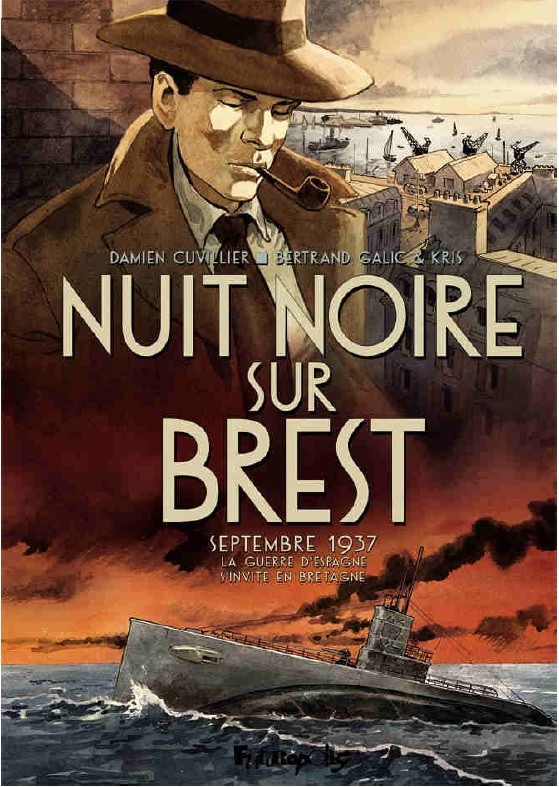
“Nuit Noire sur Brest” is a departure from the other comics I have reviewed so far in several ways. First, it’s not about airplanes but a submarine. In addition, all the other bande dessinée albums I have reviewed were published by Paquet but “Nuit Noire sur Brest” is published by Futurpolis. Furthermore, the story is presented as a one-shot and is contained in a single album as opposed to the other stories so far which have been serialized over three or four books. In addition, “Nuit Noire sur Brest” violates the usual format for bande dessinée albums with a hefty total of 66 pages, as opposed to the standard of 48.
Although my main passion is French history and culture, this BD caught my attention because I also have an interest in the Spanish Civil War. “Nuit Noire sur Brest” tells the story of the Spanish submarine C-2 and is based on the book “Nuit Franquiste sur Brest” by Patrick Gourlay. Gourlay also wrote an extensive post-face for the album which includes lots of contemporary photographs, a thorough discussion of the political atmosphere in 1937, and a description of the aftermath of the C-2 affair.
The submarine C-2 appeared unannounced in the port of Brest in September 1937 after experiencing a technical problem. The submarine’s arrival was politically sensitive because France had declared it would not intervene in the Spanish Civil War. “Nuit Noir sur Brest” follows the actions of X-10, a shadowy secret agent who supports the Spanish Republicans. X-10 investigates a plot by Franco’s agents and their conservative French allies to capture C-2.
However, the writing can be a little cliché at times. For example X-10 declares that “personne ne me connait” (nobody knows me) and “je suis le pêcheur en eaux troubles” (I am a fisher in troubled waters).
Damien Cuvillier’s art is more engaging. He uses watercolors for the sky and utilizes thematic colors in several scenes. For example, each case (image) that depicts a scene at l’Ermitage, a red-light dancing hall in Brest, is tinted in red. Scenes occurring in the interior of the C-2 submarine are viewed through a greenish-yellow filter. In addition, Cuvillier utilizes a plongée (high-angle) shot to emphasize the hustle and bustle of the dancing hall.
Unfortunately, my complaint about the male gaze in Paquet’s “Cockpit” series remains true for “Nuit Noir sur Brest” as well. The cast of characters is almost entirely male, and the only female character, Mingua, is a dancer at the l’Ermitage with little agency. She amounts to little more than a pawn and seductress.
Overall, I found “Nuit Noir sur Brest” to be an intriguing and refreshing break from the “Cockpit” series. The dialogue can be clichéd at times, but the art is engaging and Gourlay’s post-face helps this little-known incident come alive.
Brewers and other industry insiders were confident that Pittsburgh’s booming craft beer scene would eventually make the city a premiere destination for tipplers in search of the perfect pint.
In December, a report by SmartAsset.com, a financial technology company, ranked Pittsburgh as the third best city for beer drinkers in the nation. The report calculated the rankings based on the number of breweries in each city, each brewer’s average Yelp score and the average price per pint. Arch-rivals in both sports and beer, Pittsburgh edged out Cincinnati, which came in fourth. Although Cincinnati has more microbreweries, the Steel City brewers had a slightly higher Yelp rating. Both cities rose six spots since the initial report in 2015.
Rob Soltis, owner of CraftPittsburgh magazine which covers the regional brewing industry, said other cities, such as #1 ranked Asheville, NC, had a head start on Pittsburgh but it was only a matter of time before Pittsburgh broke into the top tier.
In the last five years, the local brewing industry has grown significantly. In 2011, there were eight breweries in Pittsburgh and now there are about 20, with more scheduled to open this year.
“It seems like there is a new brewery opening every week,” Soltis says. “Pittsburgh is a city with deep hard-working industrial blue-collar roots. That same spirit is leading this craft beer boom, and shit is being made in Pittsburgh again. But until recently, if you wanted Pittsburgh-made beer your options were pretty limited.”
The Church Brew Works, which opened in 1996, was one producer that entered the Pittsburgh market long before the industry took off. The Church Brew Works is located in a deconsecrated Catholic church on Liberty Avenue and celebrated its 20th anniversary last year. The brewery offers a wide variety of beers ranging from pale ales to stouts and everything in between. Brewery Manager Justin Viale has been working at The Church Brew Works since 2011 and says not only has the number of Pittsburgh breweries increased, but brewers have also become more innovative. Both trends have helped make Pittsburgh one of the top beer cities in the nation.
“Brewers are putting all sorts of stuff in beer now,” Viale says. “Now just putting a little coconut in a stout might seem a little tame. People have taken to it like cooking – they find some ingredients and look for what they can do with it in a beer.”
The Church Brew Works also includes a full restaurant and can seat about 400. But, Viale says the current trend amongst Pittsburgh brewers is to open smaller neighborhood taprooms without a kitchen.
“In the new brewery model, they don’t need massive facilities,” Viale explains. “They don’t need to grow every year. They’ve become watering hole-type places.”
Although they are competitors, local brewers often collaborate to create unique recipes, share information and assist each other, Soltis says. Tony Zamperini, brewmaster and co-owner of Draai Laag Brewing Company, says the plethora of new breweries has created friendly competition that makes it harder for a taproom or brewpub to stand out. Draai Laag, located in Millvale, specializes in Belgian and sour ales, but Zamperini says the decision to focus on a particular type of beer is not a gimmick.
“We brew what tastes good to us,” Zamperini declares. “I like big bold flavorful things. We push the envelope with flavors. There are a million ways to skin a cat but we just do it a certain way.”
Zamperini uses special yeast strains to create flavors without adding additional ingredients, such as fruit. In addition, most of Draai Laag’s beers are aged for at least six months in wine barrels, or less often bourbon barrels, to add oak or apple flavors.
“You can’t rush it,” Zamperini says. “It tells you when it’s ready.”
Tony Zamperini, brewmaster at Draai Laag, inspects the brewery’s pilot system.
Because each barrel produces a slightly different flavor, Zamperini blends the beer together in varying proportions to create the final product.
“Blending is probably the most artistic part of what we do,” he says. “We mimic the wine world in a lot of ways.”
Max Morrow, assistant brewer at Draai Laag, fills barrels.
Although most other Pittsburgh breweries avoid specializing in a particular type of beer, they do have their own distinctive styles. Zamperini, Viale, Soltis and other experts praised many local brewers, including Insurrection AleWorks in Heidelberg, which specializes in Vermont-style bitter and unfiltered beers. Penn Brewery, established in 1986, focuses on brewing beers in accordance with the Reinheitsgebot, a 16th-century German purity law. Roundabout Brewery, in Lawrenceville, has a New Zealand-inspired theme that includes beer brewed with hops from the southern hemisphere and a menu that features meat pies. Meadeville-based Voodoo Brewery is known for its barrel-aging program. In addition to numerous noteworthy local producers, Carnegie-based Apis makes honey wine, known as mead, and Lawrenceville-based Arsenal creates cider.
“I don’t think there’s a craft beer bubble,” asserts Brewer. “I feel like we are in the beginning because so many people are still learning about craft beer.”
There’s no shortage of opportunities for novices and aficionados alike to sample local beers. There are several beer festivals throughout the year, including Oktoberfest in the fall and the Pittsburgh Winter Beerfest in February. There are numerous tastings and other special events as well, including beer dinners where craft beer enthusiasts and foodies alike can enjoy a multi-course menu paired with local brews. There are many other examples of the synergy between Pittsburgh’s booming brewing industry and local restaurants. Hop Farm Brewing Company has a coffee-infused porter and the Butcher on Butler uses the grinds to create coffee-cured bacon. Eliza’s Oven uses local beer and whiskey to produces pies, cakes and cookies. Zamperini, brewmaster at Draai Laag, has collaborated with several regional chefs to create a beer-infused sorbet as well as a beer that mimicked the flavor of blue cheese.
“Food and beer go hand in hand for sure,” Zamperini argues. “Pittsburgh is definitely turning into a hip city.”
The construction of a proposed beer museum in 2018 could also help cement Pittsburgh’s reputation as a premiere destination for craft beer enthusiasts. The proposed museum would have 20,000 feet of exhibit space and a 300 seat-brew pub. It could accommodate up to 40,000 visitors, including many from out of town.
Pittsburgh also has a strong homebrewing community which contributes to the city’s rich brewing culture. Both Zamperini and Viale, as well as many brewers in Pittsburgh, started by brewing beer at home. Viale says he learned a lot through trial and error and became a volunteer at a brewery in Chattanooga before becoming the manager at Church Brew Works. Zamperini quit his job as a carpenter to become an informal apprentice at Draai Laag. His advice to anyone interested in becoming a brewer is to start experimenting with homebrewing kits and then find an opportunity to get involved at a local brewery.
“You have to be willing to make sacrifices,” Zamperini says. “It really is an art form.”
Pittsburgh has two local homebrewing clubs – the Three Rivers Alliance of Serious Homebrewers (TRASH) and Three Rivers Underground Brewers (TRUB). The clubs hold meetings where members share their latest batch of homebrewed beer and swap advice or recipes. TRASH has grown from 40 members a decade ago to more than 100. The clubs also host and participate in brewing competitions where beers are judged according to taste, color and mouthfeel. Shane Walters, secretary for TRUB, says homebrewed beer originally had a stigma of being “basement swill,” but that label has disappeared as the hobby has become more popular.
“It’s no longer this weird taboo thing,” Walters says.
Homebrewing tends to attract individuals who have careers in information technology or engineering because they enjoy solving problems, Walters says. He began brewing malt extract kits and later created a more expensive and complex all-grain system that eventually occupied his entire garage. Walters says it’s common for homebrewers to continually upgrade and expand their systems.
“It’s a never-ending process,” he laments.
Walters suggests that anyone interested in becoming a homebrewer start by making malt extract kits which don’t require as much equipment as all-grain brewing. Making sure everything is sanitized after you take the pot off the burner is the most important part of homebrewing, he says.
“If you get some bacteria in there it’s going to taste like crap,” Walters warns.
Anthony Rowsick, vice president of South Hills Brewing Supply company, says, in addition to sanitation, paying attention to detail is also important in order to succeed as a homebrewer. He also suggests that first time homebrewers treat yeast like the living organism that it is and clean their equipment soon after they are done brewing.
“It’s not rocket science but you can’t just throw it together either,” Rowsick says.
South Hills Brewing Supply has been open for more than 20 years and is where most homebrewers in Pittsburgh get the ingredients they need. Rowsick says interest in homebrewing spiked a few years ago but has declined slightly since then. He says younger men seem to be more interested in homebrewing, however more women are participating both at as amateurs and professionals.
“We have a lot of bearded guys in here doing their own thing,” Rowsick says. “It’s kind of big toys for big boys for some people. But women are making inroads too.”
The local chapter of the Pink Boots Society is trying to accelerate that trend. The organization wants to increase women’s participation in brewing at all levels. The western Pennsylvania chapter has about 15 members. Meg Evans, head brewer at Rock Bottom and chair lady of the local Pink Books chapter, says the society has provided a lot of guidance and other members are very supportive of each other because they understand the struggles women face in in the brewing industry. She became interested in brewing because it felt like a boy’s club.
“It felt like forbidden territory and I liked the idea of a challenge,” Evans says. “I felt inclined to try something that not many females were dabbling in yet.”
The Pink Boots Society has increased the number of women involved in the industry both locally and nationally, but Evans says she hopes to see even more progress in the future. Historically, women dominated the brewing industry until about 1700 because it was regarded as a household chore. When the industry began to become more commercial and profitable, men took over, Evans says. Women were also discouraged from doing physical labor and were taught to drink wine rather than beer.
“Patriarchy seems to be at the core,” Evans says.
However, attitudes in the last few decades have begun to change.
“There isn’t as much of a stigma or restriction on women making beer or doing a physical job,” Evans explains. “Once we stop stereotyping beer as male dominated or focusing on ‘female beer,’ we will find that gender neutralizing beer will move the industry into a place that includes more women.”
Thus, the Pittsburgh brewing industry is not only becoming more innovative but also more diverse. However, the current brewing boom is not new in Pittsburgh’s history. Edward Vidunas, a local amateur historian, says brewing has been an important part of the city’s economy since the first brewery opened in Pittsburgh in 1795. Production increased and the late 19th century was the golden age of Pittsburgh’s brewing industry, Vidunas says, although the lack of documents makes it hard to get an exact count of breweries in the city at the time.
The ongoing expansion of the brewing industry is probably the largest number of local producers since the end of the 1800s. Although it is may not be as dramatic as the growth of the technology sector in Pittsburgh, the expansion of the brewing industry creates jobs and generates tax revenue, Vidunas says. There’s no reason to think the trend will stop any time soon, he says.
“Pittsburgh always has been and always will be a beer-drinking town,” Vidunas says.
Until today, my blog has been silent for several weeks and I even stopped writing in my journal. During that time, I struggled with a tremendous sense of ambivalence when nothing interested, inspired or excited me – not even writing. That partly accounts for the silence, but this blog entry is about how dexamethasone set my brain on fire and made it hard to focus on anything besides cleaning.
I’m taking dexamethasone as a precaution against brain swelling due to my tumors and radiation therapy in January 2017. Apparently, I am suffering from some pretty common side effects of the drug, but they still make it difficult to function like a normal person. The dosage is slowly being reduced, but I’ll still be on it for a while and it will take some time for the effects to completely subside.
Most importantly, my brain was constantly firing on all cylinders day and night. This manifested itself in a strong desire to clean and organize all my possessions. I moved around a lot in 2016, and now I live at home again with my parents. A sudden and persistent urge to organize and purge my possessions struck me. It may seem to be a reasonable feeling, because a lot of that stuff has been in boxes in my parents’ basement since I finished graduate school in 2014. In almost three years, I’ve never even opened most of the boxes or used any of the items down there. So it makes some sense to do a little house cleaning now because I’ve got time on my hands, right?
That sounds logical, but I was obsessed with it. The books were stored in nine milk crates, and I sorted, purged, and organized them about three times. I set aside six crates to be sold or donated, and kept three. I tried to pare it down to the books that were most important to me and relevant to my interests. However, it was also very difficult because it felt like I was somehow giving my life away. I also struggled to give up books that I never read (especially if they were gifts or ones I had bought). But in the end, it’s just stuff, and replaceable items that I don’t even use or want any more. But it still felt strange to cut down everything, although it will certainly make it much easier to move out when I finally get my new life going.
Six boxes of history books and textbooks are still available – stop by now before it’s too late!
In addition, I had a modest collection of five boxes of comics that each held about 150 issues. Again, I’d been collecting them for years, and I even carefully put them in bags and boards so that they would be stored properly. In all these years, I’m not sure I ever reread more than a handful of issues. I purged most of them and kept one box that had books I thought were interesting or important (artistically, socially, politically, etc). At the same time, I felt as if I was giving up an essential part of who I am, even though it was just physical media.
Again, to the reader that appears to be productive and it certainly was. However, my poor parents were dragged into this process for four or five days straight. As soon as I ate breakfast, I felt compelled to start organizing my possessions in the basement, and I worked at it for hours. I recruited my parents to help me affirm my decisions, organize items, sort things, and throw it away. I certainly appreciate their help but I was very anxious and irritable during the whole process. I also purged boxes of ephemera as well – movie tickets, concert stubs, beer tasting flyers, etc. How did I accumulate so much crap? On the other hand, it also made me realize how full my life had been up to this point, so it was affirming in some way.
But it didn’t stop. One of the other big side effects of the dexamethasone is difficulty sleeping, and I only get about 2 or 3 hours of sleep a night right now. The rest of the time, I lay in bed thinking about where some item might be, how I could find it, and where I would put it when I located it. Before the urge began to subside, there were still a few missing items that gnawed at my mind and it was difficult to ignore. If I could have gone down in the basement and kept searching at all hours of the night without driving my parents completely insane, then I would have. Since I couldn’t organize my stuff, I sent emails and text messages at all hours of the night (especially to Amanda, sorry!).
Next, I moved on to my bedroom and closet. I sorted and purged clothes for donation that I hadn’t worn in years. I finally unpacked my collection of scale models and put them back on display so that it looks like my bedroom is actually inhabited instead of just room with furniture in it. Originally, I vowed to throw away any models that I deemed inferior, but I relented and kept almost the entire collection. It told a narrative and showed my progress from a beginner to intermediate modeler (don’t believe anyone who says I’m an expert). Again, my parents were recruited as assistants.
A portion of my mediocre scale model collection on display for a limited time!
Now, I still only get a few hours of sleep a night, but I’m taking Ativan which has helped control the fire in my brain a bit. In addition, I’ve been using Kardia, a mindfulness app, available on Android or iPhone to help me focus and control my breathing during the sleepless hours. I usually I stay awake all night but the Kardia app makes it easier to avoid fixating on anything for too long.
Clearly, my parents have been incredibly loving and understanding during this whole thing, especially the peak period of my irritability and anxiety last month. I often voiced and rehashed the same worries and guilts several times a day to them. Being in close quarters all day every day has obviously worn my parents a bit thin. I’m not sleeping well and they aren’t sleeping well either. I often snap at them for no good reason and I feel awful for it. Everyone says it’s not my fault and it’s because of the steroids. But I can’t help but feel like a tremendous asshole who snaps at my loving parents every day for no good reason even when they are just trying to help. I try and make up for it by cooking, cleaning up, or buying a little treat for them, but it feels awful to hurt someone who loves you so much, even for a second.
On top of all this, there is the knowledge that my fight isn’t even all that hard. I’m not doing chemotherapy and I only had one radiation session. I’ve already met people who face much more serious obstacles, so it is hard to accept the fact that my situation is worth complaining about. It’s hard, but, given the circumstances, it’s manageable and I feel worse when I lash out because of that. I just have to ensure that when the dexamethasone is done, I try and hold on to the love I feel right now.
Cross Fit became a regular part of my life in April 2016 when I moved to Pittsburgh. My girlfriend at the time encouraged me to give it a try, and I liked having something we could do together. I was an occasional runner and had done some exercise machine workouts before, but nothing as intense as Cross Fit. I completed the on-ramp program and started working out at Industrial Athletics. The coaches and other athletes were all very helpful and supportive. I was very slow and very weak, but I learned a lot! I completed a half-Murph workout there, which was a huge accomplishment and really boosted my confidence.
Cross Fit Blue Ash – Photo courtesy of Blake Evans
After I moved back to Cincinnati in July 2016, I knew I wanted to continue with Cross Fit because it had so many benefits and pushed me to my limits. I dropped in to a few nearby gyms before settling on Cross Fit Blue Ash. It was a convenient location, with lots of classes that fit my schedule. The members and coaches were all very welcoming as well. In addition, all the coaches have been patient as I continue to learn – especially Dr. Bob and Ali. Blake, the owner of Cross Fit Blue Ash, went out of his way to get to know me better. We come from different backgrounds, but share a common interest in Cross Fit. Through my workouts and the annual holiday party, I also came to know some of the other athletes too.
Since my diagnosis in December 2016, Cross Fit Blue Ash has become especially important to me as a way to hold on to some part of my previous life and organize my new one. In addition, the workouts give me structure, stimulate my motivation, and require a lot of physical effort. It feels great to focus entirely on the workout and be exhausted at the end of it. However, it’s getting harder and harder to do the workouts, and I usually don’t even finish them any more. I’m fatigued every day, and the WOD always kicks my ass. All I can do any more is show up three days a week and do the best I can.
Even before my diagnosis, I was never particularly strong or fast. It’s very frustrating to feel like I’m back sliding so quickly, although I know it’s due to a combination of fatigue, the drugs, and self-doubt. Rule #9 at the box is to leave your ego at the door, which I try and accommodate, although it’s not always easy. I appreciate it when other athletes congratulate me after a workout, no matter how slow I am.
Recently, I haven’t been writing much (which I’ll discuss in another rapid-fire blog post), but another athlete at Cross Fit Blue Ash reached out in a totally unexpected way that prompted me to resume. I slowly realized that the box had become as much a part of my support network as my friends, family, and church. Now I’m correcting that oversight and providing recognition to all the people who deserve it.
I recently signed up for the 2017 Cross Fit Open. I’ve never really competed in anything like that before, and I was hesitant because I didn’t really want to embarrass myself. I felt like I wouldn’t get much out of it other than to pay $20 for the privilege of looking like a weakling. I’ve been trying to be more bold, but I’m not perfect. After another athlete reached out, I decided that I had to participate in the 2017 open.
Steve and I don’t know each other that well, although we are both 34 years old. He’s the captain of the “Dancing Pandas” team at CFBA for the 2017 open. He heard about my diagnosis and printed some wrist bands so that the rest of the team and others could show some support. His kindness amazed me.
Another shock came when Blake, the owner of CFBA, told me that I inspire him! I was pretty sure the inspiration flowed in the opposite direction, because I have never been quick or tough. I never expected to galvanize anybody when it came to physical fitness, let alone the owner of the gym where I workout! However, I begrudgingly admit that my tenacity is inspirational.
However, it looks like my attempt at the 2017 Cross Open will face an immediate obstacle. I’m scheduled for surgery to try and restore my paralyzed vocal cord on February 17, 2017. The doctor ordered no strenuous physical activity (that includes Cross Fit) for at least 5 days. The first WOD for the 2017 Open will be released on February 23rd. It looks like the odds will be stacked against me, especially at the start. But I’ll close with one of my Dad’s favorite quotes from Star Wars: Episode V The Empire Strikes Back – “Do. Or do not. There is no try.”
In a little less than a month, I’ve gone from being a healthy person who does Cross Fit three times a week to having stage four lung cancer. Initially, it was a whirlwind of bad news that has been replaced by a more optimistic outlook. However, the cancer is still finding new and painful ways to attack me. This blog post will focus on some of the unexpected legal and medical consequences my diagnosis has sparked. It will be very personal, and I will try to be honest without being profane, but as Leah wrote “reality is not tactful.” (Between her and Rev. Mitra I will hardly have to write an original thought from here on out).
First, I’ll address the legal ramifications I’m facing. At 34, I never expected that I would have to consider drafting and signing a Healthcare Power of Attorney or Durable Power of Attorney. Until these brain tumors are destroyed, there’s a chance I could have a seizure, although I am on a steroid to reduce brain swelling and an anti-seizure medication. In addition, some other entirely unexpected event could happen along the way, so it’s better to have these documents ready and not need them than vice versa.
The durable power of attorney would basically allow my parents to manage my financial affairs, including taxes, banking and investments, if I am incapacitated for any reason. The Healthcare Power of Attorney would enable my parents to make medical decisions for me if I am unable to do so. It includes making choices about whether or not I want to be left in a permanently unconscious state or if I want to make an anatomical gift. These are never things I thought I would have to address at age 34, but this is what my life has become. Again, to quote Leah – “Devastation is a situation to which one quickly acclimates.” However, it still feels surreal at times and I am not sure I fully comprehend it all, since my treatment is still not yet underway.
Now I’ll address one of the newest and most painful assaults cancer has made against me. First, it took my voice (partially), then it stole my ability to drive (if only temporarily). But it also threatened my ability to have children. The data was unclear, but my oncologist said my medication could make me infertile. In addition, simply being diagnosed with cancer may have meant I had already become “sub fertile” for reasons that weren’t clear. The oncologist mentioned this during our first meeting, but the good news overwhelmed everything else and it didn’t really sink in until a few days later. Having children has not been particularly important to me up until this point, but I always assumed it was a possibility. I have thought about it in an abstract way and always wondered if I might make a good parent. I would like to think I would, but until now I’ve had a hard enough time running my own life, let alone caring for a tiny helpless person. Anyways, having kids isn’t exactly a priority at the moment.
I took it for granted that I had more time to sort out my feelings on the matter, but after my diagnosis I didn’t have that luxury any more. So on January 13, 2017, I went to the University of Cincinnati’s Oncofertility Clinic to try and preserve my sperm. It may be a moot point at this stage in life, because most potential partners probably already have all the children they want, and I’m sure I would love them as my own. If she doesn’t, then this would at least give us a chance to start a family. Again, I think it would be better to have it and not need it than the opposite. Even if it doesn’t work, there’s always the option of adopting or fostering children, of which I was already a proponent. On the other hand – children aren’t a necessity either, and it’s entirely possible I could find happiness without offspring at all.
However, this new attack has left me feeling angry and vulnerable. It was something I never even considered when this ordeal began. Although I never felt particularly manly or virile, I felt like something very private was being taken from me.
The whole thing made me feel very anxious and self-conscious for days before the appointment. Everyone at the fertility clinic was very friendly and supportive, but really it was the last place I wanted to be. I was even more uncomfortable because my dad took me to the appointment and waited for me in the lobby, because I can’t drive anywhere. The entire situation was sterile and unpleasant. I know there wasn’t really any reason to feel ashamed – this was all beyond my control. However, I couldn’t help feeling hurt and scared.
Thankfully, I only had to wait a few anxious hours to find out that I was in fact still fertile. It was a huge relief, and I was thrilled to know that the cancer wouldn’t take this very private thing from me. The rest of the day of was full of other appointments that occupied my time. I had an initial appointment for radiation therapy where I had to be custom-fitted for a mask that would immobilize me during the treatment next week and ensure that the radiation only hits the tumors. The process was a little unsettling and creepy. It felt like I was being fitted for a death mask, and it was tight enough that I could feel the blood pumping through my face.
In the end, I have some peace of mind, although I might not ever need it. Although I want to celebrate another small victory, I also hope this blog post helps raise awareness about this issue, sparks a conservation, or provides comfort to anyone dealing with the unexpected intimate devastations of cancer.
Once again, I didn’t have to wait very long for the results from the biopsy. I thought it would take several days but the doctor called 24 hours later on December 28, 2016, to tell me I have lung cancer. Everything was moving so quickly that it was hard to process what it all meant. In less than a week, I had gone from being a healthy guy with “laryngitis” to becoming a cancer patient. It was still difficult to understand that this was really happening to me. It felt like I was getting kicked in the stomach every other day with some other piece of bad news. In a way though, it’s good that the diagnosis came quickly. When my aunt was diagnosed with cancer she had to wait weeks for the results, and it was hard enough for me to wait just a couple nights.
However, the diagnosis on December 28 wasn’t the end – I knew I had cancer, I just didn’t know how bad it was. I still had to do an MRI to see if there any more brain tumors and a PET scan to see if the cancer had spread anywhere else. I also had to wait on a genetic analysis, which the doctor said would be very important for determining my treatment. The doctor said it appeared to be an aggressive genetic mutation that had already spread to my brain and neck. In other words, it was already stage four. I tried to remain positive but it felt like the situation was pretty grim because words such as “aggressive” and “stage four” don’t exactly inspire optimism.
On New Year’s Day 2017, my family and I went to go see Star Wars: Rogue 1. I almost broke down and cried in the theater because the hopelessness of the situation really resonated with me at the time. The characters went on suicide mission with a very grim ending. Jyn and Cassian saw the end coming and faced it without flinching. Although everybody dies, it was successful at the end because the message got through. I tried to hold on to that glimmer of hope.
I did the other scans and by now I was very good at lying still and waiting for bad things to happen. My friend Amanda said those skills qualified me to become a professional opossum. In the interim, I finally had an outpatient procedure to restore my voice, which was a great relief. Now, I could rejoin the real world and escape from my silent prison.
I had to wait another week for all the results to come back and meet with the oncologist on January 4. 2017. I went into the meeting with the notion that I probably didn’t have much time. I thought the only good news I would get that day was that the cancer hadn’t already killed me. However, my parents were much more optimistic and my dad especially was eager to fight. I had another surreal experience the day before my meeting with the oncologist when I googled what kind of questions I should ask at my first appointment. In what universe was this my reality at age 34? I took a notepad with me to the appointment so that I could write down what the oncologist said.
The results were better than I could have imagined. The MRI revealed that I had two brain lesions, although they were both relatively small – one was 1cm x 1cm and the other was less than 3mm. The list of lymph nodes unaffected by the cancer was a lot shorter than those that had been. However, the PET scan revealed that the cancer hadn’t spread anywhere else. In fact, it was actually a good thing that I had an aggressive mutated cancer, known as ALK, because there was a specific drug, Xalkori, that is supposed to be very effective at treating the cancer. The ALK mutation is present in only 3 to 4 percent of lung cancer cases, so it’s extremely rare. Xalkori might cause some bad side effects, in particular liver damage. The oncologist said the treatments would not cure the cancer but would control it and prevent it from getting any worse. Radiation would be used to destroy the tumors in my brain, without damaging other tissue. I also have to take a steroid to reduce the swelling caused by my brain tumors. Overall though, the main message was that I could live a relatively normal life for at least the next few years, if not much longer.
It felt like a last-minute pardon for a death row inmate. As my ex-girlfriend, Leah, said, this was a delimiting event. My life will be forever divided into the era before cancer and the era after it. In the weeks and months leading up this ordeal, I had been trying to determine what was important to me and what I really wanted to do with my life. I had revived some interests that had been dormant for a while, such my interest in scale models and French graphic novels. I had also been trying to expand my personal interests in terms of music and food.
Now it all became much more urgent. I had a second chance to accomplish all the things that I had been putting off, especially travel. I had been to France and I had always wanted to go back. I’d never been to New Orleans and I almost picked a fight with my dad right there in the oncologist’s office about how I wouldn’t let anything get in the way of that trip. Probably not the best idea, but I felt like I didn’t have a moment to waste.
I also went to the New Year’s Day service at St. Johns Unitarian Church. We had a special ceremony where we wrote down our regrets from 2016 and burned them. One of mine was not living life to the fullest. It was very cathartic, and I never want to have another New Year when I have that regret again.
In the coming days, it also became apparent that I was angry about my diagnosis as well, especially after the oncologist said I couldn’t drive. Since I did have brain tumors, he was concerned I might have a seizure and cause an accident if I was behind the wheel. I would never want to take a risk like that, but it was infuriating to descend even further into dependency. I love my parents, and friends, for driving me around while waiting for my radiation treatments to begin, but it was also very frustrating. First, I couldn’t talk, and now I couldn’t even drive myself.
I had planned to take a short trip to Cleveland as the first step in checking off items my Life List (I prefer that label instead of Bucket List). It may seem trivial, but Great Lakes Brewing Company was one of the first craft breweries that really captured my attention. Everything they do is pretty solid, although it may not be the most innovative. Before I was banned from driving, I had planned to start off my new life by going up to Cleveland and getting a drink right from the source at GLBC. Since I couldn’t drive, I briefly considered taking a bus up to Cleveland to make sure I kept my resolution. However, I got in an argument with my parents who begged me to stay at home. Cleveland in itself was not a particularly important destination, but it was symbolic of my new priorities and the urgency I felt. Reluctantly, I gave in.
My mom said I was very angry. I hadn’t really been conscious of it before, but after the argument about Cleveland I realized I was angry. I felt bad that my parents bore the brunt of my frustration when they were only trying to help. Despite my “laryngitis,” in December 2016 I had managed to secure a job offer as an E-learning specialist at a transportation company in downtown Cincinnati. It would have been my first professional job since leaving the Frankfort State Journal in 2011. It would have been a respectable salary, and I had even negotiated a 5 percent increase! However, I had to go in for the bronchoscopy on December 27, 2016, which was supposed to be my first day at the new job. They had already delayed the start date once to accommodate my persistent “laryngitis,” so I wasn’t surprised when they withdrew the offer.
I had also found an affordable apartment in Hyde Park that I really liked and was planning to move in after I got settled in at work. With the job gone, the apartment disappeared as well. It was very disappointing and frustrating. I had been working for months to re-establish myself as an independent adult and it had been within my grasp. Now I couldn’t even drive down to the grocery store by myself. I snapped at my mom when she offered to mash up my banana at breakfast because my throat was the sore the morning after my bronchoscopy. I had a short fuse for overbearing behavior before, and my tolerance now was even lower. Instead of rejoining the adult world, I was spiraling further into dependency.
When I started this blog a few months ago, I never envisioned it becoming personal in anyway, but my life has changed dramatically since then. This is the first entry in an ongoing record of my experience, thoughts, and emotions as I come to terms with my cancer diagnosis and treatment. I hope it helps people understand what I am thinking and feeling or provides some support to others who are going through a similar ordeal.
Unbeknownst to me, the warning signs of my lung cancer emerged right around Thanksgiving 2016. At first, it appeared to be a simple case of “laryngitis” resulting from a bout of bronchitis. However, the “laryngitis” persisted after the bronchitis disappeared. After about two weeks, I thought it might be something more serious. In the end, it lasted for more than a month, which was very frustrating and isolating experience.
I was working as a substitute teacher, but I had to cancel several days of work to try and give my voice a chance to recover. I also missed several social events because I wanted to stay home and avoid straining my voice. I could manage a hoarse whisper at best, and sometimes it took three or four tries to make people on the phone understand me. I also couldn’t talk on the phone so whenever a doctor or anyone called I had to have my parents answer. I felt very isolated, impotent, and frustrated because I couldn’t even have basic interactions on my own. I appreciate what my parents were doing to help, but it was also infuriating because I was losing my independence (which will be a recurring theme in future blog posts). To try and avoid taxing my voice too much, I began writing everything down on paper, which was awkward and inefficient. I also had to cancel several job interviews because my “laryngitis” just never went away.
Finally, I got into to see a doctor on December 22, 2016, who diagnosed the “laryngitis” as a symptom of my acid-reflux disease. He prescribed some medicine which didn’t really help at all, so I eventually saw an ENT specialist. The ENT specialist stuck a camera down my throat and discovered that my vocal cord was paralyzed. I couldn’t speak because my left vocal cord wasn’t moving at all and couldn’t contact my right vocal cord. Because the vocal cords weren’t touching, I couldn’t speak. My body compensated by activating muscles that weren’t even part of my voice box.
The ENT specialist said he could inject some medicine into my paralyzed vocal cord that would help it swell up and make contact with my other vocal cord so that I could finally speak. As a precaution, he also ordered a CT scan of my neck to see if there was anything that might be impinging upon the nerve that might explain why it suddenly became paralyzed. He assured me the results would come back “clean,” and I completed the scan the next day, December 23, 2016. They injected me with a tracer compound that made me feel all warm and fuzzy.
I wasn’t expecting results for a few days, but the doctor called back only a few hours later and said the results were “very alarming.” Although the CT scan focused on my neck, it also revealed tumors in my neck, lungs, and brain. He told me not to jump to conclusions, but obviously cancer was the first thing that came to mind. The doctor said I had to have a bronchoscopy, MRI and PET scan right away. The bronchoscopy would let the doctors take tissue samples which could be analyzed to determine if the tumors were cancerous. The MRI and PET scan would give them a better idea of other places to which the apparent cancer may have spread. My parents were devastated by the news – my mom’s face was completely slack and my dad has his head in his hands. However, he quickly rebounded and assured me we would all fight it together.
This led to a very stressful for Christmas for my whole family. My mind frequently operates on several tracks at once. Various trains pull ahead of others briefly, and then a different one takes the lead. Sometimes there is a huge collision where all the trains burst into flames and all the passengers die. Over the Christmas holiday, my mind jumped around on four main tracks. First, I of course hoped it was all benign and that everything would come out fine. I was a healthy person – I did Cross Fit three times a week! This wasn’t really happening to me, but someone else surely. I had never smoked and had no other symptoms, so I hoped this was a mistake or maybe some sort of Truman Show scenario where I would discover that I was really just a guinea pig under observation. Second, I was already of the mindset that if it was cancer, I would be victorious and all of us would go back to the Christmas service at St. John’s Unitarian Church next year. I’ll celebrate with a long-delayed return to Europe. Third, there was the possibility that something else an entirely, such as an infection, had caused the tumors.
Finally, I was also terrified because I thought that I was already a dead man if the apparent cancer had progressed too far. I tried to focus on enjoying my family’s company and love on Christmas, but I couldn’t stop wondering if this was going to be my last holiday with them. I enjoy brewing beer and bottled a bourbon barrel porter with my dad on Christmas day. We’ve bottled beer together for several years, and he has always been a cheerful and eager assistant. When I got anxious about spoiling the beer, he always calmed and reassured me. I couldn’t help shake the feeling that this might be the last batch we ever bottled. I tried to focus on the minutiae of bottling the beer by counting how many strokes of the pump it took to fill the 16-ounce bottles with beer (for the record, it took about 16-20 pumps on average). We also upheld our family tradition of driving around to see the Christmas lights in the neighborhood. I remember as a teenager being thoroughly bored by the situation, but now I wanted to treasure every moment like it was the last I’d ever have. We also watched my favorite Christmas cartoon “The Snowman” which almost brought me to tears. It was like reaching back into my childhood to find some safe refuge from all the terror on the horizon.
I tried to distract myself during the day with various activities, such as reading, video games, and renewing my interest in scale models. I had a number of miniature figures that I had bought more than a year ago and somehow had never found the time to paint. The figures came from a game called AE WWII which blends science-fiction, fantasy, and alternative history. It helped engage my mind, because the figures are only 28mm tall and have a lot of detail to them. It required a lot of time and attention to paint them and glue them to the bases. Cross Fit was also a great respite because it’s so intense you can’t really think about anything else for an hour except finishing the next burpee or box jump.
But at night, I quickly found that sleeping was very difficult. It was very hard to be alone in my mind in bed every night. My brain was swamped with regrets and what ifs, particularly about a recent breakup from my ex-girlfriend. It took forever to fall asleep and I frequently woke up during the night. I have sleep apnea and use a C-PAP machine, and, although I usually don’t have any problem using it at night, it had become one more distraction that made it hard to sleep. So, I tried sleeping without it, which only meant that what little sleep I did get was not very restful.
After what felt like an eternity, I went in for the bronchoscopy on December 27, 2016. It finally started to sink in that this was really happening to me. The bronchoscopy would allow the doctors to take some tissue samples and they put me under light sedation. I was supposed to be in a “twilight” zone where I wasn’t fully sedated but neither would I be fully awake. However, I distinctly remember certain parts of the procedure, especially at the end.
I think the sedation either wore off early or wasn’t fully effective. Either way, I remember an intense choking sensation as my mouth filled with blood or some other fluid. Occasionally, a nurse would suction it out of my mouth. There was a mask over my face, but it fell off several times and I could see the doctors looming over me. I also remember moving my arms and legs around on the operating table and that the staff tried to keep me in still. They also talked to me a lot, especially at the end, and tried to assure me that the ordeal was almost over and that I had done well. It was an unpleasant situation that only added to my sense that I was beginning to be overwhelmed by this experience. There was nothing I could do – I was merely along for the ride as people continued to scan on my brain and stick me with needles on a regular basis. I also felt helpless because there wasn’t anything I could do to change the outcome. This wasn’t a test that I could study for, because the answer was already inside of me. Whatever the result was, it was going to change my life forever.
Since I fell in love with Romain Hugault’s art in “The Final Flight,” in 2011 I decided to order a full series he illustrated for Paquet’s “Cockpit” collection. I settled on “Le Grand Duc,” which tells the story of two veteran pilots on the Eastern Front between 1943-45. Published in three albums, collected editions run about $100 on Amazon.com. I purchased mine through Amazon.fr for about $80, although the cost of shipping was almost as much as the price of the books!
Unlike “The Final Flight,” this series features more character development. Disappointingly, the story, created by the famous bande dessinée writer Yann, is predictable and the characters are clichéd. The two main characters are Wulf and Lilya. Wulf is the stereotypical “good German” – a patriotic Luftwaffe pilot who defends his country while also detesting Nazi ideology. Lilya is female pilot flying in the Soviet air force. Inevitably, romantic tension swells between the two enemies.
In addition, supporting characters are also uninspired. One of Wulf’s fellow pilots is a Jew who struggles with conflicting loyalties. Yann also perpetuates the stereotype of Soviet commissars as political officers obsessed with rooting out defeatists and ensuring ideological purity. In reality, political supervision was only one part of the commissar’s duties, which also included providing for soldiers’ educational, morale, and welfare needs.
The story begins with Lilya as a member of the famous “Night Witches” 588th Night Bomber Regiment. The story does deal with real issues that women like Lilya had to face, including sexism and unwanted affection from male comrades. In this respect, it’s better than “The Final Flight”; however, it retains the male gaze that I discussed in my first bande dessinée review. Although Lilya has a strong personality and never backs down from a threat, Yann and Hugault take every opportunity to remind their readers that she is a voluptuous woman. They titillate the audience by frequently finding any excuse for Lilya to be partially or fully naked. In addition, Yann adds a promiscuous and treacherous member of the helferinnen (women’s auxiliary to the Luftwaffe) to the story, which only reinforces the male gaze and perpetuates sexist myths about women in the armed forces.
On the other hand, Hugault’s art remains fantastic and there’s ample aerial combat. He portrays a number of different airplanes in lavish detail, as seen above. Aeronautical enthusiasts will be pleased by the wide array of aircraft depicted in the book, including staples such as the IL-2, LA-5, Me109, and Fw190, but also more obscure planes such as the Hs129 ground attack craft, Ta152 advanced fighter, and He219 night interceptor. Each planche tends to include several large images to show off the detailed renderings of each aircraft. A few wide panoramic images span both pages in order to give the reader a rich and expansive scene. Otherwise, Hugault doesn’t provide much else in terms of artistic innovation, although the gouttière (gap space between each image) is rendered in black on several pages instead of white in order to portray action at night.







 Freelance Writer Paul Glasser
