Travel Blog- The Wilds & Columbus 2019

In June 2019, Nataliya and I went on an “African safari” and came face to face with a rhino!

20190630_131454

The best part – the safari park was only 3 hours from Cincinnati and tickets are only cost $30 per person. In reality, we visited The Wilds – a non-profit conservation center near Zanesville. I first heard about The Wilds a couple years ago and it has been on my “life list” (as opposed to a bucket list) ever since. The Wilds covers encompasses more than 9,000 acres of reclaimed coal mine land and houses several dozen different species of African and Asian wildlife, including giraffes, cheetahs, rhinos and zebras.

Nataliya and I booked a regular safari tour on an open-air converted bus. Our driver served as our guide as well and offered lots of insightful commentary. He was very friendly and knowledgeable.

Almost immediately, we came face to face with a rhino! Our driver said she had only ever come so close to his bus once before. We could have reached out and rubbed her leathery hide! Her lumbering approach certainly inspired a sense of fear and respect in her mighty presence. Later, a few Przewalski’s wild horses came alongside the bus, but they were not nearly as interesting as a rhino. Our driver warned us against petting the wild horses since they might try to munch anything that came within reach.

20190630_134015
Przewalski’s Wild Horses

The Wilds also includes an area with several enclosures where predators, such as cheetahs and African Painted Dogs, are housed. The enclosures are quite spacious and give the animals a lot of room to roam. There is also a small bird house that visitors can enter and be swarmed by tiny, colorful birds. Otherwise, the animals tended to keep their distance so don’t expect to have close encounters the entire time!

20190630_132649

However, a Wild Side safari is the best way to guarantee a tour filled with close encounters. We saw one Wild Side safari in action and, although they cost $125 per person, they are worth it! Instead of large converted buses, you ride in a converted pickup truck for Wild Side safaris. The driver took the Wild Side group off-road and stopped right next to a giraffe while our bus stuck to the road. The Wild Side safari guide gave one participant some sort of treat to feed the giraffe which gobbled it up, licking the benefactor in the process with its big purple tongue! Participants get to pick where they go and what they do on a Wild Side tour. During the winter, Wild Side tours are available for a buy one get one free discount.

20190630_144221

There are a variety of other specialty tours, including zipline, horseback and fishing tours.The ziplines connect a series of observation platforms that tower above the pastures. Prices vary from $54-$84 depending on what type of zipline tour you pick. The fishing safari is 4 hours long and costs from $75-$100. Horseback safaris are $30 and last an hour. However, a guide at The Wilds told me the horseback safaris are more about riding than seeing the park.

The weather was very pleasant in June, but the buses are almost totally exposed to the elements. There is a roof, but if it’s cold or wet you need to dress appropriately! The park is very remote and cellphone service is very poor. You need to book a tour ahead of time – at least several weeks ahead during the peak summer season. Despite using GPS, we still got a little lost on the backroads.

We stayed on the east side of Columbus the night before and drove over in the morning. It took about 75 minutes, so it might be a good idea to stay in Zanesville. You could also drive up and back on the same day, but that’s at least 6 hours on the road!If you want a true safari experience, you can stay overnight at The Wilds in their cabins; however, they are obscenely expensive – more than $300 a night in the off season with a membership discount! Members also get a discount on specialty tours and free open-air tours.

Nataliya and I opted to make it a weekend trip by staying in Columbus. The day before visiting The Wilds, we stopped at the Columbus Museum of Art. The museum is a little small compared to the Cincinnati or Cleveland art museums, especially considering the $18 ticket price. The museum is housed in a beautiful Second Renaissance Revival building constructed in 1931. However, the back of the building is a rather ugly modern façade. I’m usually not a fan of modern art, but the “driftwood” horse was actually very interesting. Upon closer inspection, a docent showed us the horse is made from bronze. Even when he showed us some of the welding seams, it was hard to believe it wasn’t really wood!

20190629_130437
“Marias” by Deborah Butterfield – actually bronze and not driftwood!

After spending the day at The Wilds, we went back to Columbus for dinner and a show at Shadowbox Live. Shadowbox is the largest resident ensemble theater company in country and produces an array of rock musicals and sketch comedy performances, with lots of sexual innuendo and crude humor.Shadowbox operates with a very interesting model where performers are also the waitstaff. We shared a table with another couple, and it took a while for them to get their food. However, I had a steak salad and it was very tasty.

Overall, it was a great weekend, and we look forward to returning – especially for a Wild Side safari!

Travel Blog – Hocking Hills 2018-2019

My two trips to Hocking Hills, in October 2018 and again in July 2019, show how you can have a different experience in the same place. Both were fun although I think the second trip with Nataliya was probably better.

Part I – October 2018

The first time I went with my parents. We took I-71 up to Washington Court House and then got on US 35 to US 23. I strongly suggest just taking I-71 all the way to Columbus and then taking I-270 to US 33, like Nataliya and I did later on. It’s just as fast and a lot more comfortable. I almost got car sick (which hasn’t happened for years) when dad insisted on driving the hilly, twisting back roads!

In 2018, my parents and I stayed at the Holiday Inn Express in the nearby town of Logan. There aren’t a lot of hotels nearby although there are quite a few cabins for rent.

The hotel was fine and there were several restaurants nearby. We had dinner at Millstone Southern Smoked BBQ which was very crowded and loud due to an OSU football game.

The meal was good and afterwards dad and I sampled a few beers at Brewery 33, which was also within walking distance. Brewery 33 is very small but had a good selection of basic beers. This was back when I could still drink – alas! In fact, I don’t really miss it much although there are days when I really need a beer after work!

The next day, we hiked 3 trails in Hocking Hills State Park. Old Man’s Cave is the most popular spot and was our first stop. There is a large parking lot, but it quickly fills up. The visitors center was then under construction but would open only a few weeks before my return trip in 2019.

Old Man’s Cave is named for a recess inhabited by an early settler of the region in 1790s. The trail is only about a half mile long but is usually very crowded. Along the way, you’ll encounter the Devil’s Bathtub – an interesting whirlpool that supposedly swirls down to Hades (the underworld).

20181006_135500
Devil’s Bathtub

The trail descends from the parking lot into the canyon and the Upper Falls. At the bottom, the trail is cooler and easy to walk until you reach the lower falls. Hiking beyond the Lower Falls can be moderately strenuous. I elected to continue and see the Lower Falls while my parents opted to take a break. From the Lower Falls, the trail becomes part of the 6-mile Grandma Gatewood Trail, which connects several other trailheads in the park.

Instead of continuing along the loop, we got back in our car and stopped at Cedar Falls next. The parking lot is much smaller than at Old Man’s Cave and has a small bathroom and shelter. Cedar Falls is a magnificent 50-foot waterfall but is a misnomer because the early settlers of the region mistook the hemlock trees for cedars.

20181007_101955
Cedar Falls

The trail is only half a mile but descends steeply down to the falls. A mathematician designed the steps to make them as comfortable as possible, although climbing back up is strenuous. The trail was also popular as well including a swarm of approximately 50 shirtless teenagers who went jogging by – apparently some sort of high school sports team in training.

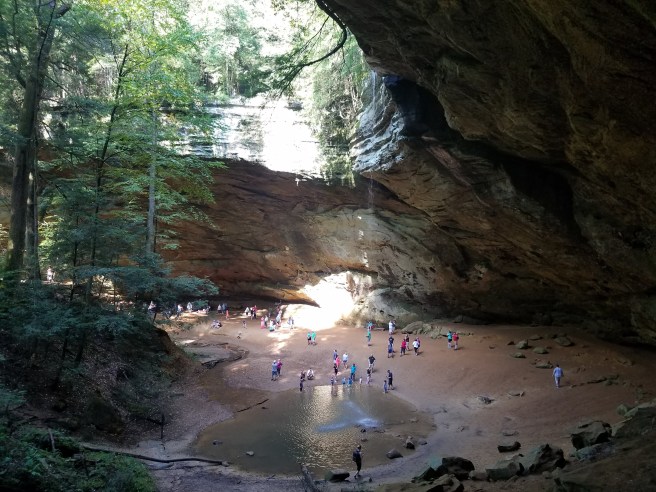
Ash Cave was our final stop on the first trip. There are several small parking lots nearby with restrooms. The path to the cave is paved and only about a quarter mile long, although a half-mile trail loop also ascends along the upper edge of the cave. Ash Cave is named for the large piles of ash found in the cave by early settlers, which probably accumulated from fires lit by Native Americans over the centuries.

20181007_114216
Ash Cave

Ash Cave is the largest recess cave in the state which is readily apparent as you approach. The massive cave is shaped like a horseshoe and stretches 700 feet from end to end. It rises 90 feet tall and is 100 feet deep. A large mound, called the Pulpit Rock, sits in the middle and provides a good view of this unique geological feature. Ash Cave was also busy, and a large group of people had set up folding chairs. Several people were playing drums and other musical instruments which rippled through the air due to the cave’s acoustics.

Part II – July 2019

Even though Hocking Hills is a relatively small park, I still had a fun time the second time around less than a year later. Nataliya and I took a different approach in several respects. First, we stayed at the Holiday Inn Express in Athens. It was a bit cheaper than Logan but also a 45-minute drive to the park. However, Athens (pop. 25,000) also offered amenities than Logan (pop. 7,000).

Athens is home to Jackie O’s Brewery, which produces one of my favorite beers – Razz Wheat (American raspberry wheat ale). In addition, Nataliya and I tried a flight of bourbon barrel beers which is one of my favorite styles. I was also extremely fortunate to have a brief window where the side effects of my medication were mild, and I could have a few sips (literally). I had a delicious salad with chicken and apples. The Rueben egg rolls were also amazing too.

After dinner, we wandered around the campus of Ohio University for a little while, which was very beautiful and quiet at night. Since it was summer, the campus was nearly deserted.Then, we went around the corner to see a movie at the Athena Cinema, a small historic theater. We decided to see “The Art of Self-Defense” which was a little ham-handed.

The next morning, we started our hike at Old Man’s Cave again. The new visitor’s center (a fire destroyed the previous building in 2016) had opened only a few weeks before and included some interesting displays on the history and ecology of the Hocking Hills region. It also features a gift shop which sells ice cream – a tasty treat after a hot hike.

20190727_100404

Even though we partly recovered my tracks from 2018, Old Man’s Cave is still a lot of fun and Nataliya loved it since this was her first trip. This time, we continued along the trail after reaching the Lower Falls and headed along the Grandma Gatewood Loop towards Whispering Cave. This recess cave is about 300 long and sometimes has a waterfall in the center (which was not flowing when we visited). A few parts of the trail were moderately strenuous. We reconnected to the Grandma Gatewood loop and hiked back to Cedar Falls. The main attractions were very busy, but the Grandma Gatewood Trail had less traffic, although it was not totally empty.

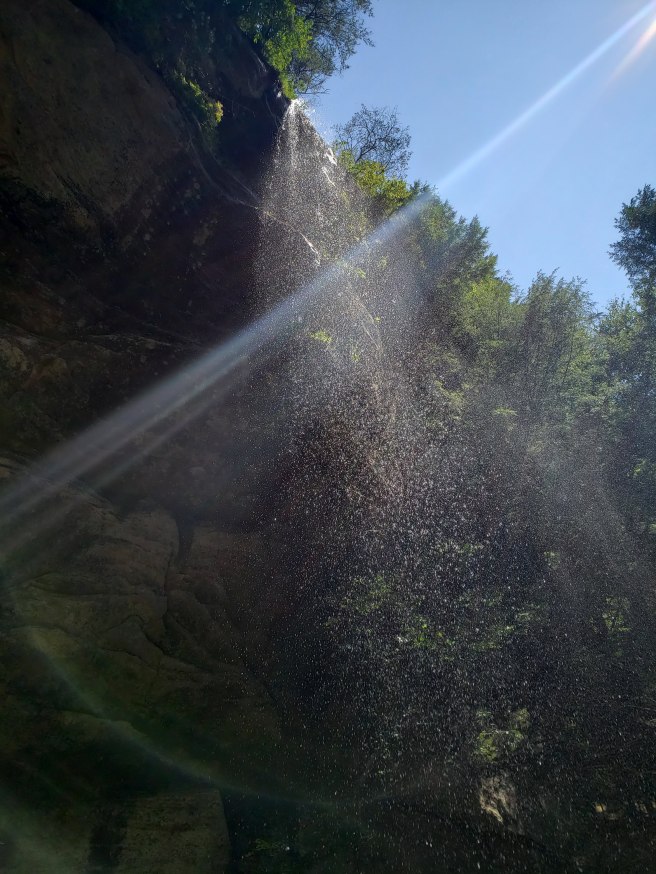
20190727_120655
Waterfall along the Grandma Gatewood Loop

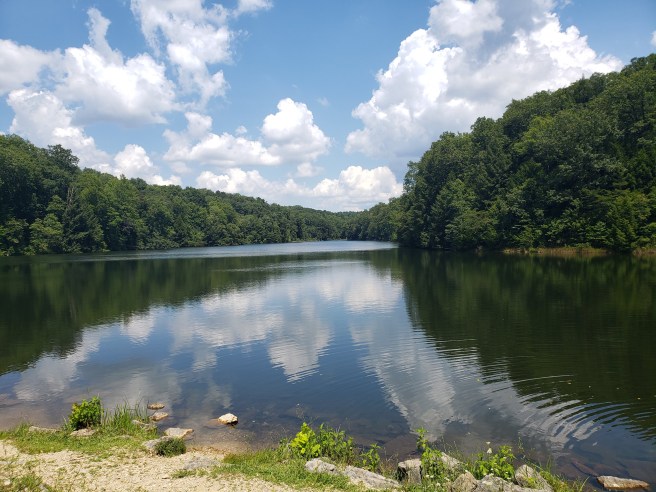
Rose Lake was our last stop before returning to Old Man’s Cave. There is a sharp climb up to the reservoir, but it is not very long. Fishing is allowed at Rose Lake with a valid permit, but swimming is not. The lake was very quiet and pretty which makes it a great spot for a short rest. By the time we returned, we probably spent about 4 hours hiking and covered about 7 miles. My legs were tired – this was my longest trek in years!

20190727_132329
Rose Lake

Nataliya and I plan to go back again since there are still several destinations to visit, including Cantwell Cliffs, the Rock House and Conkle’s Hollow. In addition, there are numerous other parks and forests nearby, including Wayne National Forest. The Sherman House in Lancaster is about 30 minutes from Hocking Hills. It is the birthplace of Civil War general William Tecumseh Sherman and is another place I’d like to visit as well.

Travel Blog – Mammoth Caves 2019

This the first article in a series of updates that will look back over my excursions in the last year. I’ve still been busy even if this blog has been quiet!


Back in May 2019, I finally made a trip to Mammoth Caves National Park, which I had been thinking about for a while. It’s about 3 hours from Cincinnati and I will definitely go back! I recommend planning your trip at least several weeks in advance and even earlier for busy holiday weekends.


The busy season at work starts in February and lasts until August. By early May, I already felt like I needed a break, so I scheduled time off on the Friday before Memorial Day. Dad and I planned to drive down on Friday morning, do a couple cave tours Friday afternoon and Saturday morning and come back on Saturday afternoon/evening to avoid the crowds.


However, neither of us knew that you needed tickets for almost all the cave tours at the park. We thought you could just wander the caves at your leisure. However, there are fixed schedules with a limited number of tickets for each tour. Certain tours are only offered at certain times as well. I did not think to look at the park’s website for details on the tours until the week before hand. Dad had been to the caves many years ago, before they started selling tickets, and was surprised to learn about the new requirement as well. There are only a few self-guide tour slots available, and they only give you access to a tiny part of the caves.


It was a lucky thing that we decided to head down on Friday, because almost every tour for Saturday was sold out! We grabbed tickets for a couple Friday slots and set out a week later. We stayed at a hotel in Cave City which was about a 20-minute drive from the park, although the park also has a lodge with some cabins as well.

From NPS website.


Our first tour was the Domes and Dripstones option, which was a little too thrilling for my taste. The tour lasts about 2 hours and includes a moderate amount of physical exertion. Tickets costs $8-$17 and several tours are offered daily. The description includes a warning that discourages any visitors with a fear of heights or claustrophobia from registering for the tour. I hate heights but I decided to challenge myself and give it a shot anyway.

From https://quirkytravelguy.com/


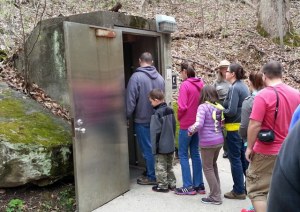
The tour met at the visitor center and then everyone boarded a bus. A few minutes later, we disembarked at a metal doorway that was totally out of place in the wilderness. It felt like something out of the “Myst” adventure video game from my childhood. The guide gave a short introductory speech and explained this doorway is called the “New Entrance” that was created in 1921 by a dynamite blast. Then we proceeded down a narrow tunnel that descended steeply. I intentionally left my phone in my pocket so I could immerse myself in the experience. As a result, I’ll rely on photos from other travelers (with due credit of course!)

The first few steps are all man-made, but then I was staring into the dark depths of the Earth. We had to walk down a very narrow metal walkway that was just wide enough for a person. The walkway was made of metal grating and you could see right down into the shadows below. I grasped the handrails tightly and stared at the back of my dad’s neck as the tour guide had instructed. I felt for the stairs with my feet and concentrated on every tiny little feature on my dad’s neck – every mole, every pore. I felt anxiety creeping in. The metal grating was slippery in spots which only made it more excruciating as it slowed our progress, and I stood on the grating. It felt like I was suspended over nothing.

We descended for several minutes with brief stops on solid rock outcroppings. Then it was back on the grated stairway as we continued down for several hundred feet. Finally, we reached the main passage and completed the tour on solid rock, much to my relief. As I stepped off, my whole body unclenched, and I began to breath normally again.


The tour did include some very interesting geological features, including stalactites and stalagmites. The “Frozen Niagara” really does look like a frozen waterfall. However, you can access it much more easily and quickly on the tour that is named after it, rather than the Domes and Dripstones option. I am glad I made it through the challenge, but I would strongly encourage anyone else with a fear of heights to pick another option. In addition, a couple brought their screaming toddler on the cave tour, which was also a little distracting and disruptive. Who thought that was a good idea? The kid was too young to appreciate anything he saw anyways.

Upon returning to the visitor center, we had to walk across mats soaked in soapy water to slow the spread of white-nose syndrome amongst the bat population, which unfortunately has already been devastated.
We visited the small museum in the visitor’s center, which was actually very informative and interesting. It did a great job of addressing not only the history of the Mammoth Cave system but also the ecology of the Green River valley as well. The exhibits also highlighted the role of women and black cave guides, which I was glad to see.


Afterwards, we had dinner at the Green River Grill which is in the lodge near the visitor’s center. Both dad and I had the barbeque which was mediocre at best. The baked beans were the best part of the dish unfortunately. You must go outside the park for other options, but there is little besides fast food. Foodies beware! In fact, there is not much of anything outside the park except for a few decrepit and depressing “attractions” such as Froggett’s Guntown Mountain. It offers wholesome family entertainment, such as mock gunfights and can-can shows. Another outlandish destination is Dinosaur World, which features dozens of large dinosaur statues made from foam and fiberglass.


We ended our Friday night with our last tour, but it was by far the best! We walked down to the Old Entrance for the Star Chamber tour. As we approached the massive opening, we could feel the cool air rushing out and it was probably 15 degrees cooler in the cave than it was outside, even in the evening. I had on shorts and a t-shirt for the tour, and it was a little chilly inside. You will warm up after a little walking, but I might recommend a light jacket and/or some pants anyway.

From NPS website.


The Star Chamber tour was much more interesting and much less stressful than Domes and Dripstones. First, it was much smaller (about 30 people) than the Domes and Dripstones tour (about 90 people). Second, it had a distinctive and intimate atmosphere because it was lit only by hand-held gas lanterns. There were approximately 8 lanterns for the whole group, and all the interior lights were off. I carried the lantern for my little group, and it was a very different feel from the Domes and Dripstones tour. The lights flickered on the walls, and I could feel the heat from the lantern rising to my fingers. It gave me a good idea of what it was like to explore the caves in the 1800s or early 1900s. It would be interesting to go back and experience a regular tour with all the lights on and compare it to our torchlight tour. The tour lasts about 2.5 hours and is also moderately difficult. Tickets cost between $10-$20 but is only offered once a night.


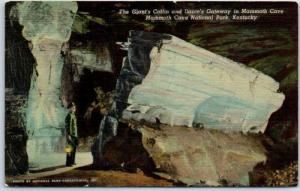
Our guide on the Star Chamber tour was much more of a storyteller than the one on the Domes and Dripstones tour. He told several intriguing stories about the mythology and history of the caves. Our guide also demonstrated an illusion called the Giant’s Coffin. This large rock (called a breakdown block) fell from the cave ceiling and remained intact. When guides shine their lights on the rock in a certain way, it makes it seem like the “lid” on the Giant’s Coffin is lifting.

From https://www.hippostcard.com/


The guide also told us about Native American remains that had been discovered in the caves and about the tuberculosis colony that briefly inhabited the tunnels.

The Star Chamber was, of course, the highlight of the tour. The name comes from the torch soot that has coated the ceiling over the centuries. Visitors created “stars” in the “night sky” by throwing rocks at the ceiling that chipped away the layer of soot and revealed the glittering gypsum beneath it. The trick inspired Ralph Waldo Emerson’s essay “Illusions.”

The most dramatic moment occurred when the tour guides took away our lanterns and disappeared down a side passage, leaving us in unsurpassed darkness. It was really quite unsettling. Thankfully, the guide returned with our lanterns, which shined like the “rising sun.” It was long past my normal bedtime when we returned to the hotel, but it was absolutely worth it!


Since we couldn’t find tickets for any tours on Saturday, dad and I went on a short hike above ground before we left in the morning. There are a number of excellent trails to choose from, and we opted for the Sinkhole Trail which was about 1 mile long. It was relatively quiet and shaded. The sinkhole is only one of many in the region, which is sometimes called the “Land of 10,000 Sinks” or the Sinkhole Plain. We also learned that the sinkholes funnel water down into the Mammoth Cave system. I snapped a few photos of the tropical plants that inhabited the sinkhole before we headed home.


https://photos.google.com/search/may%202019/photo/AF1QipPTy0yERvx7hOC3DB20aoiIz4vkKfgfwKD2OWef


Although I would have liked to do at least one more cave tour on Saturday, I have an excuse to return!


Up next: Columbus & the Wilds followed by Hocking Hills. Looking into the future. Next, I’ll recount a weekend each in Cleveland and NYC. Then, a 5-day vacation to Las Vegas with Nataliya.

The fate of heroes

Here is the epilogue to our Pathfinder story arc (level 1-7) that lasted a year:

By defeating Iramine, the party has become more powerful and everyone has reached level 7.

20191227_091349

But the first thing you need to do is rest since the difficult battle has worn you down. By this point, enough time has elapsed that the first ring of the city is mostly flooded with molten gold. The only option is to wait out the flood. The highest point in the city is the Tabernacle of the Jewel of Everlasting Gold, so the party climbs onto the tabernacle’s domed roof and waits as the tide of molten gold rises ever higher and higher before cresting only a few feet below the top of the dome. You have to use your last potions of resist energy to fend off the punishing heat. The flood begins to recede a couple hours later and slowly drains from the entire city over the course of another 24 hours.

Then the party begins to fight their way back out of the City of Golden Death, encountering wandering Golden Skeleton patrols and a few more Golden Skeletal Ogres. Moving swiftly, the party fails to notice another pair of constructs – a pair of Golden Caryatid Columns. These gold-plated statues of female warriors holding falchions suddenly come to life.

https://www.d20pfsrd.com/bestiary/monster-listings/constructs/caryatid-column/

One swings at Nog but misses. Nog retaliates with his great sword and upon striking the statute feels a deep, penetrating vibration that ripples down the blade into the pommel and then telegraphs into his arms. Nog glances quizzically at Quinn, the investigator, while raising his sword to strike again.

“Hold your blade!” Quinn shouts. He points at the living column and says “their defenses will shatter your sword if you strike again! We must withdraw.”

Izlea raises her wand to blast the living columns while the party retreats but Quinn tells her they are also immune to magic.

After beating another hasty retreat, the party eventually reaches the exit and begins the dangerous trek back to the beach. The sun hangs low in the sky, but the party decides to press on and reach the rendezvous point before midnight. The terror treant that lobbed boulders at the party during your approach to the City of Golden Death has thankfully moved on. But many other threats inhabit the twisted forests of the Isle of Terror.

https://www.d20pfsrd.com/bestiary/monster-listings/plants/treant/

In addition, black lighting rains down from the sky periodically and one bolt crashes into Izlea doing 20 points of damage! She collapses to the ground and groans. Her body is wracked with pain and she convulses for a few moments as black energy ripples up and down her body in waves. After the black energy dissipates, Quinn helps Izlea to her feet and then gives her one of the few remaining healing potions to partially restore her.

The sun dips below the horizon as the party trudges westward.

Eventually, the party approaches the abandoned keep that overlooked the beach where they need to build a signal fire and recall the old pirate Mabon the Destroyer so he could take them back to Venture-Captain Reginar at the Pathfinder base in Tamram. Dusan, the crazed Pathfinder that has accompanied you across the island, asks to be taken back to Tamran so that he could make his report to Venture-Captain Tree Roots. The party readily agrees and sets to work building a signal fire.

Just as Nog is about to light the fire, stones from the nearby keep suddenly leap into the air and batter the party members. Everyone tries to defend themselves against the barrage of bullets by ducking, dodging and parrying with their weapons.

Dusan shouts “I warned you!” and hastily “refreshes” his “olfactory camouflage”.

Quinn dodges a hurtling stone and then looks quizzically at Dusan.

“…shadow…demons…” Dusan hisses quietly as he peers furtively into the dark forest.

https://www.d20pfsrd.com/bestiary/monster-listings/outsiders/demon/demon-shadow/

The barrage of stones continues for a few more moments, with a dozen rocks seemingly aimed at the party in the span of only a few seconds. 

The fusillade ends as abruptly as it began.

A moment later, a shadowy bat-winged demon flies out of the darkness and pounces on Hank. Its lashes out, and its teeth and claws seem to pass effortlessly through Hanks’ heavy armor. The demon’s icy touch leaves large, painful black scars on Hank’s chest and limbs.

“You need a cold iron weapon to fight shadow demons,” Dusan shouts!

Hank drops his great sword and draws his cold iron mace. He swings at the dark figure hovering in front of him, and it seems to recoil. Nog charges in to attack but his greatsword seems to have little effect on the malevolent monster. Quinn studies his target but finds no weak spots. Martha’s crossbow likewise seems to be ineffective.

Izela sends a few shimmering magic missiles towards the creature. The impact causes the shadowy apparition to flicker.

The shadow demon rakes Hank from head to toe with its claws and teeth. Hank groans and slumps to the ground, unconscious. The shadow flutters a little higher into the sky.

The party struggles to do any damage to the demon, except for Izlea’s magic missiles which again strike true.

Quinn also feels the demon’s chilled touch before it seemingly disappears into the darkness.

Quinn uses the party’s last healing potion to bring Hank back to consciousness. Nog finally lights the signal fire and everyone huddles close with their backs to the flames and their eyes peering into the inky darkness until Mabon’s ship arrives. It seems the shadow demon has left the party in peace. 

The party quickly embarks on the rowboat and hastily paddles for the pirate ship. They clamber abroad and urge Mabon to make for Tamran with all haste. They awe the crew of the ship with a dramatic retelling of their adventures on the Isle of Terror.

After passing through the shroud of black storms that surround the island, Martha suddenly remembers that Hank has an intriguing deck of cards in his bag of holding.

https://www.d20pfsrd.com/magic-items/artifacts/minor-artifacts/deck-of-many-things/

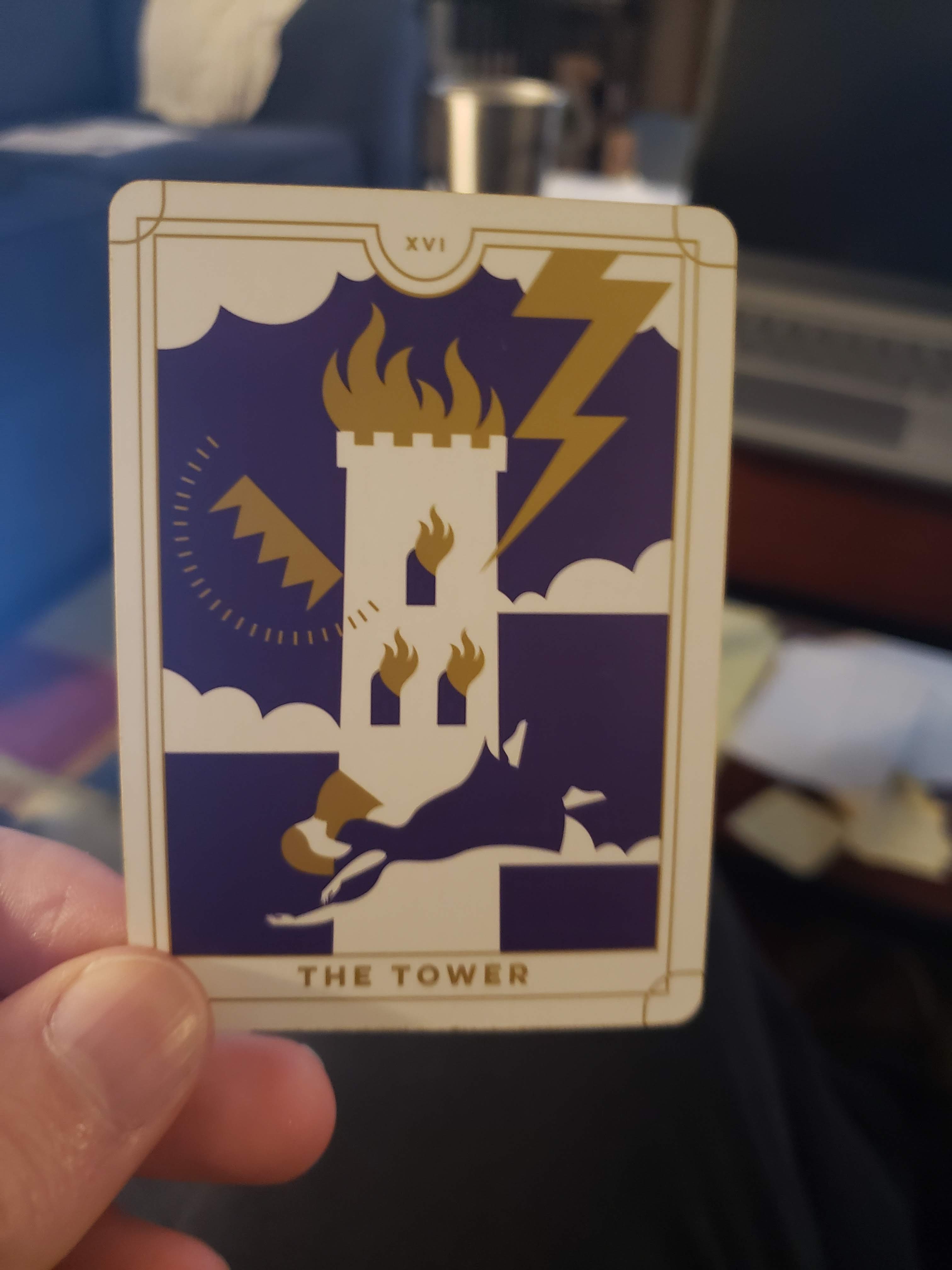
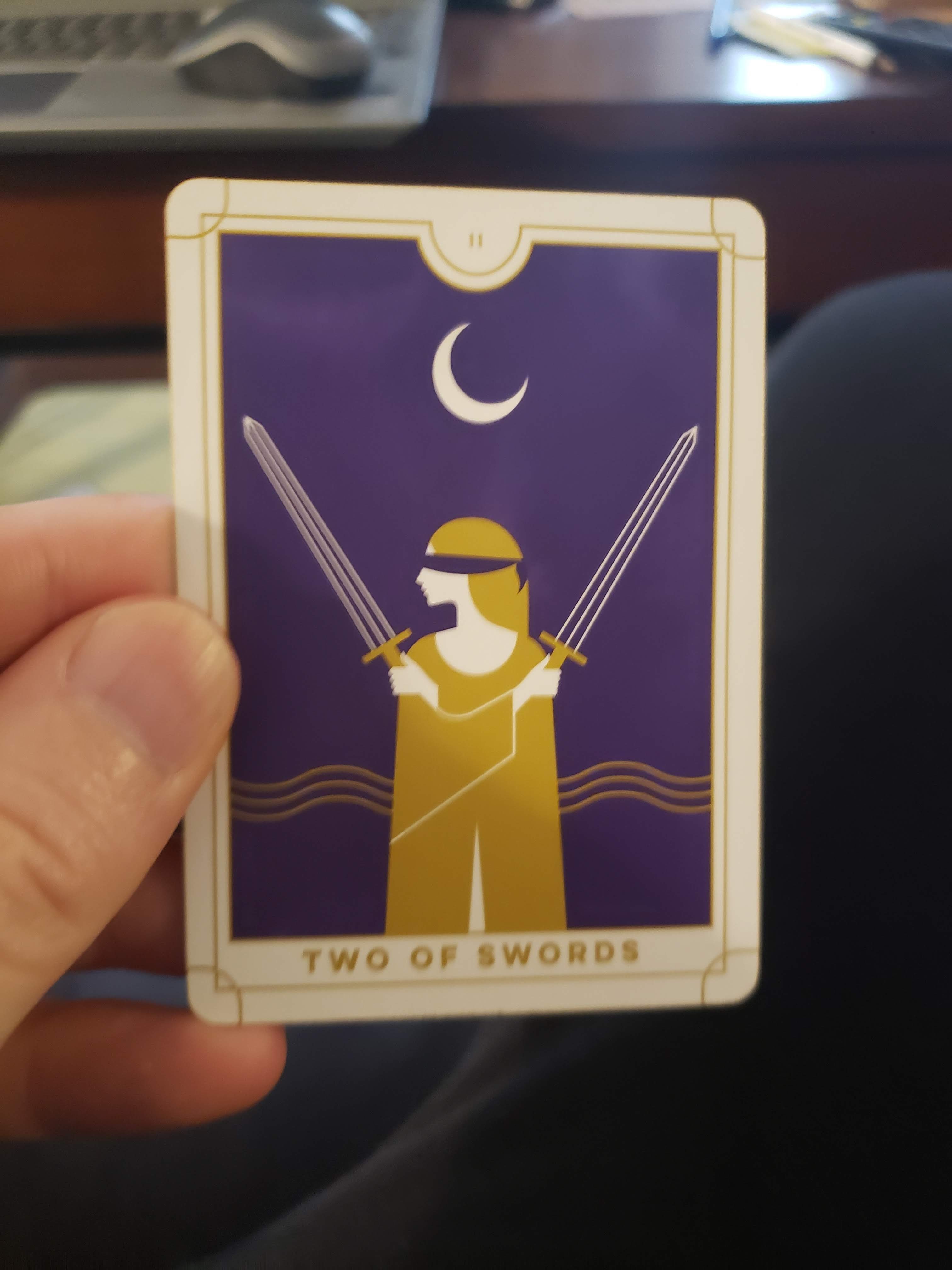
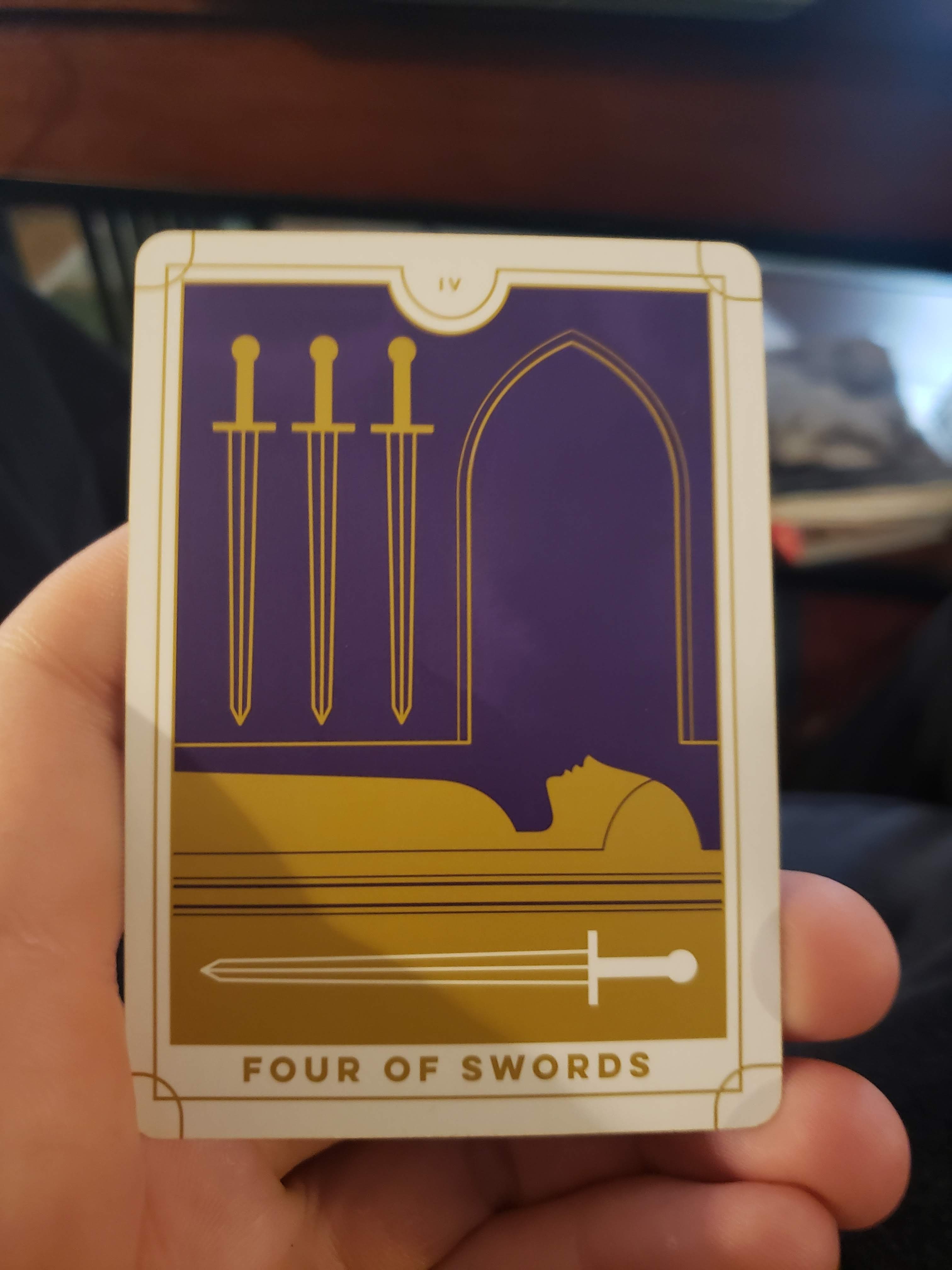
The cards are from the Every Day Tarot deck: https://www.everydaytarot.com/

Hank reaches into the bag of holding and takes out the deck. Hank resists his chaotic nature and declines to participate. He presents the deck to Nog.

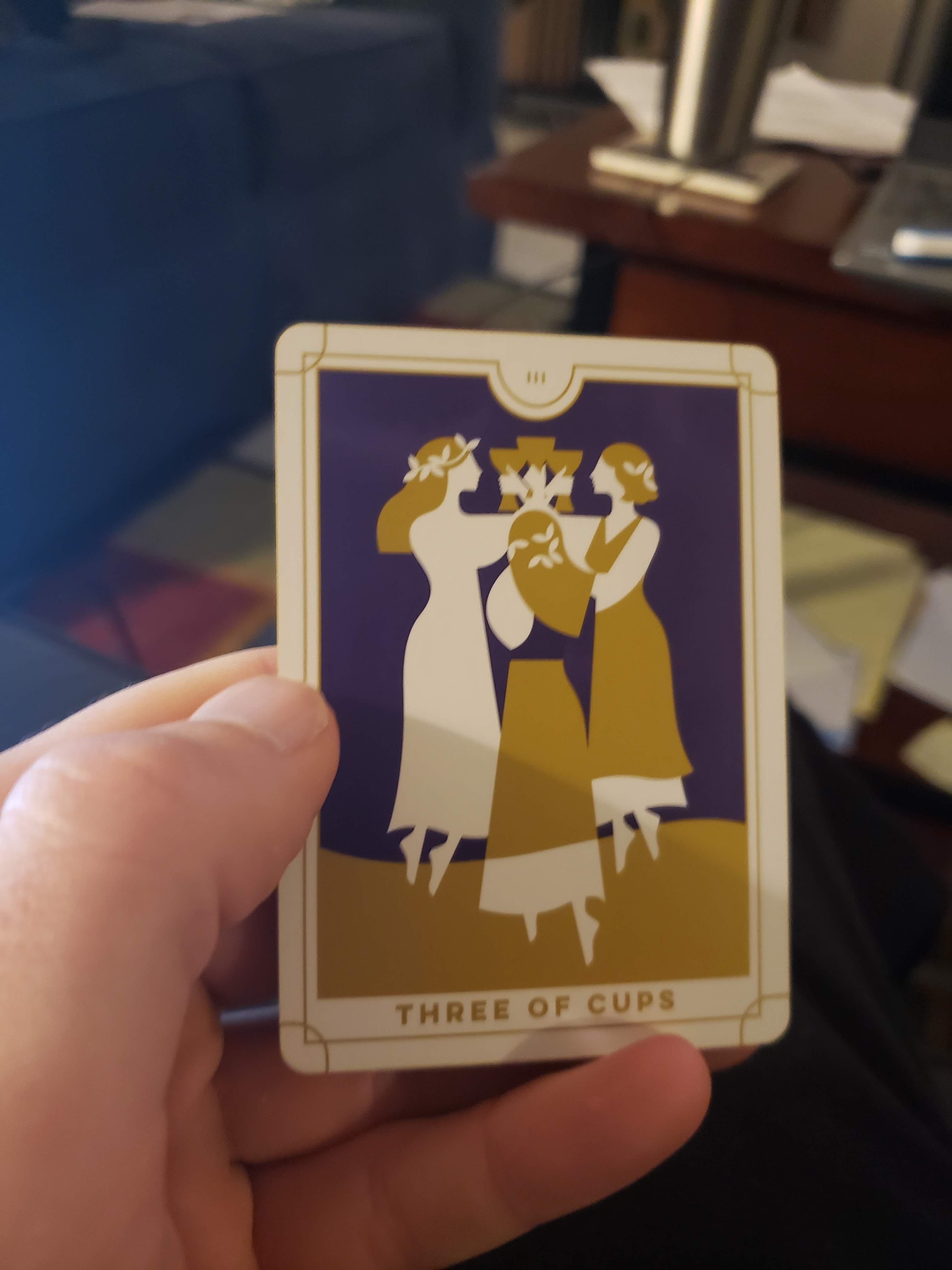
Nog draws one card – the Fates (represented by 3 of Cups)! He is suddenly restored to the throne of Ashu as its rightful ruler!

20191217_094032

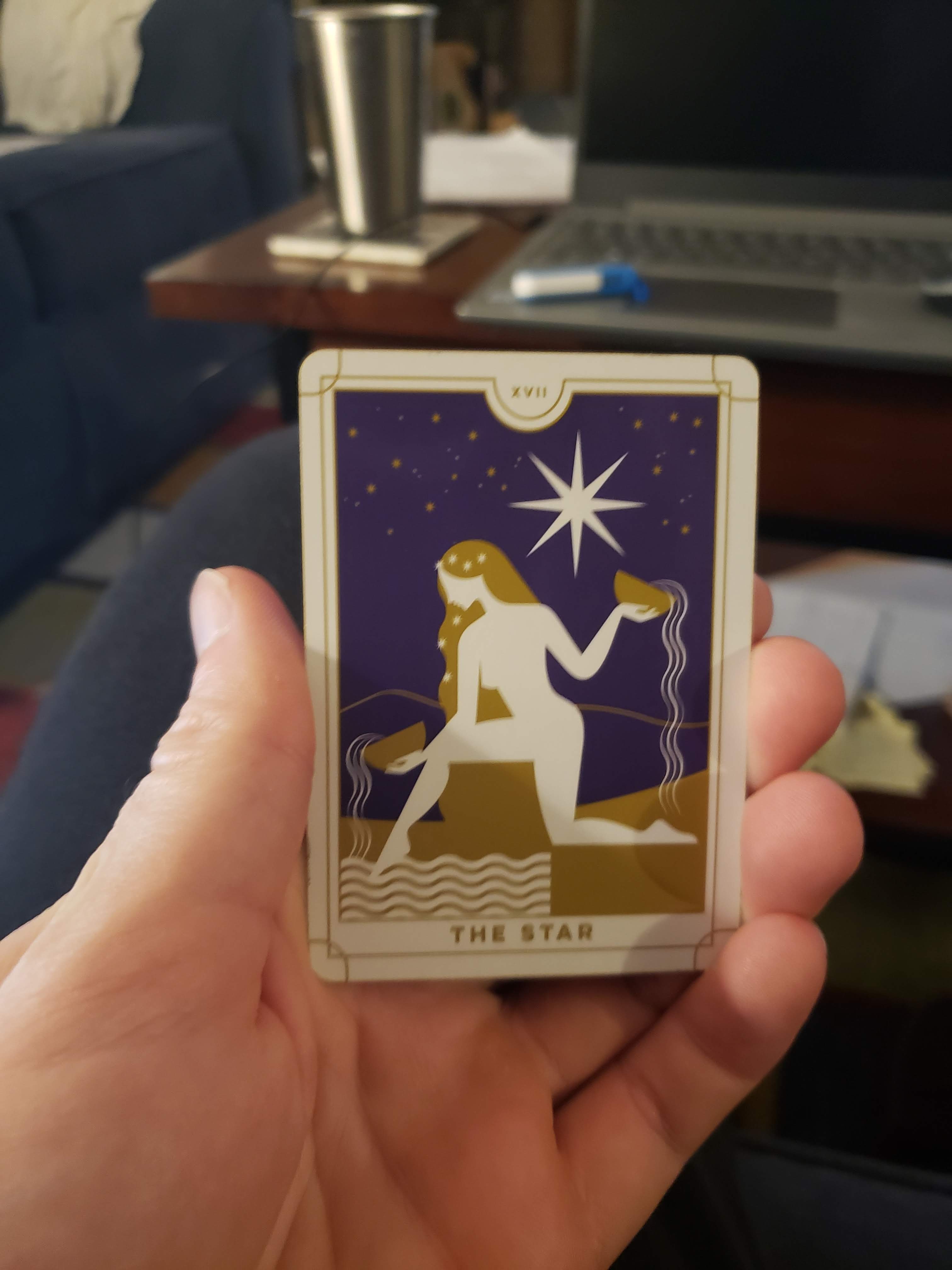
Izlea draws two cards. The first is the Star, which makes her even more beautiful and powerful than she was before (+2 charisma)!

20191217_094426

Her second card is the Vizier (represented by the Hermit)! She is able to solve any problem or question (once) by consulting a supernatural source of wisdom.

20191217_094601

Quinn draws one card, with a sense of dread. It is Ruin (represented by the Tower)! All his non-magical possessions suddenly crumble to dust!

20191217_111036

With a confident smirk, Martha declares she will draw 4 cards. The first is the Gem (represented by 7 of Cups)! A stream of glittering jewels erupts from the ocean on the port side of the ship and dozens shower down upon her! Izlea appraises them with a quick glance and estimates there must be about 50 different stones, including rubies, sapphires, topaz, and diamonds, which are worth a total of 50,000 gold pieces!!!

20191217_111318

Her eyes wide with greed, Martha draws her second card – Comet (represented by 2 of Swords)! Martha knows intuitively that the next time she encounters an enemy of any kind, she must defeat it single-handedly. If victorious, Martha will immediately gain one level – otherwise, the benefit is lost. She feels giddy about not only being richer than her companions but also more powerful…

20191217_111536

Grinning from ear to ear, Martha draws her third card – Donjon (Represented by 4 of Swords)! Immediately, a woman with dark brown hair, light brown skin and brown eyes clad in leather armor with several gold earrings and a blue headscarf appears on deck a few feet away from the party. The woman shouts “I, Pasha Al-Jakari, shall now take my revenge against you meddling Pathfinders who ransacked by outpost on Stonespire Island and stole my mirror!” The party rushes towards the woman as she points at Martha and exclaims “You, the most troublesome of the lot, shall be my slave!”

20191217_111740

A brief look of horror spreads over Martha’s face before both she and the Pasha disappear in a flash of light! The pirate crew murmur amongst themselves at this strange turn of events.

Izlea smiles smugly and says “My Vizier card will come in handy when it comes to rescuing Martha from the clutches of the treacherous Pasha. We may even be able to rescue the djinni once we defeat the Pasha.”

After the excitement dies down, Nog takes the opportunity to throw the Everlasting Jewel into the ocean. While Nog watches it sink beneath the waves, Hank walks up behind him and says “You know, there are fish people down there too.”

Nog suddenly regrets his decision and feels a wave a dread wash over him. Hopefully, any fish folk who find the Everlasting Jewel will not fall under its control.

Nevertheless, the Everlasting Jewel left its mark on Nog, even though he held it for only a few moments in the City of Golden Death. For the rest of his life, Nog still feels the Jewel’s dark, seductive call in the back of his mind. Nog should have been satisfied after being restored as the rightful ruler of Ashu, but the riches of the Golden City are not easily forgotten…

Upon arriving in Tamran, the party quickly locates Venture-Captain Reginar. After hearing your report, he says “Your adventure will be recorded in the Chronicles of the Pathfinder Society as one of its greatest moments!”

However, he also seems concerned about the fate of the Everlasting Jewel and says he will dispatch another team to recover it.

Reginar is also astounded to meet Dusan. He consults the Chronicles and discovers that Dusan was part of another Pathfinder team that had gone to the island more than 7 years ago. Since Venture-Captain Tree Roots was reassigned several years ago, Reginar also records Dusan’s “version” of events as well.

After all the paperwork is complete, Reginar asks to see the amulet which functioned as the key to the Golden City. “I feel this must be returned to its rightful owner – Kassen.” He asks the party to accompany him back to Kassen’s tomb.

Everyone readily agrees and the uneventful river cruise takes only a few days. The party is welcomed back as heroes in the village of Kassen. After several festive hours, you managed to extract yourselves from the unending banquet arranged in your honor.  You approach the tomb after a short ride on horseback.

A few bats and other minor vermin harass the party as you descend into the tomb. However, you brush them aside easily. Only a year ago, these tunnels had seemed frightening but now they are only dark and cold.

As you approach Kassen’s tomb, his translucent spirit rises to greet you.

“Welcome, noble heroes! It seems like you were here only a moment ago, but time slips by so quickly down here. However, I sense you have fought many battles since we last met. I am glad you have survived to return. Did you recover the amulet?”

“Yes,” says Izlea as she steps forward and presents the amulet to Kassen’s ghost.

Kassen says you must break the amulet into pieces and place one fragment in his tomb and the other in Asar’s crypt.

Nog sunders the amulet with one swift blow of his great sword and reverently places the fragments in their rightful resting places.

“Thank you,” says Kassen’s spirit. “Go with my blessing. I shall rest now.”

With that the spirit dissolves into nothing and the party departs the tomb. (All members gain the boon of Kassen’s Blessing which allows you to reroll any die).

Many adventures lie ahead of you, including the daring rescue of your companion Martha, but the stories have not yet been recorded in Chronicles of the Pathfinder Society…


Mindfulness and Being a Frequent Flyer after 2 years of Treatment

My mother said her attitude towards my cancer is to look ahead rather than behind. I generally share that same approach, but I recently spent some time reflecting on the 2 years that have passed since I was diagnosed with stage 4 lung cancer on Dec. 28, 2016.

Overall, my treatment has gone well – the brain tumors were quickly irradiated and show no signs of recurring. The tumor in my lungs has been reduced from about 3 in. by 3 in. to 1 in. by 1 in. There have been a few hiccups along the way, but overall my treatment has been pretty painless and with few side effects. That makes me very lucky, but my cancer is rare and presents its own unusual challenges. My friend Michael described it like “having this man-eating wolf in my house, and I’ve got him locked in the other room, for now. Even though he’s definitely trying to tear through the door to get to me, the door’s holding for now.”

Normal chemotherapy treatment plans usually last between 4 and 6 months. But, after two years, I still take medication every morning that attacks my specific type of cancer, and there’s still no end in sight. After 2 years, I am still very much “in treatment” which most people seem to forget, especially since I don’t post about my condition unless there’s some specific reason. I still go for a CT scan every 3 months and an MRI every 4 months. Because I’m on a drug that was only recently approved by the FDA, I still go in for blood work and an exam every month or sometimes more frequently as well. My latest CT scans showed a slight reduction in the lung tumor, and the latest MRI showed no new brain lesions.

In fact, shortly after Thanksgiving, I joked with my doctor that I was a frequent flyer because I had 4 appointments in the span of 2 weeks. The only perk is free parking – unfortunately, the hospital doesn’t have a reward point program or loyalty card. I go to a young adult cancer support group, and I certainly felt, on occasion, a little jealous of other survivors there who were on biannual or annual checkups. The constant rhythm of appointments, scans and blood draws is numbing and runs the risk of making me feel too complacent. Although the MRI screeches loudly and constantly, I am so inured to it that I find it hypnotic and doze off inside. I really don’t have much to complain about if my biggest gripe is that I have too many doctor’s appointments.

On the other hand, I wonder if sometimes I’m not forgetting the gravity of my condition. I am extremely lucky because I live a relatively normal life, aside from non-voluntary sobriety. In addition, my treatment has been effective, albeit with a few bumps along the way. I am afraid that sometimes I might forget the precariousness and lethality of my position. After 2 years, despite all the good news, my dad said he still gets anxious before each scan. I usually don’t get too anxious, although I was a little concerned about what the first CT scan would show after starting the most recent version of my medication. However, generally I feel like there’s no point in worrying because it won’t have any effect on the results. My therapist called that “radical acceptance,” and I won a CrossFit award for being “Cool under Fire.” I feel like it’s those two latter options rather than naivety or complacence.

Conversely, it’s hard to forgot that I have a deadly disease, since I take my medication every morning. In addition, the medical appointments sometimes crowd my calendar (I’m lucky to have an employer who is very flexible). Furthermore, I always try to make the most of every day, since awareness of my own mortality is never absent for very long. It seems I don’t need an app to remind of that. I hadn’t ever thought of this habit as mindfulness, but I suppose it is.

In the future, things could become easier or more difficult. Either way, there’s no point in worrying about it now. Instead, I’ll get on with living and trying to strike a balance between being mindful of my own mortality without becoming numb to the risk.

District of Columbia: How I came to love the Metro and Profiteroles

I recently spent five days in Washington D.C. partly for business but also for fun. One of the things that struck me about D.C. was its comprehensive and efficient public transportation system. The company didn’t want to pay for a car in D.C., so I was placed in a different situation from my daily life in Cincinnati where I can drive everywhere. I know there’s public transportation in Cincinnati (including buses, bikes and the street car), but I never need to use it. If I did, I suspect it would be less convenient than the system in D.C. I don’t have a lot to compare it to, but I think D.C. public transit is pretty good. Paris also had a good public transportation system, but we were just less reliant on it.

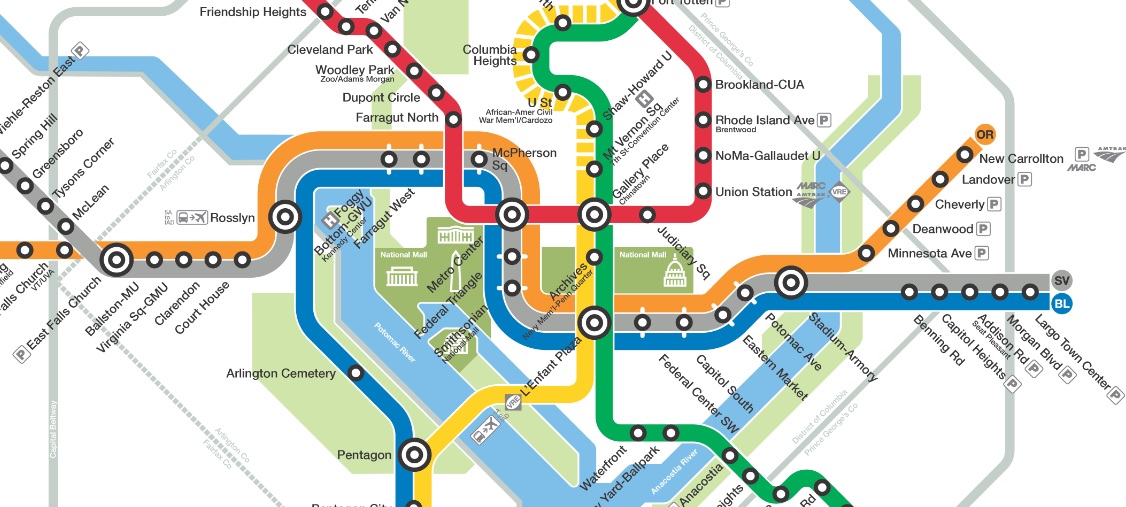
First, I love the D.C. metro. It’s fast, efficient and pretty cheap ($2 for a basic fare). It was a little confusing on my first day since I don’t normally ride public transit, but it didn’t take too long to figure out. After visiting Paris with my family earlier this year, I quickly felt like a savvy independent traveler on the metro. The metro staff were all very helpful. One of my fondest mementos from my D.C. trip will be the crumpled and torn metro pocket map which I consulted multiple times every day. The trains ran every 10 minutes and the cars and stations were pretty clean, if dimly lit. Sitting in the rear car was pretty cool, because it felt like you were in some sort of sci-fi hyperspace tunnel with the lights flashing by and trailing off behind you. My only gripe about the metro is the lack of a stop at the western edge of the National Mall which discouraged me from visiting the Lincoln and Jefferson memorials. However, I did visit the White House, Washington Monument, Supreme Court and the Capitol. I thought the Washington Monument was the most serene and striking at night, although I ended up with a great picture of the Capitol as well.

wash monument

Capitol

The metro also provided excellent opportunities for people watching and observing the masses going about their daily lives. The metro is a social environment in which I have never really spent a lot of time, but in D.C. I was immersed in it every day for five days straight. I drive to and from work every day in Cincinnati, which is a very isolated activity. There are thousands of other people on the road as well, but you can’t really see them or interact with them. Usually I took a taxi to my work meetings in D.C., but afterwards I took the metro back into D.C. After a meeting at the Defense Intelligence Agency, I entered the nearest metro station (on the Green line on the south side of the Anacostia River) in Anacostia, a mostly African-American neighborhood, and suddenly found myself in the minority. Of the people milling around or waiting for the metro, only one other person was white. I felt out of element in a way that I rarely have felt before, and I admit it made me a little uncomfortable. However, it gave me an appreciation, if only briefly, for how non-white people might feel in the opposite situation. But only one stop later, and I was back in the Navy Yard – a vibrant and more diverse neighborhood.

metro.map.jpg

I did a few other things in D.C. (such visit museums and eat amazing food) besides ride the metro, but we can discuss that later! While I mostly rode the metro in D.C., I used the bus when leaving because there wasn’t a direct metro line to the Dulles airport, although there is one for Reagan. Upon arrival, I took an express bus from Dulles to L’enfant Plaza – a major public transit hub in D.C. When I left, I took the metro until I got as close to Dulles as I could, and then I finished the last few miles on a local bus route (again only $2). The bus also stops at the Udvar-Hazy Air and Space Museum near the airport which I also utilized since I had a few hours before my flight left for Cincinnati.

D.C. also has a bike share program that I used only on my last day. I didn’t really think about bicycles before I arrived in D.C. and probably could have used it more during my trip instead of walking as much as I did after getting off the metro. The bike share program costs $2 for a 30-minute ride – plus, the docking stations are solar powered! However, the first station I tried to use seemed to be out of service – I couldn’t rent or return any of the bikes in the rack. However, there was another station nearby, and I was quickly able to get on my way. The rental process is quick and easy.

Although not public transit, I rounded out my stay in D.C. with a cruise down the Potomac River. I’ve had the idea for a dinner river cruise since my family went to Paris – we planned to float down the Seine but couldn’t fit it in our itinerary. I signed up for the Spirit of D.C. dinner cruise. I was a little hesitant because of the price (about $100), plus the company adds on about $30 in fees when you try to buy a ticket. None of that includes the gratuity for the crew either. However, there’s a discount code on their website that takes 15% off, which made it a little more palatable. In the end, I went for it because it was my only significant out-of-pocket expense on the whole trip.

I was hoping for more of a night-time narrated sight-seeing tour, but it ended up being a booze cruise with loud music and white people flailing about on the dance floor. The food was good but not great – I liked the smoked duck appetizer with cherries and cranberries. For the main course, I had the beef short ribs which was fine but not outstanding. The mashed potatoes definitely seemed like some sort of watery instant-serve product. Since I can no longer drink, I’ve become a desert aficionado and the warm butter cake with ice cream was pretty good! The cruise didn’t offer much in terms of good night-time views except for the Kennedy Center. In addition, the boarding area was a little hard to find and I spent a while walking up and down the Wharf trying to find the right spot.

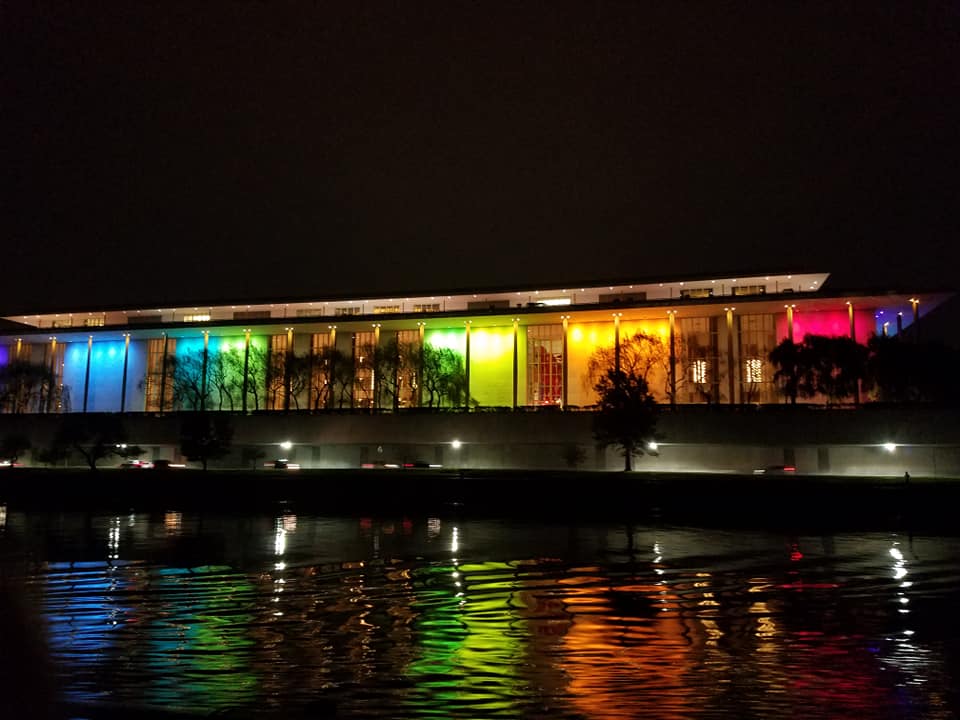
kennedy
Kennedy Center viewed at night from the Potomac River.

In addition to transportation marvels of D.C., I also enjoyed the monuments and museums. I usually finished with work at about 2 p.m. each day, so I could hop on the metro and get to a museum in 30 or 45 minutes. I visited the International Spy Museum. At $25, it offered a good historical overview of espionage but didn’t have much new information (at least for me). However, I did enjoy the different hands-on exhibits where you could take a stab at being a spy yourself. I also really loved the collection of WWII counter-espionage posters, because that style just really appeals to me for some reason.

spy poster
WWII Counter-Espionage Poster

spy exhibits
Would you make a good spy?

As a former journalist, I felt obligated to visit the Newseum even if it cost $25 and the Smithsonians are all free. The design of the museum was a little disconcerting since a large part of the interior is open-air and heights make me anxious. That meant I didn’t go up to the top floors, but there were still several interesting exhibits. For example, I thought the Berlin Wall exhibit was good, and I enjoyed the Pulitzer Prize photo collection.

Berlin Wall
Berlin Wall Segments at the Newseum

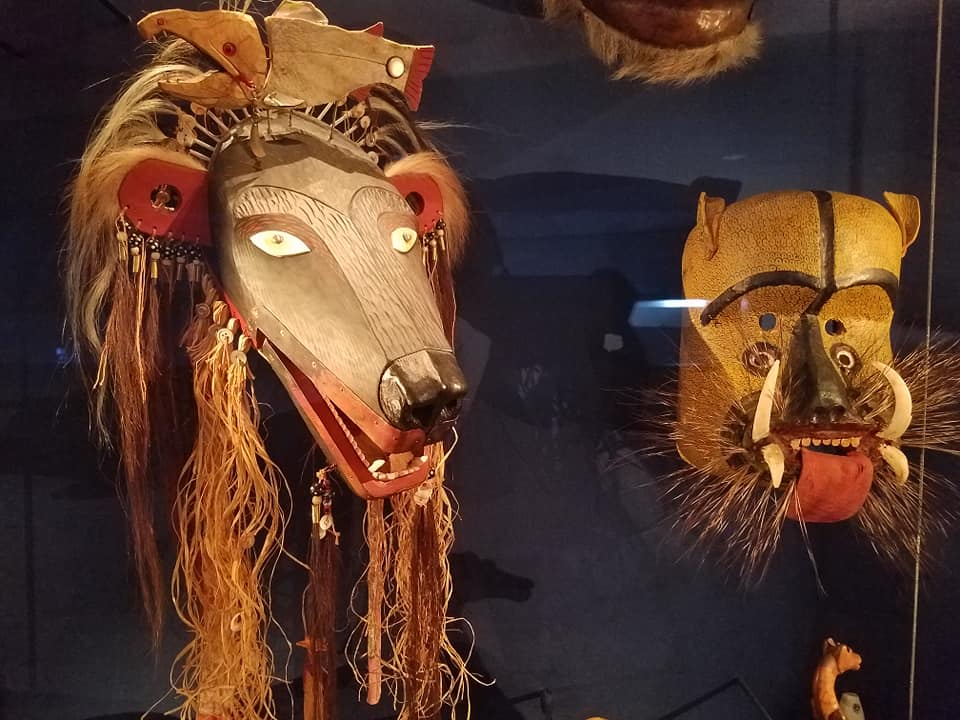
I also visited the Smithsonian National Museum of the American Indian. I wasn’t able to visit the café unfortunately, because it was closed by the time I arrived. However, I did have a couple hours to tour the museum, which was one of my favorites. I just love Native American history, and the museum had an excellent collection of artifacts. In addition, there is an excellent exhibit about the Incan empire that focuses on the roads the empire built. The gift shop also offered a number of excellent Christmas gifts.

Indian Masks.jpg
Native American Masks at the Smithsonian

I visited my last museum in D.C. only a couple hours before my flight left, and it was one of my favorites. The main Smithsonian Air and Space Museum is located in D.C. but the Udvar-Hazy museum at Dulles airport came highly recommended, so I picked that one instead and I have no regrets! I vaguely remember visiting the main museum as a youngster on family vacation. However, Udvar-Hazy has an amazing collection and it’s easy to view the whole collection in just a couple hours. I didn’t see every plane, but I walked through almost the entire collection in about two hours. The entire collection is housed in one huge hanger with an elevated walkway around the perimeter. Plus, it’s accessible from Dulles via a quick bus transfer, and I could roll my luggage around the entire place without being hassled.

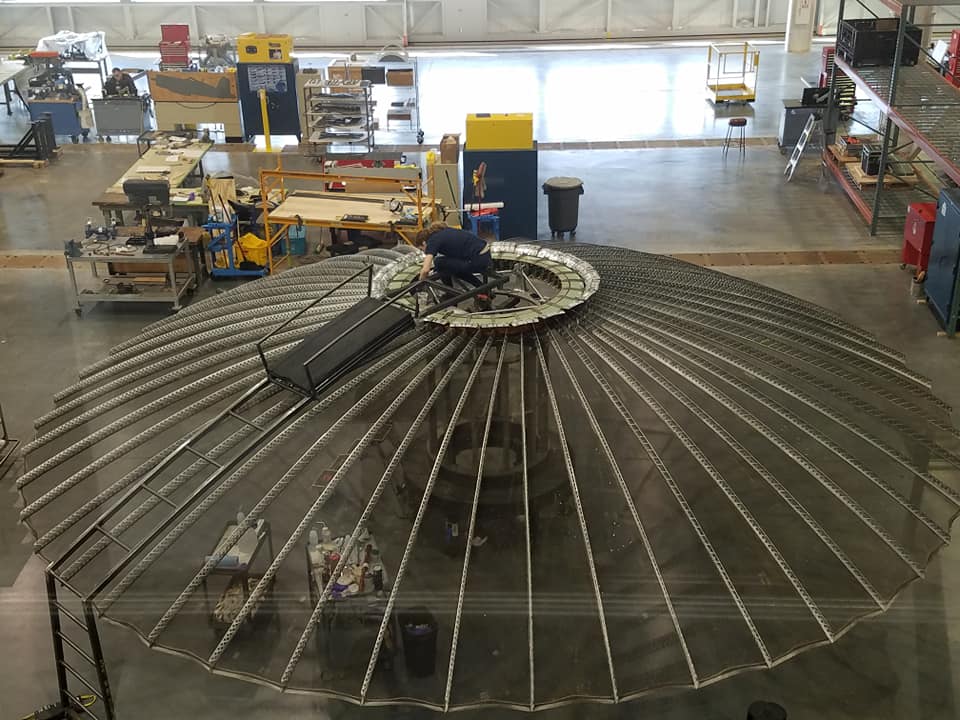
The museums houses an excellent collection – especially of rare experimental German planes from WWII. I have several scale models of these planes at home and it was an amazing experience to be only a few feet away from the real thing! But wait, there’s even more! The museum also includes a restoration wing where visitors can watch experts complete repairs and conservation work. The museum also houses an excellent collection of pre-WWI aircraft, which are only 30 years older than the German jets of WWII but look more like paper toys. The museum also includes a space exploration exhibit that includes the shuttle Discovery, which is also very impressive. It looks like I went to museum at the right time, because in a few short weeks the museum will close to begin a 7-year renovation project. The only disappoint was the gift shop, which didn’t offer any postcards of some of the iconic planes on display. I’ve been building a postcard collection from all my various trips and excursions, and I had hoped to add to my display!

Arrow
Do335 “Arrow” on display at Udvar-Hazy. A rare example of this experimental WWII front/rear twin-engine fighter.

hazy
Technician restoring a space antenna at Udvar-Hazy.

My coworker Chelsie suggested I also check out Du Pont Circle, and since I love to read I stopped in at Kramer’s Books where I purchased “How to Love” by Thich Nhat Hanh, a Buddhist monk. I had first become interested in Hanh’s books a few years ago, and it was felicitous coincidence I couldn’t resist!

Now finally, a quick round-up of my favorite spots to eat in D.C. Nando’s Peri-Peri came highly recommended and didn’t disappoint. I had an order of wings which were tender and moist, unlike most other wings I’ve ever had. I also had the Portuguese rice with turmeric and the mint peas on the side. The mint peas really stole the show – they were delicious and tasted more like they belonged in an Indian buffet. You can also order the Peri-Peri sauce on Amazon, which I’ll do shortly. I also had the nata custard tarts and pineapple carrot cake, which were both tasty.

Old Ebbitt Grill also came highly recommended and the crab cakes didn’t disappoint. As a recently self-declared desert connoisseur, the chocolate chip bread pudding was a little disappointing. I’ve had some really great bread pudding before and it was a little underwhelming. It was also an enormous amount of bread pudding. The music was exceptionally loud and the whole restaurant was crowded cheek to cheek on a Tuesday, but the staff were very helpful and efficient.

Last but not least, Le Diplomate where two out of the three dishes were amazing. I let the waiter guide my choices (except for dessert). I normally don’t pick cheese as an appetizer, but I decided to try something new and was not disappointed. The three cheeses were all very tasty and were accompanied by fruit, nuts and honey that were all excellent accents. The main course was not as amazing as everything else, but it wasn’t bad either. The waiter suggested the skate Grenobloise, and I assented in the spirit of experimentation. I’m not really a fish connoisseur and it was a fine meal – just not as amazing as everything else. My only real complaint was the loud music and the fact my humble attire meant I was relegated to the heated patio and not the main dining area with more ambience.

The finale was dessert (seeing a trend so far?) and the profiteroles came so highly recommended it was the main reason I went to Le Diplomate. Profiteroles are made from puff pastry buns with ice cream and bananas in the middle. The top layer also includes thin strip of chocolate. Over all of this, a cup of molten chocolate sauce is poured that forms a lake on the plate. It’s obscene – that’s the only way I could describe it.

Le fin.

Living on Borrowed Time

For the last year or so, my status had been pretty stable and positive. The drugs were working to keep the cancer at bay. Recently, the cancer began to grow again and my doctor switched me to the fourth generation medication. It’s supposed to be effective and the side effects have been modest so far.

However, the transition to a new medication was a wake-up call that I had become complacent again. Because I took my medication twice a day I could never forget I have cancer, but consistent waves of good news had made me forget how tenuous my position really is. In addition, a former coach at my gym died unexpectedly at the age of 26. Combined, these two events made me remember that I’m living on borrowed time. Really, I should have been dead at this point – the life expectancy of stage 4 lung cancer patients is not great.
For practical reasons (such as rent and health insurance), I can’t quit my job and travel the world. However, I can make it a priority to do the things I love that are within reach. I’ve already been doing a lot of that, such as volunteering and participating in the Alliance Francaise. But this just added a new urgency to it all.

I love teaching and for the past several years I’ve been teaching an online world history class. Someone else designed the course, so it doesn’t suit my teaching philosophy. Again, I got complacent and let the same lectures and assignments rollover each year. I made a few minor changes two years ago, but the course really needed to be completely redone. So, I’m finally going to make the class mine and teach it the way I think it should be taught. Hopefully, I’ll make it a better class as well.

Revamping the course rekindled my passion for teaching. I couldn’t stop thinking about the syllabus and jumped out of bed in the middle of the night (during my drug-induced insomnia) to jot down ideas. I expanded my syllabus while eating breakfast. I took joy in ordering books, taking notes and writing lectures. I think I’ve missed that academic stimulation since I quit working as an adjunct full-time.

I also started to come to terms with the fact I wasn’t a teacher full-time. I have a job that pays well, offers good benefits and lets me work with nice people. At the same, I get to teach the topics I want to teach and do it the way I want to do it, instead of teaching to the test and disciplining students.

Roleplaying games are my other recently renewed passion. I played a few different varieties before and after graduate school, but I haven’t played for at least two years. I decided to pick it up again after seeing some kids play at church. I found some acquaintances at church who wanted to play, but none were willing to organize a group or serve as the dungeon master (arbiter of rules and storyteller). I’m most familiar with Pathfinder (a variant of Dungeons and Dragons 3rd edition) and stepped up to lead even though I just wanted to be a player.

And I fell in love! I had been a (rather mediocre) game master before, because I tended to railroad the players into a specific storyline and was unwilling to improvise. Now, I’ve tried to be a little more flexible. Plus, I’ve really thrown myself into creating immersion. I found a great site that produces mood-setting ambient music and a great variety of faux-parchment printer paper that I use to create clues and maps. I’ve also found a few other trinkets to surprise and delight my players.

Usually, I’m a pretty even-keeled kind of guy, and I have been described (most infamously) as inscrutable. But during game nights I get into character when I take on the role of a frightened villager or surly guardsman. I’m still not great at improvising dialogue, but I try to have fun with it. One player described me as a “natural GM” which I never would have imagined a few weeks ago. I have fun because my players are enjoying the game.

Although the transition to a new medication was a little scary, it helped me reclaim what I really love to do.

Paris – 18 years and one cancer diagnosis later

Immediately after I was diagnosed with stage four lung cancer in December 2016, I vowed to fulfill my long-standing desire to return to Paris. More than 1 year later, I finally did it.

I first visited Paris as part of a school-sponsored tour in the summer of 2000. I always wanted to go back, but I put it off for one year, which became two, then three and eventually 18. This won’t be a simple diary but rather a commentary on my experiences in Paris. There were a lot of great moments that I don’t want to be overshadowed by my critical commentary, but I do hope it will inspire people to be more thoughtful while traveling.

On this blog, I’ve explained how and why I’ve become a Francophile. My desire to visit Paris went on the back-burner until I was diagnosed. Suddenly, time became precious and I wanted to make up for lost opportunities.

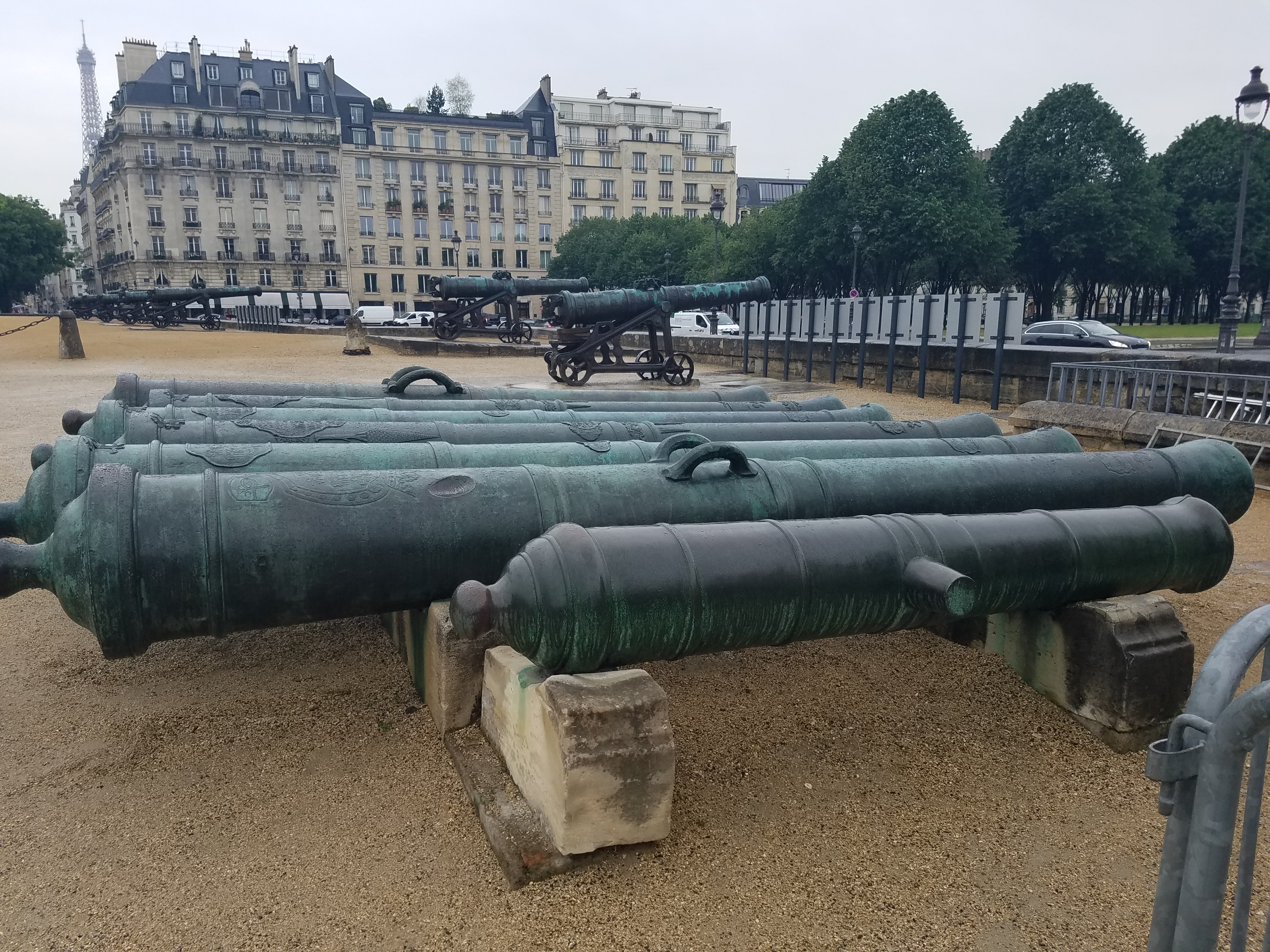
I went back to Paris in May 2018 with my mother, father and brother. I am lucky to have shared this experience with them and have their love and support throughout my illness. We visited a lot of the same places I saw in 2000, but it was better to have them along with me. I also visited a few new places, such as the military museum at Les Invalides and explored on my own.

20180514_112846
Artillery at Les Invalides.

There were lots of happy moments. One of my favorite memories will be rushing to see the Eiffel Tower on our last night in Paris – it was cool and rainy, but it was still a joyful experience. We all rode the carousel near the Eiffel tower. I was on a zebra that leapt through the air, and I got to be a kid again for a moment (video). I probably haven’t ridden a carousel in 20 years, but I almost started to cry because my emotions were so strong. I was almost overwhelmed by the love and gratitude I felt, but I also felt a deep sense of relief because I finally accomplished what I had delayed for so long. Without the epiphany caused by cancer, I may have kept prolonging this trip and other priorities indefinitely.

20180514_190541.jpg

I love French film and I had originally hoped to visit the massive Grand Rex theater , but I settled for something more intimate: the Filmotheque du Quartier Latin. We stayed in the Latin Quarter near the Sorbonne, which actually turned out to be home to a number of small independent theaters. The Filmotheque was literally right around the corner from our apartment and the walls were adorned with political graffiti. It happened to be showing the classic Cary Grant and Audrey Hepburn film “Charade,” with an excellent musical score by Henry Mancini. The Filmotheque only had two small theaters – each without about 50 seats. It was like sitting in someone’s private home theater. The rest of the family stayed in to rest, so it was my own private Parisian moment.

20180509_132550.jpg
Street art in Paris.

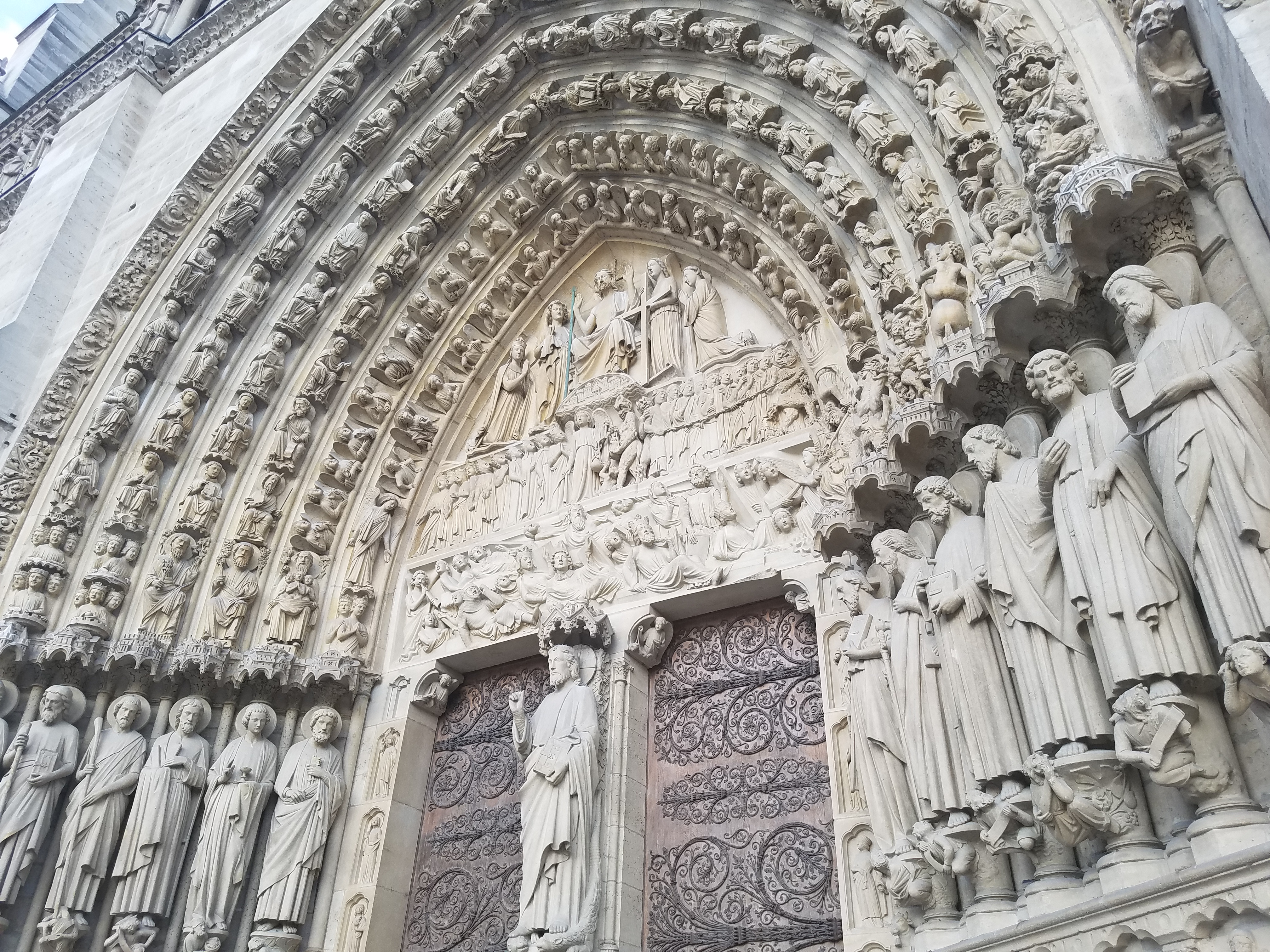
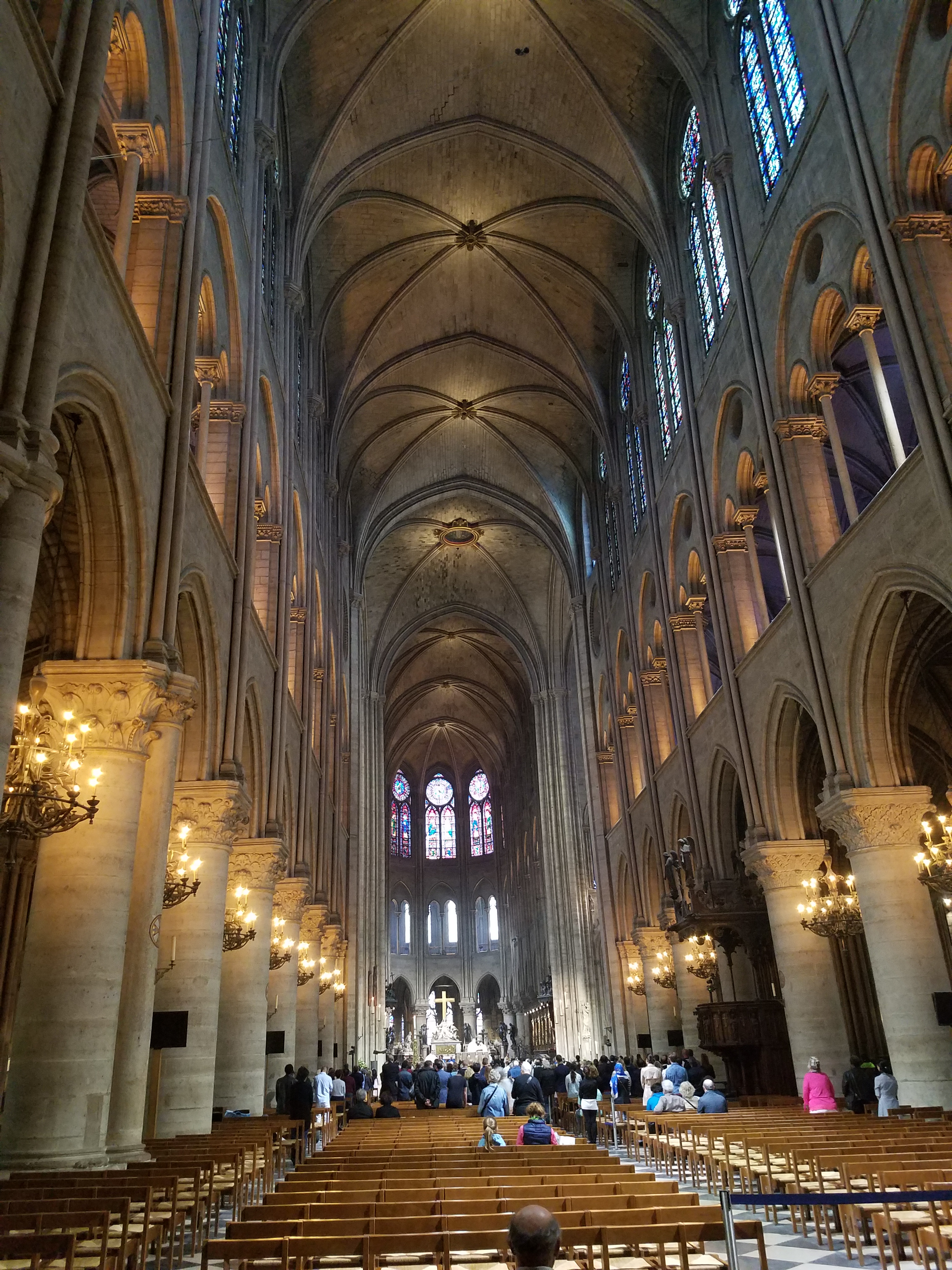
However, I kept my eyes open to the realities of Paris and its history as well. Notre Dame was one of the first places we went to. Built between the 12th and 14th centuries, it’s one of the best examples of a Gothic church. The western façade features three entrances which are richly decorated with images of saints and martyrs. Of course, Notre Dame is also famous for its magnificent stained glass. Inside, the high domed ceilings reach up more than 100 feet into the air. We toured Notre Dame during a Wednesday morning mass. The hymns, combined with the flickering votive candles, created a very peaceful and reflective atmosphere, which my mother found to be quite moving. However, I was quite ambivalent about it. I was certainly impressed by the amount of labor, time and money that went into creating such an impressive monument.

20180509_200142.jpg
Entrance to Notre Dame.

On the other hand, it struck me as rather misguided. I’m skeptical of organized religion in general, and the Catholic Church is no exception. For more than 200 years, skilled artisans and architects dedicated themselves to creating a monument to the glory of God and the Catholic Church. Much good has been done in the name of God, but much hatred, violence and oppression has been committed in his name as well. I appreciated the artistic value and the engineering accomplishments Notre Dame represented, but I couldn’t help feeling the effort was misguided at best. How much good could have been done in the world with the money and effort spent to create this awesome monument? And remember, it was only one of dozens of massive cathedrals throughout France. I’m not anti-Catholic, but I am critical of how resources spent by any religious organization to glorify God could be better used for that same goal by alleviating suffering here on Earth.

20180510_105430

This sense of inequality and injustice would be a recurring theme throughout my trip and my reflections. Don’t get me wrong, I was thrilled to have the chance to return to Paris, especially with my family. I’ll back again, and next time I’d love to get outside the city. Maybe someday I’ll even do the classic “romantic” escape to Paris. However, Paris is a real city – not just the stereotypical “City of Love.”

20180511_105100.jpg
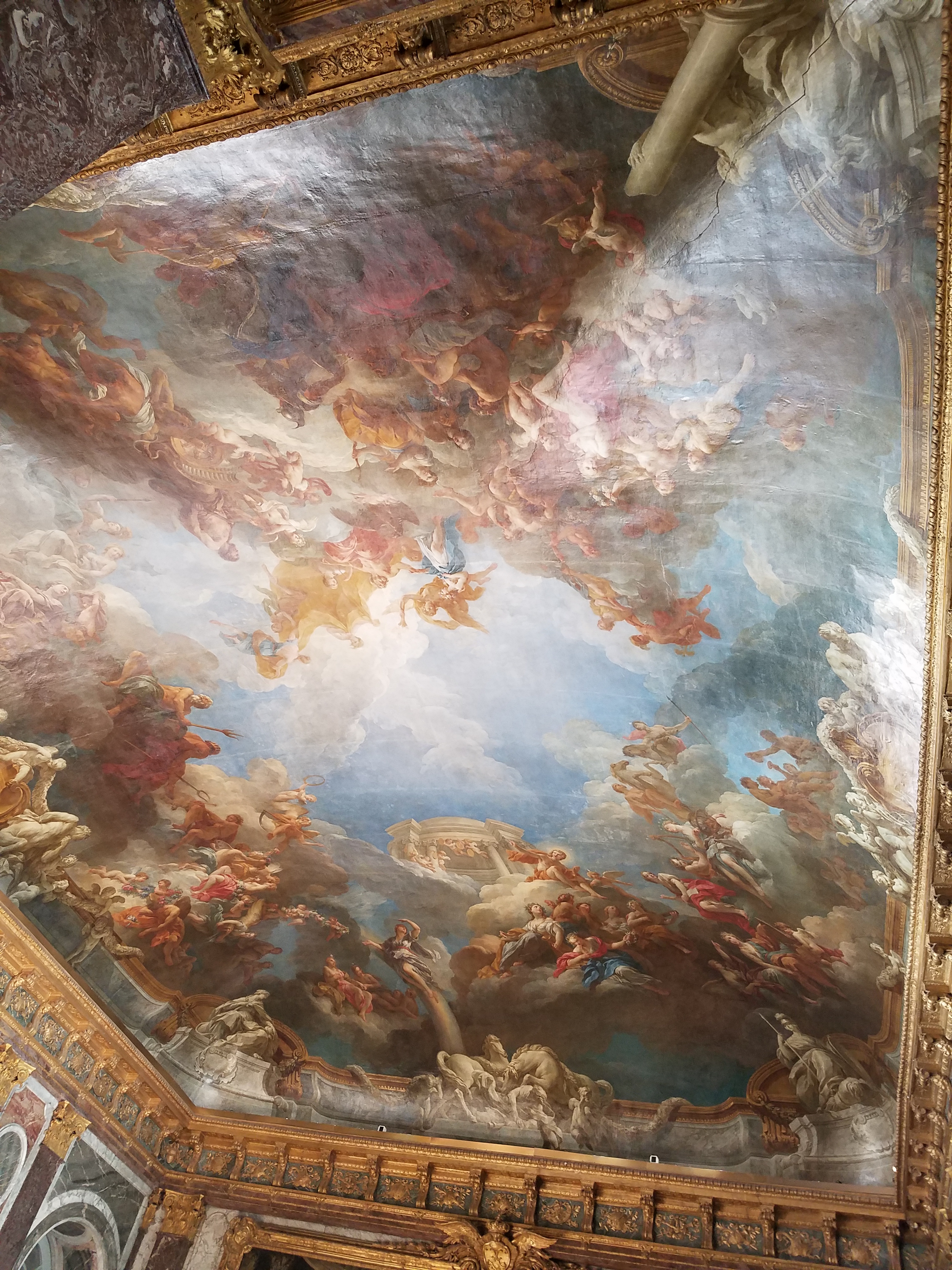
Ceiling tapestry in the “Hercules” room at Versailles – more than 5,000 sq. ft.

I had visited the Palace of Versailles 18 years ago, and I went back with my family earlier this year. Originally a royal hunting lodge, King Louis XIV made Versailles more than just a mansion in the 1600s. It became a byword for decadence, opulence and luxury. A single room in the palace represents a vast fortune of art, furniture and furnishings. The palace interior was overwhelmingly lavish and featured the largest ceiling canvas in Europe (more than 5,000 square feet). The palace in its entirety is incomprehensible.

20180511_125521.jpg

We did the main tour and then walked down to the Apollo fountain in the massive gardens. The gardens were a refreshing break from the crowds and the weather was perfect. I laid down in the grass near the Apollo fountain and took a brief snooze. Soothing classical music flowed through the air and dozens of ancient statues adorned the gardens. However, even after several hours we didn’t have time to visit the Trianon Palace, to which Louis XIV retreated when life at Versailles was too hectic.

Visiting Versailles made it obvious that revolution against the monarchy in France in 1789 was almost inevitable. Versailles represented a nearly incomprehensible amount of wealth, but it was only one of many royal estates the Bourbon dynasty owned. I cherished the opportunity to revisit Versailles, which is a UNESCO World Heritage site, but couldn’t ignore its historical context.

20180513_111532.jpg

The Louvre was a “new” destination for me. It was on our itinerary 18 years ago, but I missed it because I was lying on a bench ill and tired. I was excited about having the chance to return and see the impressive collection of Egyptian artifacts. We’d already visited the Musee d’Orsay so I had already seen enough European paintings. I’ve always had a passing interest in ancient Egyptian history and, as a child, once dreamed of becoming an archeologist like Indiana Jones (instead I chose the equally lucrative field of history). Again, after several hours we had only scratched the surface on the Egyptian collections at the Louvre, let alone the extensive exhibits of ancient sculptures, Islamic art and European paintings.

20180513_131150.jpg

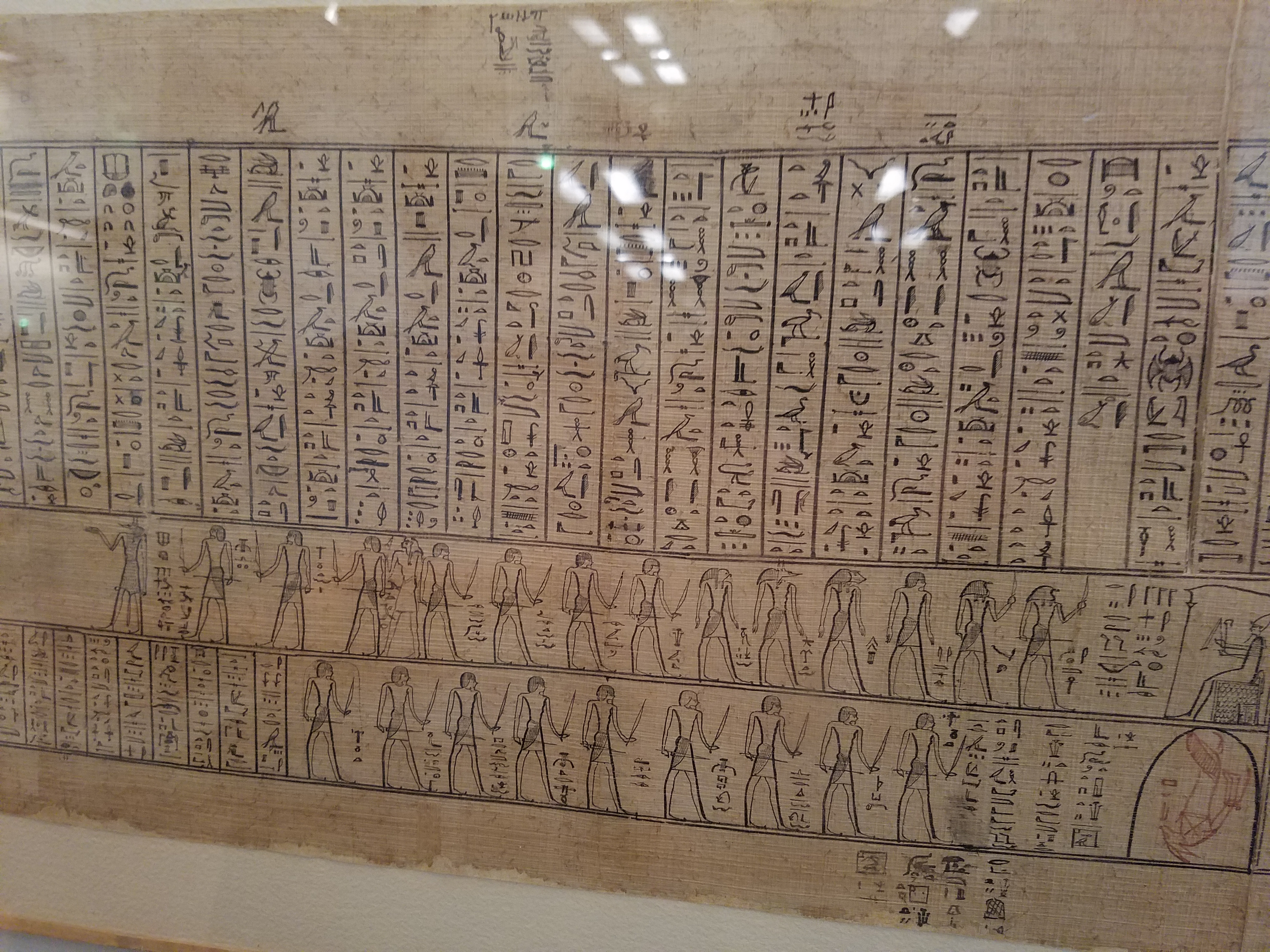
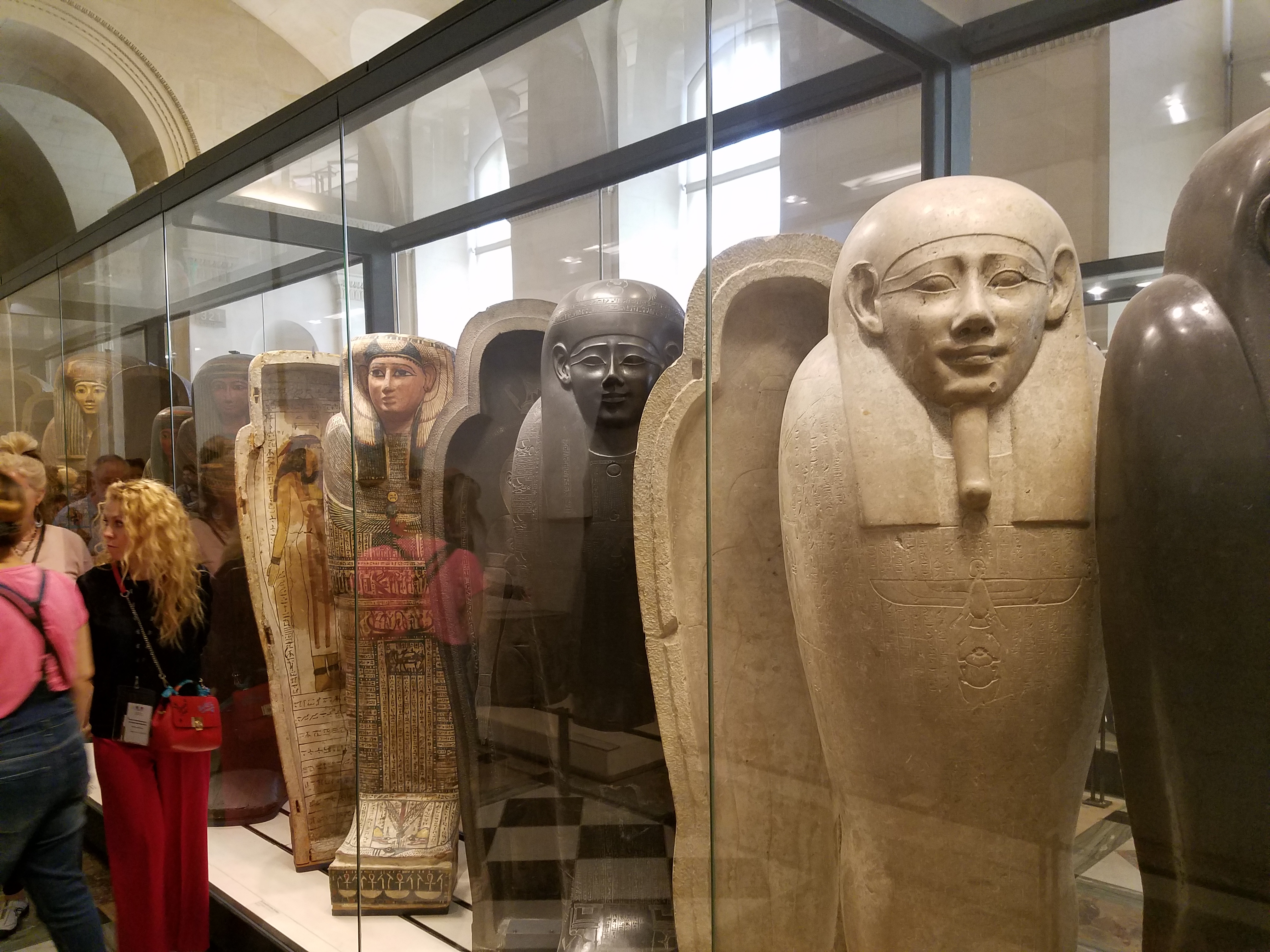
The vibrant colors of the Egyptian artifacts, especially blue pottery, really struck me. The wonderfully intricate hieroglyphics were also inspiring. Again, the sheer amount of material was overwhelming. There were entire rooms on display, as well as an entire exhibit hall filled with dozens of sarcophagi. I’ve never been to Egypt, and, although I’d like to go someday, I may never visit. So, it was rewarding to be able to see these artifacts while visiting France, but I couldn’t ignore the moral context of the exhibit.

20180513_134552.jpg

Egypt has demanded many institutions, including the Louvre, return artifacts that were taken sometimes illegally and sometimes only under a “legal” façade created by bribery and corruption. I think any institution with Egyptian artifacts should return them or sign an equitable agreement for retaining them on loan. It might be costly or embarrassing, but it’s the right thing to do. Cultural imperialism is still imperialism.

The stark reality of life in Paris also regularly intruded into the bright joy of our time in Paris. When arriving and departing from Charles de Gaulle airport, we traveled through the grimy working-class suburbs of Paris near the Stade de France. Gone were the pristine cafes of the Ile de la Cite – instead there were store fronts covered in graffiti. Every day we also encountered beggars, and this issue doesn’t get much attention. Back in the United States, I often wrestled with the quandary of whether I should give money to panhandlers. I prefer to give out bottled water to beggars back home, but that wasn’t an option in Paris.

Ultimately, I did give money to several Parisian panhandlers – especially those who had a pet dog and another who had a pet rabbit. But Paris is filled with people in need, even if more financial support and social services are available than in the United States. In addition, there are a lot of refugees in Paris and the rest of Europe. Again, my point is not to tarnish experience in Paris with negative memories but to embrace the city in its totality instead of immortalizing it as the romantic ideal. Similarly, I cherish both the good memories from New Orleans as well as remembering the glimpses of inequality. To ignore it would be a disservice to the real people of Pairs. Just because you’re on vacation doesn’t mean you leave your compassion at home.

I’ll carry my love for Pairs home with me when I watch classic French cinema, read bande dessinee and participate in French discussion circles. But I’ll also remember that Paris is vibrant and complex city – not just a cliched postcard.

Cancer, Obamacare and the “Gig” Economy

NPR recently did a series of articles on the contracting/freelancing economy. This resonated with me, because, until recently, I relied on the “gig” economy to survive. After I graduated from UK with my master’s degree in 2014, I worked a number of temporary jobs. I taught a wide variety of college history courses on an “as needed” basis. The pay was low and I usually only taught at any one college for one or two semesters before I had to move on to the next position. I also wrote freelance magazine and newspaper articles. I enjoyed it, but the pay was irregular and low, even by industry standards. I also worked as a substitute teacher – another poorly paid, unreliable, and stressful job. On top of this, I didn’t receive any benefits from these myriad jobs. The only reason I was able to make ends meet was that I was living at home for most of the last four years. I couldn’t make enough money on a steady basis to afford living on my own.

Then I got sick. I was extremely fortunate that I was able to live at home and didn’t have a family for whom I had to provide. I didn’t have to try and make ends meet with irregular low-paying work while I was going through treatment. It would have been nearly impossible, since I couldn’t speak for about two months (a major problem for a teacher and journalist), and then my voice was very weak for at least another month after that. Plus, I was a huge jerk while I was on steroids.

Medicaid was the biggest benefit I received. It paid for the first nine months of my treatment, and, without it, my meager savings would have evaporated instantly. I was spared the added stress of dealing with mounting medical bills on top of everything else.

If I hadn’t had insurance, my whole upper-middle class family might have been financially ruined through no fault of their own. I had three surgeries in a single six-week period, and each cost several thousand dollars apiece. The CT scans were more than $1,000 each (I had four last year alone). The MRI scans cost thousands as well, and I had four of those too.

The biggest expense would have been my medication, which costs about as much as a house every year. Medicaid covered it all. So, my advice to anyone who gets sick is to first be very poor and qualify for Medicaid. It’s great that we have at least some basic safety net for people who are poor, but many people don’t qualify for Medicaid but can’t afford decent insurance either. My whole recovery would have been so much more difficult if I had to worry about skyrocketing medical bills and trying to take care of a family at the same time.

Eventually, once I got back on my feet, my income rose, and I lost my Medicaid coverage. I couldn’t find a permanent job with good benefits right away, so I relied on more temporary work and insurance from the Obamacare marketplace. This time, the work was steady, reliable, and well paid. It was project-based, so my job was relatively secure for the duration of the assignment. The pay was also about twice my highest previous salary. However, I didn’t have any PTO, insurance, or retirement benefits.

The Obamacare insurance was a good temporary solution, but it wasn’t a permanent fix. I still qualified for a subsidy, which reduced the monthly premium from about $300 to a more affordable $200. The benefits were pretty good – the deductible was a $1,000 and I met it almost instantly. However, at the end of 2017, the plan changed. The premiums went up to almost $500 (about $250 after my subsidy) and the deductible rose to $1,500. The out-of-pocket limit also increased, copays went up, etc. The insurance wasn’t as great as it had been, but it was still better than nothing.

However, the insurance didn’t cover my medication. Luckily, the manufacturer has a program that will help patients get access to their medication if they can’t afford it. For me, my income was still low enough that the foundation covered 100 percent of the cost. That generous assistance may eventually expire, but the foundation also offers co-pay assistance on a sliding scale. I’m lucky that the manufacturer put lives ahead of profits, but not all of them do.

So, a whole network of programs exists to help people who are very sick, including Medicaid, Obamacare, and private assistance programs. However, Trump has severely undermined Obamacare since he took office. He eliminated subsidies and the big tax cut also killed the individual mandate to buy insurance. Trump has authorized the sale of cut-rate plans and cut funding for the 2018 open enrollment period. Despite these setbacks, almost 9 million people signed up for Obamacare in the 2018 open enrollment period, exceeding expectations. Obviously, there is still a need and a desire for Obamacare. It’s not perfect but introducing instability and uncertainty hasn’t helped.

Recently, I found the Holy Grail of health insurance – the employer sponsored plan. I was hired for a permanent position by the same company with which I had been consulting. They offer a 401k, PTO, and several different health insurance options. Obviously, I picked the most comprehensive plan. The premiums are affordable, with a low deductible and reasonable copays. However, it still doesn’t cover my medication, and I rely on the corporate foundation to fill my prescription every month. Countless Americans are not so fortunate. Millions now rely on the gig economy and will face undue hardship if they ever get sick or hurt.

We should do everything we can to ensure that every person can get the healthcare they need. It’s a right, not a privilege. I can’t imagine how difficult it would have been trying to get through my treatment while also facing financial ruin. Illness, injury, or another disaster could strike any one of us (rick, poor, black, or white) at any time. It is basic compassion to ensure your neighbors of all classes and races have basic comfort and security. If the “gig” economy is here to stay, then we need a new sustainable system that offers health insurance, retirement, and other benefits. There are some models already, such as the Freelancer’s Union, which offers benefits; however, more should be done to ensure that nobody falls through the cracks. At the very least, professional programs, like the Freelancer’s Union, need to be improved and expanded. Adjunct professors are particularly vulnerable, although the Faculty Forward movement is trying to make improvements. New state and federal laws could also improve working conditions. I’ve been very fortunate, and I want to ensure all Americans have the assistance they need when facing major medical crises.

One Year Living with Cancer

I think this comic accurately sums up my attitude to 2018. 2016 was an unhappy year that ended with my diagnosis with stage four lung cancer. The tumor paralyzed my vocal cords, and I could only speak in a hoarse whisper. I was frustrated because I lost a good job and a nice apartment. Suddenly, I wasn’t allowed to drive myself because of the brain tumors. I wanted to get my life back together as quickly as possible, and, one year later, I’m on the cusp of achieving that. However, it’s been a long road and the future remains uncertain.

2017 was also a traumatic year. The steroids drove me crazy and kept me from sleeping for weeks on end. Surgery restored my voice to about 90 percent of what it was before I was diagnosed. My treatment also proved to be effective. I also fulfilled a long-time desire to visit New Orleans, and I had a great time with my uncle and dad. Friends and family have been invaluable this last year.

Eventually, I started to work again and even fell in love with Jessie. But, it wasn’t too long before I was reminded that disaster can strike at any time. If any health crisis was going to happen soon, I assumed it would happen to me. However, Jessie suddenly was diagnosed with ovarian cancer and immediately went through some very serious surgery. It was terrifying, but I gave her all the love and support I could.

Despite that, she decided to end our relationship and focus on her treatment. It was heartbreaking, but I couldn’t blame her. She seems to be doing well, which is a relief. She is a kind and generous person who certainly doesn’t deserve this (not that anybody really does).

I’ve been picking up the pieces of my life these last few months. I found a temporary job and will be hired on a permanent basis later this month. I’m planning to finally move out, and I will fulfill another big dream that I’ve been putting off. For the last 18 years, I’ve been talking about going back to France, but this spring I’ll actually do it.

I recently had my annual checkup and the scans show my brain tumors are gone. The chest scans are also largely unchanged, and my liver function remains normal. The doctors say things are stable for now, but the long-term picture remains unclear. The disease could mutate and become resistant to the drugs I’m taking. If that happens, there are other treatments available. Still, uncertainly looms.

The last two years have been very challenging, but I’m on the verge of finally regaining my independence. Despite the good news, I can’t get overly complacent or optimistic. Aside from my disease, the mundane tragedies of life, such as a car accident, could strike me or someone I love at any moment. Even worse, Trump could start a war and get us all killed. So, 2018 looks like it’s going to be a good year, but nobody can predict the future. Thus, I’ll keep my guard up.