Monday July 14
After a whirlwind tour of London, we prepared to cross under the English Channel on our way to Paris. Paris is one of my favorite cities, and I have been extremely fortunate to visit it previously; however, this was Nataliya’s first time, so we tried to accommodate her wish list!
Unfortunately, I had developed a nasty eye infection during the last few days in London, so I quickly tried to find a clinic or doctor who could prescribe something before we left for Paris. Like America, the emergency room was full and had a huge waiting list. Fortunately, pharmacists can prescribe medication to treat minor illnesses in Britain, such as my eye infection! In just a few minutes and for approximately $15, I was on my way in time to arrive at the magnificent St. Pancras station which was built in 1868 and is located underneath the beautiful St. Pancras Autograph Collection hotel.
The Eurostar train has its own waiting area, which was standing room only by the time we arrived, so you definitely need to buy your tickets in advance! Two round-trip tickets cost us about $450. The trip was very smooth and convenient. We also watched the picturesque French countryside zip by as we passed by Caen and Lille (cities we would love to return and visit in their own right in the future).
However, I was a little anxious about our arrival because July 14th is Bastille Day (la fête nationale) in France. The holiday commemorates the storming of the Bastille, an infamous prison during the monarchy, which was an early event during the French Revolution in 1789. Celebrations include a military parade and fireworks, as well as street parties organized by local fire departments (known as Bals des Pompiers). I was concerned Paris would be gridlocked with traffic and celebrations, however, most of the street parties are scheduled a day or two before July 14.
We arrived at Gare du Nord and managed to make our way to our apartment immediately adjacent to the former location of the famous Les Halles market. Les Halles was one of the most important fresh food markets in Paris from the 12th century until it was demolished in 1973. The demolition was extremely unpopular with most Parisians and tourists, and a modern shopping center replaced it. This in turn was demolished in 2010 and rebuilt underground. The Chatelet-Les Halles metro station is also very close as is the Louvre and the Centre Pompidou (which closed shortly after we left and is undergoing major renovations until 2030). I was also concerned that the bustling market might be too loud at night even after shops closed, but again my concerns were unwarranted!
We grabbed a few groceries at Monoprix but were slightly confused at the self-checkout lane. It turns out we had to weigh our fresh fruits and vegetables separately before trying to checkout.
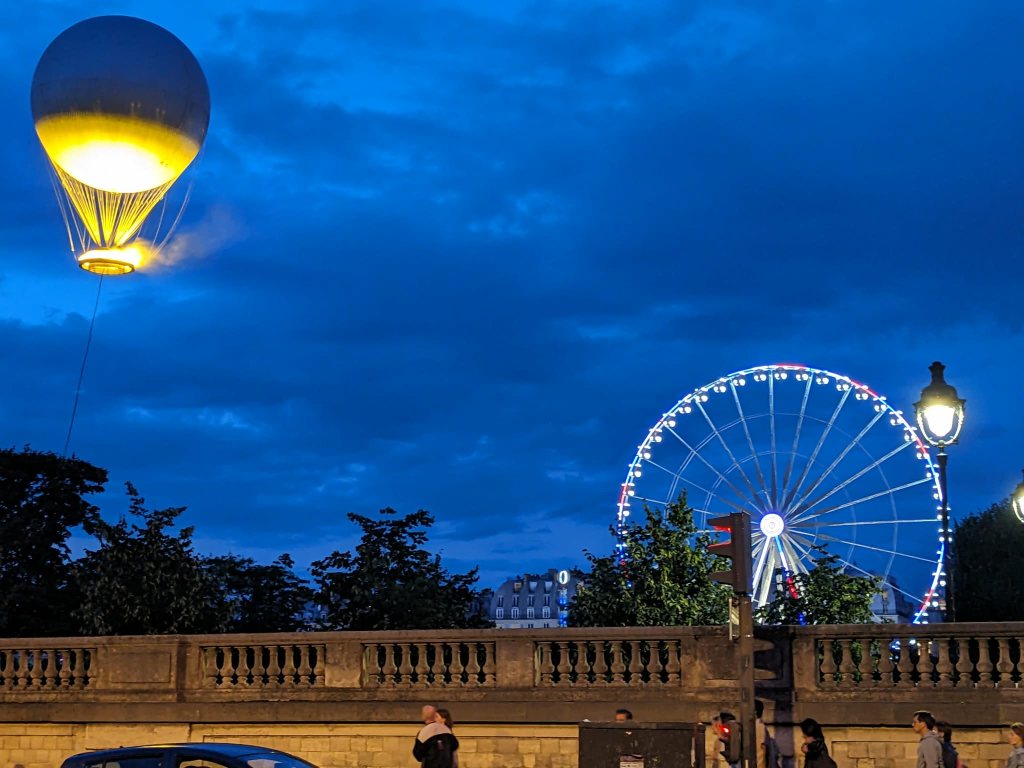
After a quick dinner, we hit the streets to try and find a spot where we could see the fireworks along the River Seine. If you can arrange it, watching from a terrace or rooftop is obviously the best vantage point; however, the Right Bank of the Seine (opposite the Eiffel Tower) offers a relatively unobstructed view as well. By the time we arrived, most of the prime spots along the river were packed with crowds. We did manage to snag a street corner in front of the Louvre that had a good view. The fireworks also included drone light displays which were pretty impressive! It was a remarkable way to start the next leg of our whirlwind tour!
Tuesday July 15
For our first full day in Paris, we visited the Picasso National Museum which was also just a short walk away from our apartment. The museum is open seven days a week from 9:30 am to 6 pm. Tickets are about $20.
Picasso settled in Paris in 1904 and lived there until he moved to southern France in 1946. The museum displays nearly 300 of Picasso’s paintings, as well as 300 sculptures, and approximately 2,000 drawings and illustrations. Some of his most iconic works include a self-portrait in 1901 during his “Blue Period” and a portrait of his mistress Dora Maar from 1937 during his Cubist phase. I’m not a huge fan of modern or post-modernist art and prefer more traditional styles. However, Nataliya studied studio art in college and felt like the ambiance of the museum brought out the best of the collection. I would suggest allocating two hours to tour the museum – it’s not huge.
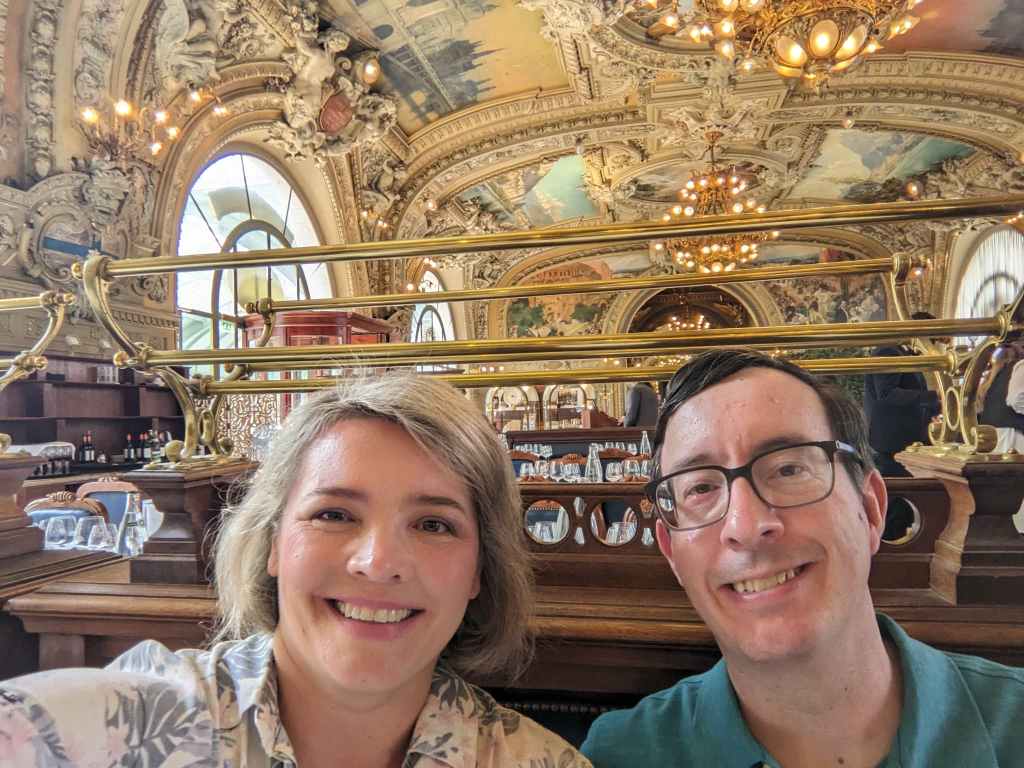
Before dashing off to the next attraction, we stopped for a quick lunch at Le Train Bleu – a famous restaurant in the Gare de Lyon train station. Le Train Bleu began as the station’s buffet to serve visitors for the Universal Exposition of 1901. It was renamed in 1963 for the iconic overnight train that connected Paris to Cote d’Azur / French Riviera along the Mediterranean. The grand crystal chandeliers, polished parquet floors, wall frescoes, and gilding transport diners back to the Belle Epoque of the late 1800s and early 1900s. The frescoes highlight the leisure of visiting southern France and its colonies in North Africa.
The menu focuses on classical French recipes (such as a leg of lamb) with seasonal ingredients which all make the restaurant a hotspot for Instagram influencers. Several multi-course set menus are also available ranging from $90-$140. We opted for several a la carte selections including a salad with dried apricots, vegetable tart, fish, and foie gras. Since Le Train Bleu is so popular on Instagram, reservations are limited to one hour and are strictly enforced by the staff. Nevertheless, we highly recommend Le Train Bleu for a mouth-watering meal in a beautiful environment! We had lunch on a Tuesday, and it was still very busy so I would avoid trying to get a table during prime time. We were VERY lucky to get a table without a reservation even on a Tuesday.
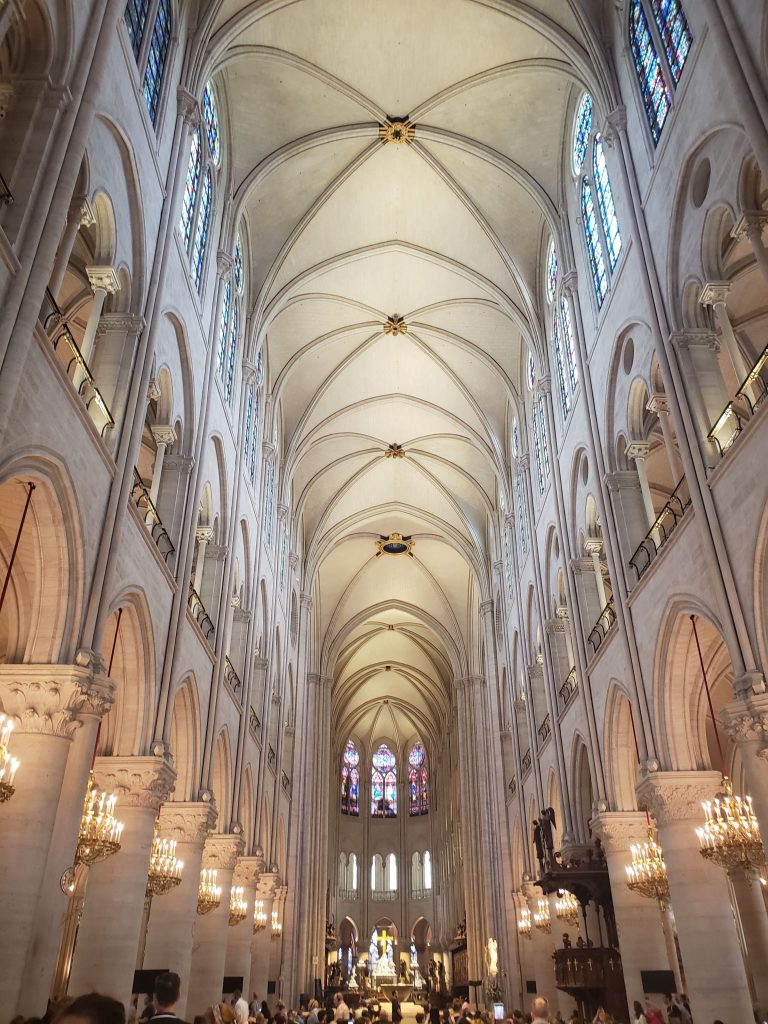
After pausing to digest, we sped off to Notre Dame which had only recently reopened after the devastating fire of 2019. I was astounded by the speed and quality of the restoration. Since tickets are free, we had a difficult time trying to schedule a reservation since slots are only available shortly before the allotted time (making it impossible to schedule in advance). Ushers were also turning away visitors who were dressed immodestly, so you should also take that into consideration, especially during the summer!
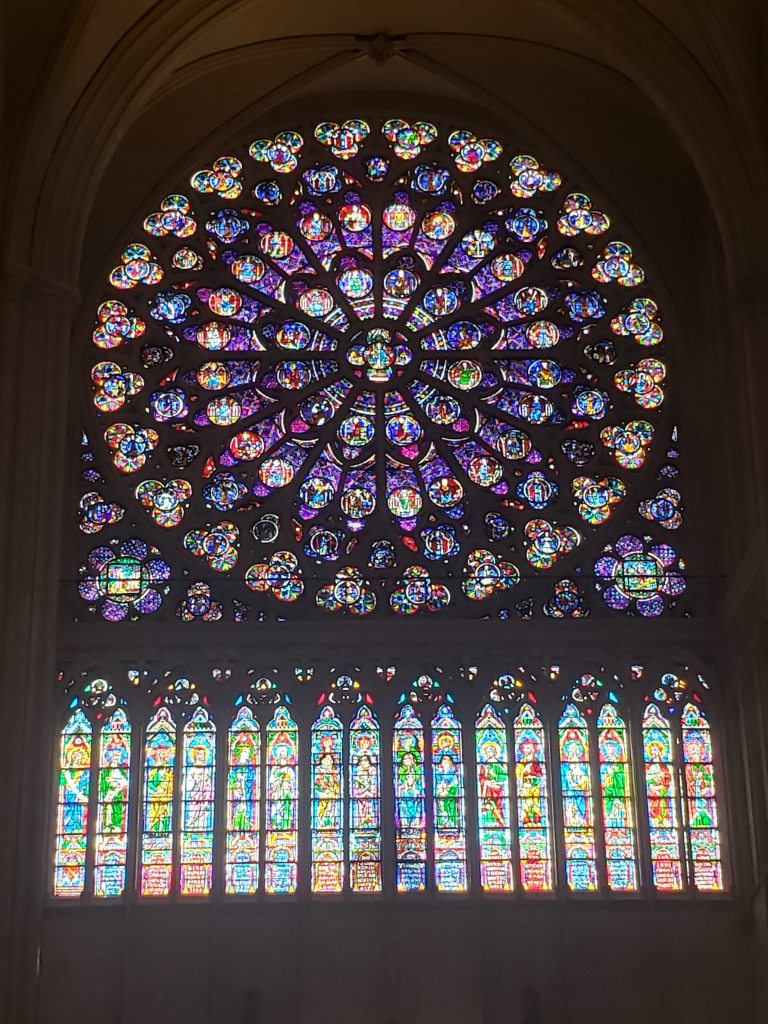
Built during the 12th and 13th centuries, Notre Dame survived the German occupation of World War II largely unscathed. However, a devastating fire in 2019 destroyed the spire and the timber beams. Incredibly, the façade, walls and buttresses were intact. Almost immediately after the fire, the French government made plans to restore Notre Dame, but I never expected it to be so successful and so quick! Notre Dame is still awe-inspiring although the interior is much more pristine since the restoration included cleaning the interior stone and spraying it with a latex solution. The cleaning has been controversial, as was the addition of a series of new modern stained-glass windows even though the original panes had not been damaged by the fire!
Maintaining our Too Fast Too Furious pace, we squeezed one more destination in the afternoon which I had never been to either – Chateau de Vincennes. The castle is easily accessible from the Metro station of the same name and tickets are inexpensive ($15).
Since the chateau is located on the very edge of Paris, it is far less crowded than the more centrally located destinations. Originally built as a royal hunting lodge in the 12th century, Chateau de Vincennes was fortified with defensive walls and towers during the 14th century. It also served as a royal residence and dungeon which housed the infamous Marquis de Sade during the 18th century. It also houses a chapel inspired by the iconic Saint Chapelle on the ile de cite and is also named after it. Both chapels are quite beautiful. The chateau is also adjacent to the Bois de Vincennes which is the largest park in Paris and covers more than 2,400 acres. The park was originally a royal hunting preserve, and, although we didn’t have time to stroll through it on this trip, I would love to visit it on a return trip.
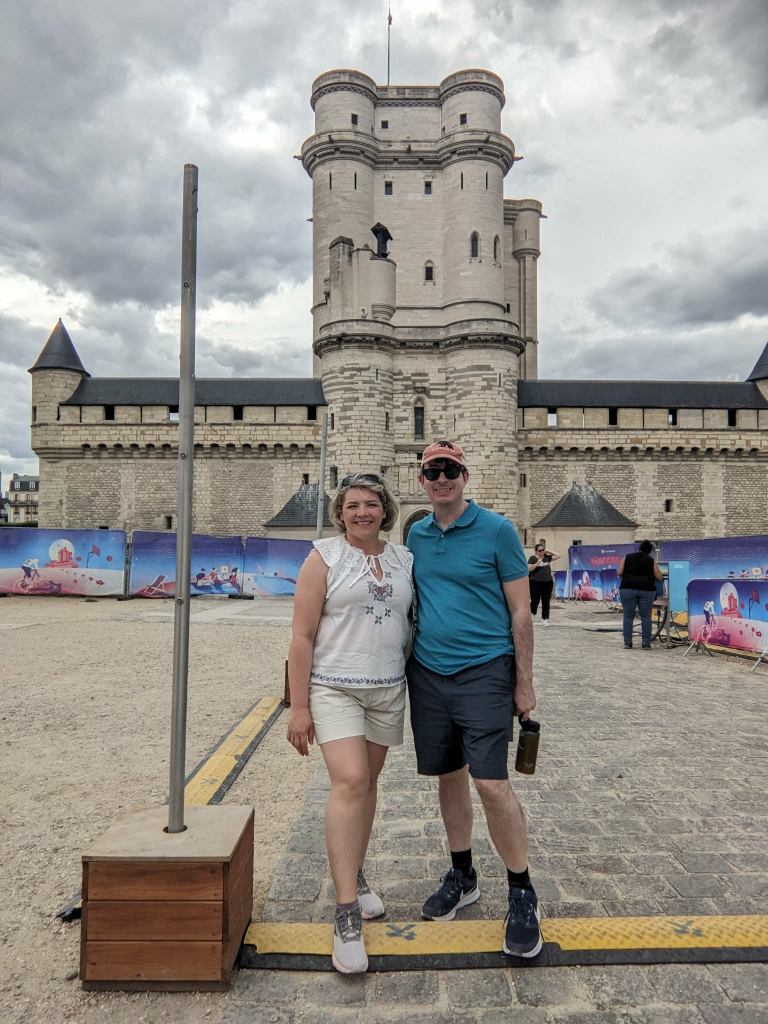
The castle is impressive from the first moment as you approach the outer walls and moat. We entered through the main gate and walked past a number of stalls offering arts and crafts for sale as part of a summer festival. We visited the Saint Chapelle Chapel first, which was almost completely empty. It features beautiful stained-glass windows, unfortunately, the original glass was destroyed during the Revolution of 1789-1792.
Next, we headed to the original fortress which housed the king’s apartments, as well as a prison and arsenal. The inner keep was surrounded by another set of walls. However, I wasn’t able to explore the upper levels of the tower because of my fear of heights. The main entrance to the tower is a bridge suspended about thirty feet above the ground with no supports underneath. It made me too anxious, so I stayed on the ground floor while Nataliya explored the upper levels. The staircase is a narrow one-way ascent. Nataliya was skeptical at first because of the hodge-podge collection of architectural styles, but she liked it the best before we left! She said the castle exudes history and medieval atmosphere. She describes it as light and elevated as opposed to her expectations of a dark and gloomy medieval castle. Nataliya was thrilled to see it in person since she remembers studying it in art school.
Visitors can also reserve tickets for special tours that explore the attic and upper terrace (approximately $18 additional fee). The castle’s website claims it offers a wonderful panoramic view of Paris since it’s the tallest dungeon in Europe at 165 feet high. Check it out – if you dare!
Wednesday July 16
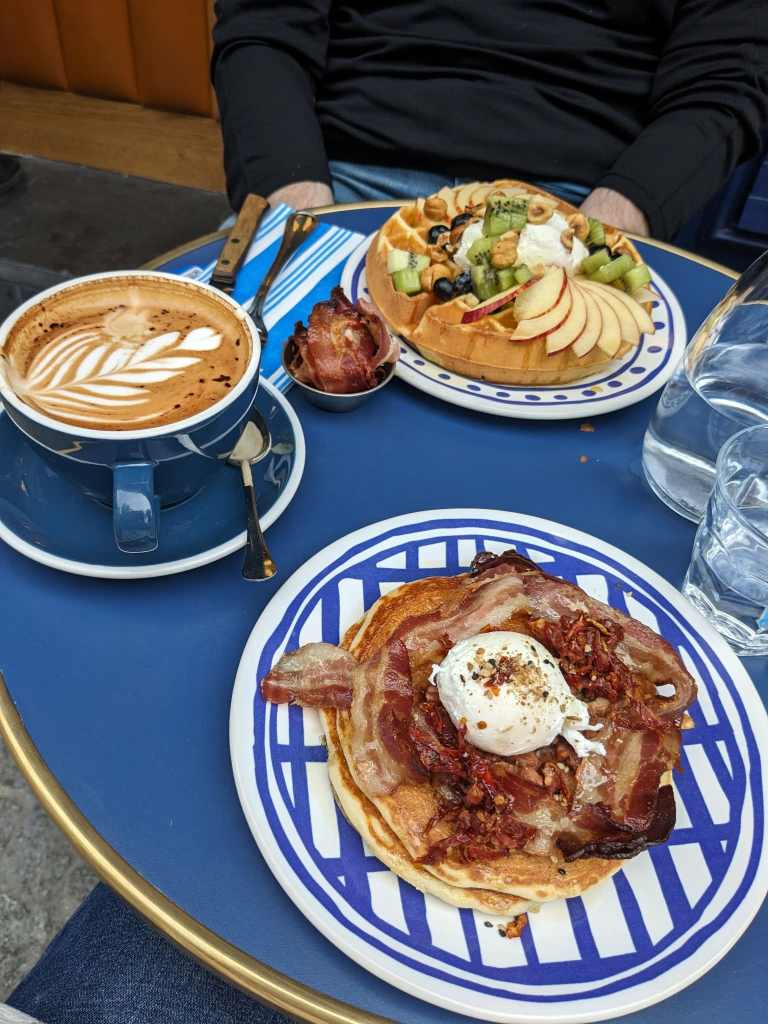
We started today off slowly with a relaxed American-style brunch at Kozy café. The menu offers a variety of pancakes and waffles that appeal to the tastes of American tourists with huge portions and excessive amounts of sweet toppings. We probably could have shared one dish and maybe an a la carte item but instead ordered two dishes – pancakes with bacon and waffles with fruit. The pancakes (approximately $16) also included candied bacon, a poached egg, sun dried tomatoes, maple syrup and dukkah (a Middle Eastern spice blend). The waffles (approximately $15) came with crispy apple slices, kiwi, toasted hazelnuts, real whipped cream, and maple syrup.
After a long pause to digest, we visited another museum that I had never been to before – the Museum of Decorative Arts. The museum exhibits a wide variety of decorative objects including furniture, fashionable clothes, and graphic art. The general exhibits are free, but the temporary exhibits required a timed reservation (approximately $16). We toured the special exhibit on Paul Poiret, a fashion designer and parfumier.
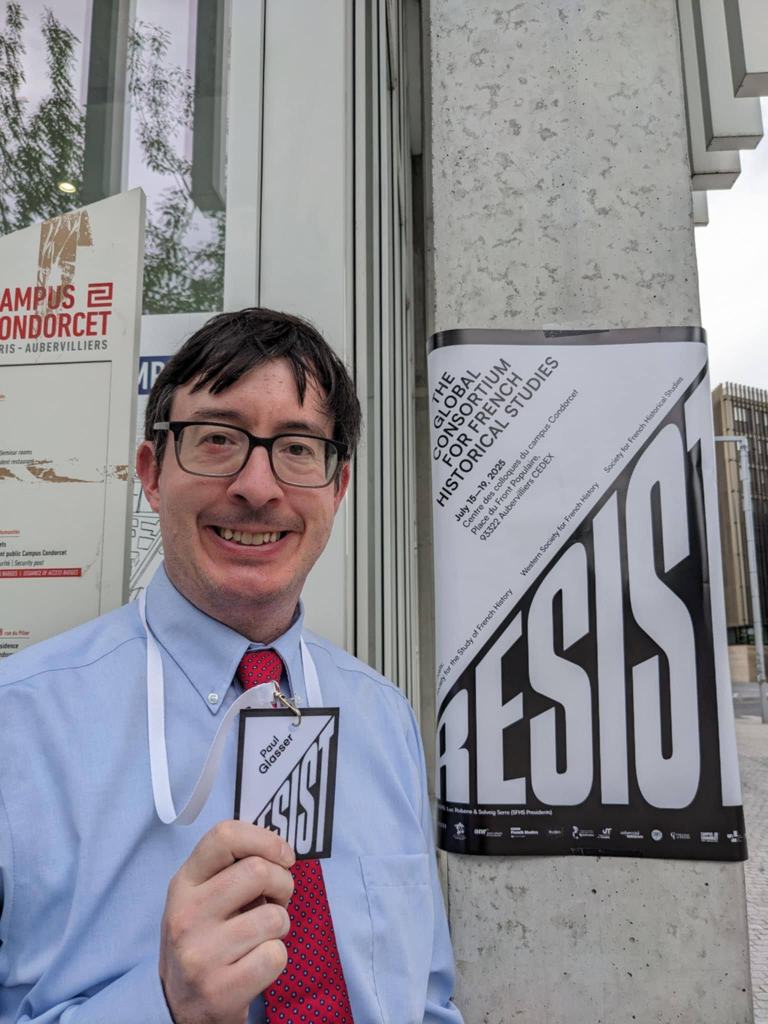
In the afternoon, I made a long-overdue return to academia by presenting at the 2025 Global Consortium for French Historical Studies conference. I studied French cultural history for my master’s degree from 2011-2014 at the University of Kentucky and wrote my capstone paper on the memoirs of the French resistance during World War II. The theme for the conference was resistance (of any type, not just during World War II) so I felt destined to attend – the conference was the original impetus for the whole trip! For the last several years, I have been revising portions of the master’s research to try and publish it in a scholarly journal, so the conference was the perfect place to get some feedback on my ideas. I was a little anxious since I haven’t presented or published in a decade, but I managed to cut my presentation down to 20 minutes. I practiced reading through it several times which ensured that everything went smoothly at the conference. Nataliya also attended and was very supportive – it was one of my proudest moments recently (besides proposing to Nataliya)! I received some valuable feedback from the participants and have submitted my first article to a journal. While waiting for a response, I’ve already started on my next article!
Thursday July 17
While the conference was a success, the next day started out with a string of setbacks! Our first destination was the magnificent palace of Versailles; however, the most convenient train station was closed so we had to use another station. It wasn’t much further away but numerous problems beset us along the way. When we arrived, it had started to rain, but neither of us had a raincoat or umbrella (despite only a 10% chance according to the weather app)! We tried to find a store that sold one, but we were already drenched by the time we found one at a pharmacy. Then, I left my phone at the cash register when we left! Thankfully I noticed almost immediately, and nobody had stolen it by the time I arrived back at the store. My GPS was very unreliable, so we wandered around Versailles trying to find a café ro re-energize. We stumbled upon the Stray Bean which provided some respite and refreshment. We were already very frustrated and tired before we even arrived at the palace! I felt like this was going to ruin the whole day and maybe even spoil the remainder of the trip, but thankfully it didn’t!
However, the trials weren’t over because I wasn’t able to retrieve our tickets on my phone to my IMMENSE frustration! Apparently, this is a very common problem amongst visitors, since the ticket office was able to retrieve the tickets in their system – a valuable tip if it happens to you! I also learned the important lesson of downloading all the tickets on to my phone for the day before leaving the reliable Wi-Fi at our apartment!
We used the Paris Museum Pass for discounted entry to several museums in a four-day period (approximately $120), including the Versailles palace. However, the gardens and Trianon estate require separate tickets. Because each museum has its own ticketing system, it can be very challenging to keep track of all your login credentials!
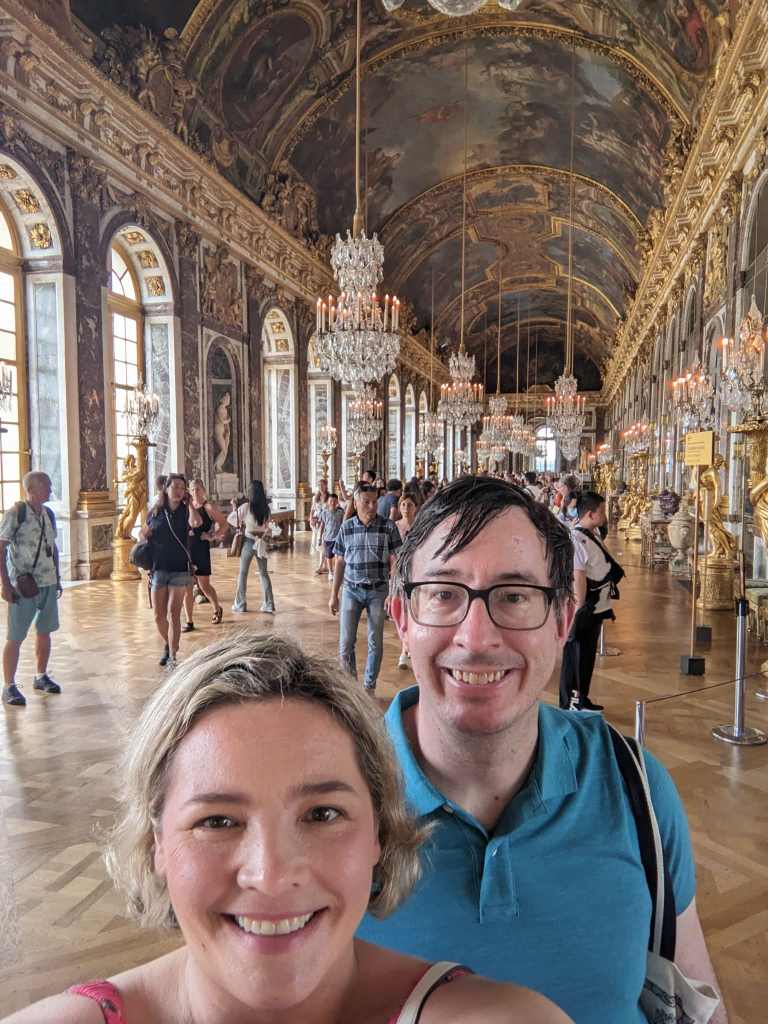
I have been lucky enough to visit Versailles and the gardens before, and the palace was as crowded and beautiful as I remember. However, there seemed to be fewer docents than previously so there wasn’t anyone to stop visitors from touching statues or other artifacts. Nataliya felt the palace was somewhat of a letdown and was not as impressive as Catherine the Great’s palace near St. Petersburg (which she had visited as a student). However, Versailles had been mostly abandoned during the French Revolution of 1789-92 and may treasures were looted or confiscated by the revolutionary government. The most iconic room, the Hall of Mirrors, is magnificent but also jam-packed with visitors. Built in the 17th century, the hall contains 357 mirrors as well as 30 paintings on the ceiling. The hall was the site of the Proclamation of the German Empire after the disastrous French defeat in the Franco-Prussian War of 1870, as well as the Treaty of Versailles which ended World War I which reversed the power dynamics.
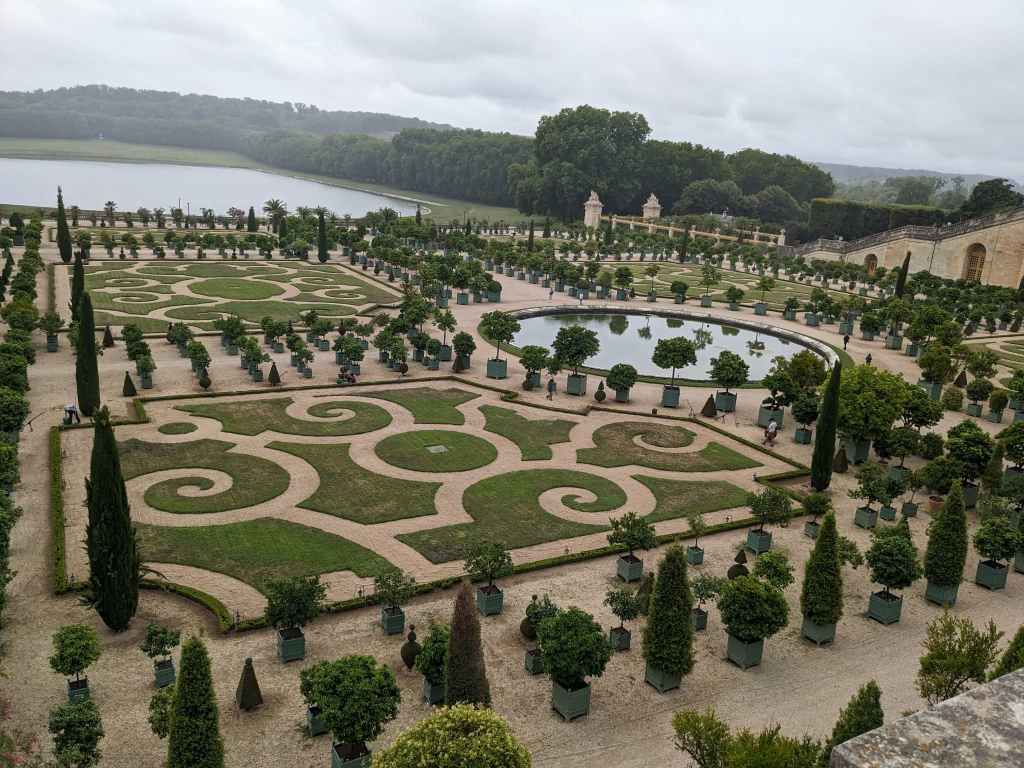
The gardens are worth a visit for their own sake. Covering 2,000 acres, the gardens feature 50 fountains and more than 800 sculptures (mostly depicting figures from Greco-Roman mythology). There’s also a musical performance at the fountains on Saturday and Sunday between April and November as well. A grand canal that is 1.5 kilometers long was built during the 17th century that allowed the king to host a private fleet of yachts, gondolas, and barges (known as Little Venice). No wonder the French launched a revolution in the face of such outrageous luxury! Today you can rent a rowboat for about $23 per hour.
We grabbed a quick lunch at the Dauphin’s concession stand in the gardens, which offers salads, sandwiches, and buckwheat galettes (similar to a crepe). We had a ham and cheese galette that was inexpensive and tasty, as well as refreshing pistachio ice cream (although not as good as the gelato in London).
After some refreshment, we decided to continue walking to the Trianon estate which is about 1.5 miles from the palace. Other options include bicycle rental ($12 per hour), electric golf carts ($50 per hour), or a shuttle tram ($10 round trip). This part was a new experience for me since I had only visited the main palace. The Trianon estate includes two smaller chateaus (Grand and Petit) although they are both very regal as well. Marie-Antoniette preferred the Petit Trianon as her refuge from the formality of the royal court at Versailles. Later, Napoleon kept the Grand Trianon as an imperial residence which included a distinctive open-air porch with colonnades known as a peristyle. I liked the Grand Trianon and its peristyle compared to the Petit Trianon which was more sparse and modest (likely due to looting and confiscation during the revolution). The only part of the of the estate that we didn’t visit was Marie Antoinette’s hamlet – a rustic retreat that served as a working “model” farm. Despite walking all day, Nataliya preferred to keep strolling back to the main palace without waiting for the shuttle. We took the train back to our apartment and took a long nap before dinner!
I wanted to try something exotic and discovered a little restaurant that specializes in Alsatian flammekueche (a type of tarte flambee, similar to a flatbread pizza). The menu included about a dozen different variations ($15 each) of the same basic recipe which includes a thin, crispy bread topped with crème fraiche, onions, and smoked bacon (lardon). The menu also includes several sweet dessert options, such as apples or banana with chocolate. We shared the “Game of Tomme” variant, which included mushrooms, Alsatian cheese, and substituted ham for bacon. We also shared a salad which were both delicious!
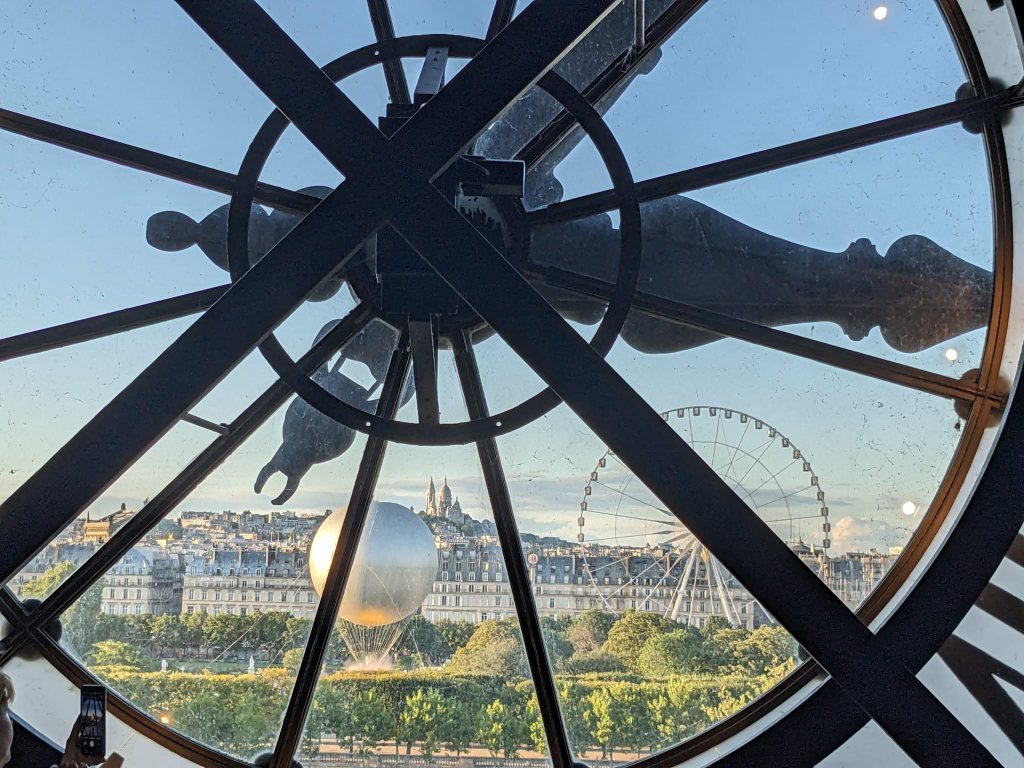
After digesting, we dashed off for an evening visit to the Musee d’Orsay which has extended hours until 9pm on Thursdays (also included in our museum pass). This is one of my favorite museums since it’s housed in a 19th century train station with a beautiful arched glass roof. Given we only had about an hour, we decided to visit the Impressionist collection on the fifth floor, which includes works by Monet, Manet, Renoir, and Van Gogh. Nataliya also snapped a quick photo through the glass façade of the large clock that faces out towards Montmartre. Given how rushed we were, we didn’t get much of a chance to take in each work of art. Nevertheless, it was a fun evening excursion, although I would recommend you allot yourself more time if possible!
Although the sun was rapidly setting by the time we left, Nataliya wanted to squeeze in another must-see landmark: the Eiffel Tower! We saw it from afar during the firework display, but Nataliya wanted a closer look, so we walked quickly as the sun was setting. The sun had almost completely disappeared by the time we got to Les Invalides, but Rue Saint-Dominique (where my family had previously rented an apartment) offered a relatively unobstructed view. The tower lights up with a glowing illumination for five minutes at the top of every hour after sunset. We arrived at Rue Saint-Dominique only moments before it started! We paused for some selfies and to appreciate the romantic glow before finally heading home to catch some well-deserved sleep!
Friday July 18
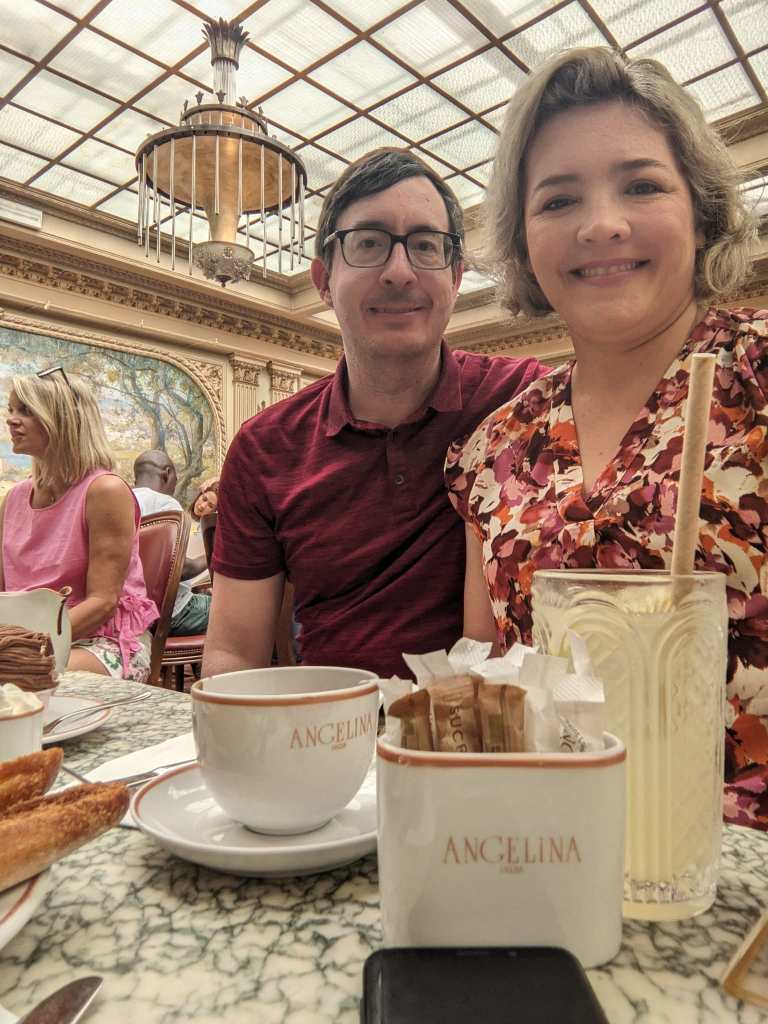
This was our final day in Paris, and we took full advantage of our museum pass by visiting the Louvre and the Orangerie. But first, we started with brunch at Angelina on Rue de Rivoli which is conveniently a 10-minute walk from the Louvre. Founded in 1903, Angelina is known for its thick hot chocolate and Mont Blanc desserts. The Mont Blanc is made of thin vermicelli-like ropes of pureed chestnuts topped with whipped cream. The dessert is named for the iconic peak in the Alps since the original version resembled a snow-capped mountain. However, the current offering is inverted with the chestnut puree encasing the cream, which results in a less visually appealing treat. Nataliya was craving the famous hot chocolate and of course we couldn’t skip the main attraction! The Mont Blanc was delicious but also very rich and dense. We also shared the Trocadero pastry with crunchy hazelnut, chocolate cream, hazelnut cream, and Chantilly cream. The Belle-Epoch architecture of the tearoom was also very beautiful, with restored moldings, polished marble tables, and hand-painted frescoes. It’s a perfect destination to get a taste of the elegant Parisian lifestyle. You can also fuel up before visiting the Louvre or refuel afterwards (or both)! The tearoom was very busy, but we didn’t have to wait. Nevertheless, I would still recommend trying to avoid peak hours.
The Louvre is only a short walk away. Originally a fortress, the Louvre (admission about $10 but also qualifies for the Museum Pass) became a royal palace before opening as a museum during the French Revolution in 1793. The museum houses more than 35,000 artifacts, and it would take at least two days to see the entire collection! However, we only had a few hours to visit some of the greatest hits, including Mona Lisa, the Winged Nike, Liberty Leading the People, and the Napoleonic crown jewels (which would be stolen during a dramatic daylight heist only a few months later!).
The Mona Lisa, by Leonardo da Vinci, is in the Denon wing and obviously attracts huge crowds which make it difficult to appreciate the beauty of the work. Winged Nike (the goddess of victory) is displayed at the top of the main staircase. Unearthed in 1863, the statue is one of the few surviving original Greek sculptures as opposed to later Roman copies, which are more numerous. Despite missing the goddess’ head, the statue is still incredibly realistic and a magnificent piece of art! Liberty Leading the People, by Eugene Delacroix, is one of my favorite works and is absolutely massive (about 8.5 feet wide and 10.5 feet tall)! Liberty Leading the People is a tribute to the July Revolution of 1830 not the original Revolution of 1789 as is often assumed! Lastly, the Napoleonic crown jewels were dazzling to behold! Unfortunately, a gang of thieves conducted a brazen daylight robbery where they posed as construction workers. In eight minutes, they stole a necklace, earrings, brooches, and the tiara of Empress Eugenie. The tiara is made of gold and includes more than 50 emeralds and more than 1,300 diamonds! The thieves dropped the tiara, which was badly damaged, but the museum is currently restoring it. The suspected thieves were eventually arrested and are awaiting trial; however, no other jewels have yet been recovered. We remain hopeful that someday they might be!
We had a quick lunch at the Café Mollein, located at the top of the Mollein staircase, where the menu includes sandwiches, salads, and pastries at reasonable prices. We didn’t have to wait too long, and the café has outdoor seating that offers a wonderful view of the main courtyard and Pyramid.
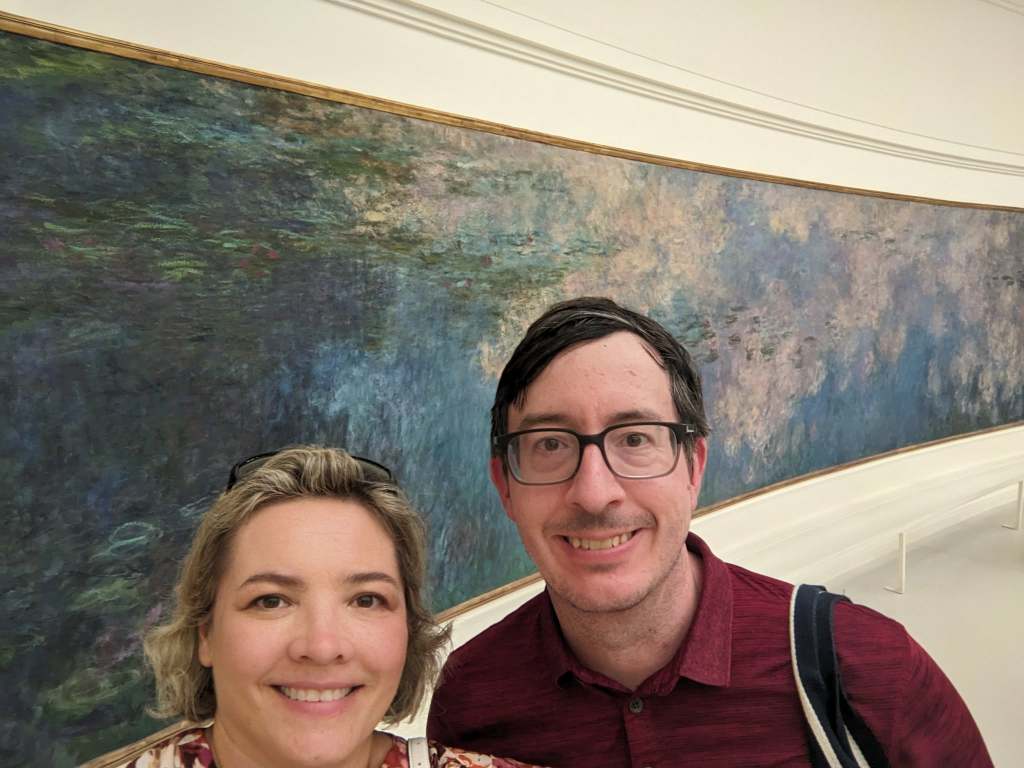
After refueling, we took a quick walk through the Tuileries Garden to the Orangerie Museum (about $13 but also eligible for the Museum Pass) to see Claude Monet’s famous Water Lillies series of paintings. The Museum Pass let us skip the line which is another great benefit! The Orangerie is a specialized greenhouse (which grew oranges and other fruit trees) of the former royal Tuileries palace. The Water Lillies are displayed in two custom-built elliptical galleries designed to give the viewer an illusion of “wave without horizon and without shore.” The paintings depict lilies in the garden of his home in Giverny, about 50 miles northwest of Paris (a popular day trip destination). I love the paintings because they showcase Monet’s use of layering and texture to capture the surface of the water.
Since this was our last night in Paris, Nataliya wanted to use every last minute we had. Although it had been a long day, and I was very tired – Nataliya convinced me to go to Montmartre with her for our final adventure. We took the Metro and got out to snap a quick picture at the Moulin Rouge. We had considered attending a cabaret show at either Moulin Rouge or Crazy Horse, but both cost about $300 and conclude late in the evening.
As the sun was setting, we hiked uphill to Sacre Coeur – the iconic white basilica overlooking the city. If we hadn’t been in such a rush, we might have had time to linger and savor the romantic atmosphere as we gazed out over the cityscape. I first visited Sacre Coeur on a school trip more than 25 years ago, and I was surprised to see it again. At the time, I never even imagined I would be back and certainly not 25 years later on a romantic evening escapade. Next time, I hope we aren’t as rushed as we were in 2025.
Saturday, July 19
Our journey home had several legs, and I was worried that something might go wrong along the way that could leave us stranded. Fortunately, we only made one small mistake and still arrived on time. Our journey began at the Gare du Nord station where we took the Eurostar train back across northern France and through the Chunnel to London (which took about 2.5 hours). I was sad to see the French countryside go by in a blur but look forward to seeing in again in the future.
After arriving back at St. Pancras, we took the Tube to Heathrow (1 hour), although we missed one stop where we had to change lines. We had to double back but still made it to the airport and through security on time! It was an appropriately rushed ending to our Too Fast Too Furiously paced trip. I cherished my time in Paris with Nataliya, and we plan on returning – hopefully with a slower tempo!




































































 Freelance Writer Paul Glasser