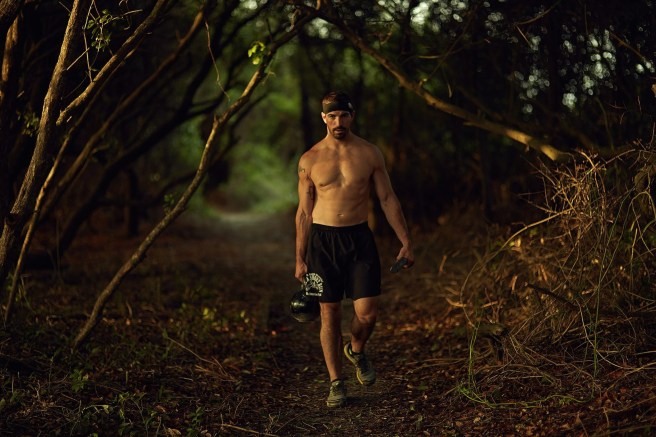
Cancer at 34 Part 6: Cross Fit and Tenacity

Cross Fit became a regular part of my life in April 2016 when I moved to Pittsburgh. My girlfriend at the time encouraged me to give it a try, and I liked having something we could do together. I was an occasional runner and had done some exercise machine workouts before, but nothing as intense as Cross Fit. I completed the on-ramp program and started working out at Industrial Athletics. The coaches and other athletes were all very helpful and supportive. I was very slow and very weak, but I learned a lot! I completed a half-Murph workout there, which was a huge accomplishment and really boosted my confidence.

img_20170106_235555_147
Cross Fit Blue Ash – Photo courtesy of Blake Evans

After I moved back to Cincinnati in July 2016, I knew I wanted to continue with Cross Fit because it had so many benefits and pushed me to my limits. I dropped in to a few nearby gyms before settling on Cross Fit Blue Ash. It was a convenient location, with lots of classes that fit my schedule. The members and coaches were all very welcoming as well. In addition, all the coaches have been patient as I continue to learn – especially Dr. Bob and Ali. Blake, the owner of Cross Fit Blue Ash, went out of his way to get to know me better. We come from different backgrounds, but share a common interest in Cross Fit. Through my workouts and the annual holiday party, I also came to know some of the other athletes too.

Since my diagnosis in December 2016, Cross Fit Blue Ash has become especially important to me as a way to hold on to some part of my previous life and organize my new one. In addition, the workouts give me structure, stimulate my motivation, and require a lot of physical effort. It feels great to focus entirely on the workout and be exhausted at the end of it. However, it’s getting harder and harder to do the workouts, and I usually don’t even finish them any more. I’m fatigued every day, and the WOD always kicks my ass. All I can do any more is show up three days a week and do the best I can.

Even before my diagnosis, I was never particularly strong or fast. It’s very frustrating to feel like I’m back sliding so quickly, although I know it’s due to a combination of fatigue, the drugs, and self-doubt. Rule #9 at the box is to leave your ego at the door, which I try and accommodate, although it’s not always easy. I appreciate it when other athletes congratulate me after a workout, no matter how slow I am.

Recently, I haven’t been writing much (which I’ll discuss in another rapid-fire blog post), but another athlete at Cross Fit Blue Ash reached out in a totally unexpected way that prompted me to resume. I slowly realized that the box had become as much a part of my support network as my friends, family, and church. Now I’m correcting that oversight and providing recognition to all the people who deserve it.

I recently signed up for the 2017 Cross Fit Open. I’ve never really competed in anything like that before, and I was hesitant because I didn’t really want to embarrass myself. I felt like I wouldn’t get much out of it other than to pay $20 for the privilege of looking like a weakling. I’ve been trying to be more bold, but I’m not perfect. After another athlete reached out, I decided that I had to participate in the 2017 open.

Steve and I don’t know each other that well, although we are both 34 years old. He’s the captain of the “Dancing Pandas” team at CFBA for the 2017 open. He heard about my diagnosis and printed some wrist bands so that the rest of the team and others could show some support. His kindness amazed me.

624_1486215026363

Another shock came when Blake, the owner of CFBA, told me that I inspire him! I was pretty sure the inspiration flowed in the opposite direction, because I have never been quick or tough. I never expected to galvanize anybody when it came to physical fitness, let alone the owner of the gym where I workout! However, I begrudgingly admit that my tenacity is inspirational.

However, it looks like my attempt at the 2017 Cross Open will face an immediate obstacle. I’m scheduled for surgery to try and restore my paralyzed vocal cord on February 17, 2017. The doctor ordered no strenuous physical activity (that includes Cross Fit) for at least 5 days. The first WOD for the 2017 Open will be released on February 23rd. It looks like the odds will be stacked against me, especially at the start. But I’ll close with one of my Dad’s favorite quotes from Star Wars: Episode V The Empire Strikes Back – “Do. Or do not. There is no try.”

Zipping to Greatness

unnamed

Published by IN Community Magazines – Penn Hills Winter 2016

PITTSBURGH – When Marc Alexander plays soccer for the University of Akron in 2017, he won’t be the best player on the field like he is now.

“Everyone will be better than me,” he says. “Mentally, I will have to change the way I play.”

Marc is currently a senior at Kiski School and is a center back on the soccer team. He says he was surprised to receive a full scholarship to the University of Akron, because such opportunities are rare. The university made the offer after Marc participated in a camp in Akron in July. He played against the current UA Zips team and says he was impressed by the skill and speed of the players: “It was a totally new level that I’ve never seen before.”

Marc is a little nervous about making the transition to play for the Zips because the team has a good reputation. He’ll work on improving his strength and agility before then.

“Only players who want to go pro go through the program,” he explains. “I’ll have to play smarter, faster, and quicker.”

He was also very impressed by the close relationships between players on the Zips team.

“It felt a family and that’s somewhere I want to be,” he says.

For aspiring young players, Marc advises them to make sure they maintain their grades while also working hard at practice.

“You have to go all out,” he says. “Every piece matters. Coaches are watching you at all times.”

Players also have to avoid giving up mentally, even when the situation may seem hopeless. Marc recalls one example when he played on the Century United soccer team three years ago, in a game where team was down by two goals. They came back to tie the game, and the team went on to win the tournament.

“We had to keep going and I had to keep the entire team together,” Marc says.

He credits Jeremy Gillespie, a former coach with Century United team, with helping him reach his full potential as a player: “He helped me get to where I’m at now.”

Marc will study engineering at Akron and would like to become a professional soccer player. His favorite team is Manchester City and his favorite player is Sergio Aguero.

Marc started playing soccer at age six but also played other sports, including basketball, football and baseball. He decided to focus on soccer and played as a forward before he became a defender. He enjoyed playing as a striker because it gave him the opportunity to score goals.

“Everyone wants to be the guy scoring goals with all the glory,” he says.

However, being a center back is also a good fit because Marc is so athletic.

“Now, I can lock down basically whoever I want to on the field at any time,” he says.

In 2013, Marc joined the Olympic Development Program soccer team and played in Zagreb, Croatia, and Venice, Italy. The team came in fifth place.

People often complain that soccer is boring, but according to Marc, playing the game or watching it in person is very different from seeing it on television.

“When you watch it on TV it looks like there’s a lot of space and it’s slow,” he says. “But in person you can see the speed of the game and how difficult it is to play. Everything is very quick.”

Dreams of Gold

67487122-DUT_2028-90.jpg

Published in IN Community Magazines – Moon Township Winter 2016

PITTSBURGH – Grace Howard, a sixth grade student at South Fayette Middle School, hopes to compete at the 2024 summer Olympics.

Grace has already started on her path to the Olympics by winning her third medal at the Junior Olympics in Sacramento in July. More than 7,500 youngsters from across the country competed in a variety of events. Grace won sixth place in the high jump competition for girls age 11-12 with a jump of 4 feet, 11 inches. She says she excels at the high jump because she 5 feet, 3 inches tall and has long legs.

“It’s almost like you are floating in the air,” Grace says.

She was nervous before she competed but used tips from her coaches to take her mind off of the task at hand. Grace likes cupcakes, so she pretends there is a cupcake tree over the bar.

“If you don’t think about it too hard, it comes more naturally,” Grace says. “My coaches are a big part of this, because without them I wouldn’t have gone to the Junior Olympics in the first place.”

Grace hoped to do better in the high jump event because she tied for second place at the 2014 Junior Olympics. She also won sixth place in 2015.

“After I thought about it, I realized that a lot of people would have been happy to take my sixth place spot,” Grace says. “I will definitely be back next year.”

Grace qualified for the 200-meter sprint but decided to focus on the hurdles and high jump instead. She also competed in the 80 meter hurdles and achieved a personal record of 14.52 seconds.

“Running with the wind blowing in your face is really fun,” Grace says.

She was inspired by watching the 2016 Olympics on television after returning home from Sacramento. Allyson Felix is Grace’s favorite runner and she won gold in the women’s 4×100 and 4×400 meter relays and silver in the women’s 400-meter sprint.

“She’s very relaxed when she runs, and her reaction at the start is very good,” Grace says. “She smiles at the end too, which is very nice.”

Felix ran from lane four which is now Grace’s favorite starting position. Grace says she wants to improve her reaction time because she noticed many other runners at the Junior Olympics hesitated when the starting shot was fired.

“My goal is to be the first one out of the blocks,” Grace says.

Grace started running when she was six years old. She was living in Texas as the time and she beat older boys in the neighborhood in several races.

“It was the first clue she had a natural running ability,” says her mother Yvette.

Grace runs on the Wings of Moon team. Her mother says she will support her dream to compete in the Olympics but says her daughter will have to put in a lot of hard work and make sacrifices. However, she says she won’t pressure her daughter to aim for the Olympics either.

“We will support her in the sport she loves and excels at,” Yvette said. “The future is the future.”


South Fayette Native Makes his Debut on “American Ninja Warrior”

img_3503

Published in IN Community Magazines – South Fayette Fall 2016

PITTSBURGH – Even though Mike Shuck’s first attempt to conquer the American Ninja Warrior obstacle course was unsuccessful, he’s already planning his next attempt.

Shuck grew up in South Fayette and is a math, science and language arts teacher at Aiken Elementary School in Greentree. He appeared on the June 27 episode of NBC’s American Ninja Warrior. The episode was filmed in Philadelphia in May and Shuck was eliminated when he slipped on the fourth obstacle and fell into the water. Shuck was climbing up a series of vertical metal bars when he lost his grip and fell.

“I knew I could have done it,” Shuck says. “I was very hard on myself. I took a few days before I was not constantly replaying that and asking what I could have done better.”

Shuck says he would have been less disappointed if he encountered an obstacle he knew he couldn’t complete. He wants to try again next season to prove he can do better. Shuck is already planning his next audition video although there’s no guarantee he will be picked again next season.

“I went out unsatisfied and I couldn’t leave it at that,” he says.

In addition to teaching at Aiken Elementary School, Shuck is also an instructor at Pittsburgh Kettlebell & Performance in Greentree. He trained for a year before he was selected to appear on American Ninja Warrior. He built different obstacles at the kettlebell gym but says he wants to get more practice on actual objects from the American Ninja Warrior course before he submits his next audition tape. If he is allowed to compete again, Shuck says he hopes to complete the course. If not, he won’t try a third time.

“If I don’t make it to the top of the warped wall that will be it,” he says. “I need to do substantially better in order to meet my own expectations.”

Shuck has always been interested in physical fitness and been very competitive. His parents were both body builders and met at a gym. From an early age, they taught Shuck the importance of physical fitness and healthy eating. Shuck participated in football, soccer and wrestling as a youngster. He hopes to someday open his own gym. He started watching American Ninja Warrior about three years ago and was impressed by the level of athleticism the contestants displayed. Many of the athletes also have very inspiring stories.

“Some people have battled through unbelievable circumstances,” Shuck says.

After watching American Ninja Warrior for several seasons, Shuck began to wonder if he could compete on that level. While most people wouldn’t give it a second thought, Shuck says he was looking for a new challenge. He decided to audition and began to train about a year ago. Grip strength is very important to succeeding in the American Ninja Warrior obstacle course so Shuck began to build different obstacles that focused on climbing and hanging.

Shuck submitted his audition tape online in November 2015 which portrayed him training for the competition, working with his students at Aiken Elementary School and leading classes for kids at Pittsburgh Kettleball & Performance. After he submitted his audition, his students asked him every day if he been selected.

“They thought it was the coolest thing,” Shuck says. “They were a part of the process from the very beginning.”

However, Shuck didn’t find out he had been selected until May.  As the weeks of waiting turned into months, Shuck says he gave up hope, especially after he learned that filming had begun for an episode in Atlanta in March.

“I didn’t think it was going to happen,” he says. “I told myself I had missed the boat.”

Finally, Shuck received a phone call in early May while he was leading a class at Pittsburgh Kettleball & Performance. He didn’t recognize the number and let the call go to voicemail. But then Shuck realized the area code was a California number and when he ran outside to check his messages he learned that he had been selected to compete in the Philadelphia episode only two weeks later.

“My head was spinning,” Shuck says. “I had already given up. My mind had already moved past it and the phone call brought everything back. It took a day or two to really sink in.”

Shuck says he’s not as athletic as some of the contestants who have appeared on American Ninja Warrior, but he thinks the producers picked him because they liked how he was involved with kids and fitness.

“TV shows want a good story,” he says.

With only two weeks’ notice, Shuck says there wasn’t much he could do to prepare and he was extremely nervous. For the next two weeks, students at school and people at the gym asked him questions and encouraged him every day.

“There was a constant knot in my stomach,” he says. “I felt a whole lot of pressure not to let people down. They had high expectations of me.”

Before he left, Aiken Elementary School organized a pep rally to honor Shuck. Everyone assembled in the gym where they played a fight song, and several students read aloud letters that described how Shuck had inspired them in different ways.

“That’s worth the price of gold,” Shuck says. “That’s all a teacher ever wants. That will always stay with me.”

Shuck drove to Philadelphia the day before filming began so that producers could interview him and about 60 other athletes who had been selected to compete. Shuck was one of only a few rookies while most of the other contestants had competed in American Ninja Warrior before. Many of the veterans had trained at special gyms that specialized in preparing athletes for the American Ninja Warrior obstacle course.

“Some people dedicate their lives to this and some guys quit their jobs to train specifically for this show,” he says. “They’ve been here before and they know what they are doing. I felt I was at a disadvantage.”

He was very nervous and didn’t sleep well the night before the competition. Because the episodes are filmed at night, Shuck spent the next day in nervous anticipation of what he would face since details of the obstacle course were not released until the last minute. He read some of the letters his students had written in order to try and find some extra motivation before the competition began.

“I wanted to relax but I couldn’t,” Shuck says.

The episode was filmed at an old industrial power plant outside of Philadelphia. After checking in, the contestants finally saw the obstacles they would be facing. The producers allowed the contestants to walk through the course and then let them watch as an expert tackled each obstacle. Shuck was not called to the starting line until about 11:30 p.m., and he says walking out on to the platform was an out of body experience.

“It really hit me that I’m about to do this,” he says. “When the horn sounded my senses shut down. My brain went into tunnel vision. I didn’t hear a single thing.”

Each contestant is allowed to have a team of supporters walk beside the obstacle courses and cheer them on. Although he couldn’t hear them, Shuck says his family were very supportive. His wife, author Ashely Boynes-Shuck, was especially supportive, he says.

“She helped me get my name out there and has been my stability,” Shuck says. “When I was driving myself crazy with doubts and fears she brought me back to earth.”

He completed the first obstacle which was a series of large quintuple steps that were angled at 45 degrees. Successfully navigating the first obstacle helped calm his nerves a bit. At the second obstacle, Shuck grabbed a swinging log and held on tight as it tried to dislodge him.

The third obstacle caused most contestants to fail, Shuck says. It was a series of staggered steps that would tip over as soon as a contestant put any weight on it. The key was to move quickly to avoid being dumped off, Shuck says. He thought he might fall on this obstacle too because he had never really trained for it, but once he reached the other side he felt like he could make it to the end.

However, he lost his grip on the next obstacle and fell into the water. Shuck says he was surprised that all the other contestants cheered and supported each other.

“It was eye-opening to see the closeness between the other competitors,” he says. “I wasn’t expecting that.”

Even though he was eliminated, the producers sent a film crew to Greentree a week later to shoot a segment about Shuck’s background.

American Ninja Warrior is growing in popularity and Shucks says he thinks it might become a legitimate sport. Shuck suggests that anyone who is interested in competing on American Ninja Warrior create a daily plan and focus on grip strength. It’s also important to stay calm and be persistent even when in doubt, he says. The best way to prepare would be to train on actual obstacles from the American Ninja Warrior course and get advice from experienced contestants.

“When you have a passion you have to commit all the way,” Shuck says. “Everything looks easy on TV.”