The Adventures of Tin Tin

It took several years, but I finally picked up a few books from the Adventures of Tin Tin collection. I’ve been trying to branch out from my rather narrow focus on World War II related books, and I realized I have never read any Tin Tin which, alongside Asterix, are probably some of the best-known examples of bande dessines. Tin Tin is also classic example of the ligne claire style which features dark black outlines and bright colors.

The_Adventures_of_Tintin_-_20_-_Tintin_in_Tibet
Courtesy of Herge Foundation

I started off with the adventure in Tibet, the 20th book in the series. It came highly recommended and I think it was a great place to start. Herge, the artist, drew lavish backgrounds based on photographs from Tibet. Tin Tin’s Tibetan expedition includes a compelling story based on friendship and adventure. It’s also based in a single exotic locale that is explored in more detail, as opposed to the “Cigars of the Pharaoh”, which I’ll discuss next.

The_Adventures_of_Tintin_-_04_-_Cigars_of_the_Pharaoh
Courtesy of Herge Foundation

The “Cigars of the Pharaoh” is the 4th book in the Tin Tin series and I found it to be much less compelling than the Tibetan story. This adventure begins in Egypt but shifts abruptly to India. The story is rather far-fetched as Tin Tin combats an international drug cartel. Although Africans appear in the story only briefly, Herge presented them in a very racist caricature. The book was originally produced in 1934, and Herge later disavowed this attitude. However, I did enjoy the introduction of Thomson and Thompson (or Dupont and Dupond in the French version) – two nearly identical detectives. The duo are uncharacteristically effective as compared to their later bumbling, which is my next target.

The_Adventures_of_Tintin_-_21_-_The_Castafiore_Emerald
Courtesy of Herge Foundation

The “Jewels of Castafiore” is a rather claustrophobic story compared to Tin Tin’s previously wide-ranging adventures. It’s set entirely at the country estate of Tin Tin’s companion Captain Haddock where a house guest reports her prize jewels have been stolen. However, the story grows rather tiresome after it’s discovered the jewels aren’t really missing and the whole farce is repeated several more times. Thomson and Thompson are depicted as comically ineffective this time around. Compared to the racism earlier in the collection, this book features Tin Tin and Captain Haddock standing up against the persecution of Romani people.

I feel like these books gave me a representative slice of the Tin Tin collection. I might pick up a few more, but I doubt I’ll complete the whole series. Each story gave me a few chuckles and were pretty fun for the most part. I really enjoyed “Tin Tin in Tibet” and the “Blue Lotus” was its prequel. Other critics have denounced some of Herge’s early works, such as overt racism in Tin Tin’s Congolese adventure, so I’ll probably skip those. In addition, Tin Tin is merely an observer in the earlier stories as opposed to a full participant in the later adventures that I read. I enjoyed seeing Tin Tin evolve through the series, but maybe I’ll even try some science-fiction next…

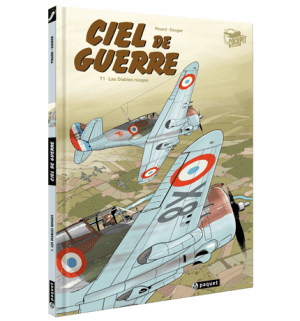
The Ligne Claire Style – “Ciel de Guerre”

Story – Philippe Pinard

Illustration – Olivier Dauger

couv-3d_2.png

“Ciel de Guerre” introduces an artistic style I haven’t discussed in depth yet – ligne claire. This method of illustration was pioneered by Hergé, the artist who created “Tintin.” Ligne claire features dark outlines around each character and object (“Comics in French: The European Bande Dessinée in Context,” pg. 122). Ligne claire comics usually feature very monochromatic colors that produce a crisp, clear image as seen in the following panels from volume one.

cieldeguerre1

“Ciel de Guerre” tells the story of a French fighter squadron, “Les Diables Rouges,” between May 1940 and 1942. The story is spread across four albums, and Individual copies are available on Amazon.com for about $25 each. A collected edition is available on Amazon.fr for about $63 plus shipping.

The artist, Olivier Dauger, depicts several esoteric aircraft including the H-75 fighter. However, the planes are rather immaculate compared to the worn and weary aircraft in the stories illustrated by Romain Hugault. In fact, everything appears to be too neat and orderly because uniforms are never dirty or stained, even when the pilots are stationed in the desert.

There’s ample aerial combat, but it’s far less heroic and dramatic than what we saw with Hugault. The pilots often make mistakes and combat is portrayed in a more abstract manner. For example, in the following image, lignes de movement are used to convey a sense of speed as the planes move through the air.

cieldeguerre3.jpg

In this image, emanata are used to convey a sense of surprise or shock, such as when an enemy pilot performs an unexpected maneuver in combat.

cieldeguerre2.jpg

As a result, Dauger’s execution of the ligne Claire style doesn’t really appeal to me because the visual elements are too flat and abstract. However, the story is much more satisfying than previous bande dessinée I’ve reviewed.

“Ciel de Guerre” covers several often-overlooked theaters of World War II, including Operation Exporter – the Allied attack on Vichy-held Syria and Lebanon in 1941. The last volume also portrays the well-known Allied in invasion of North Africa in 1942, “Operation Torch,” from the French perspective.

The main characters are Etienne de Tournemire and André Marceau – two pilots in the “Diables Rouge” fighter squadron. De Tournemire is a conservative while Marceau is a communist who fought in Spain with the International Brigade. Writer Philippe Pinard tells a rich story as the two men struggle to interpret the “strange defeat” of May 1940. He does a good job depicting the confusion and despair that came after the armistice. De Tournemire and Marceau also clash over the definition of duty and honor. They must eventually declare allegiance to either the Vichy regime and Henri Pétain, or the Free French forces lead by Charles de Gaulle based in London.

“Ciel de Guerre” is also a relief from the male gaze which was so prevalent in the first two bande dessinée reviews I recently published: “Le Grand Duc” and “The Final Flight.”

Male characters dominate the story, except for de Tournemire’s cousin Caroline. She serves as marrainne de guerre, a kind of military godmother, to the pilots of the “Diables Rouge” squadron. Instead of becoming a sex object, Caroline instead contributes to the plot of “Ciel de Guerre” by flirting with collaboration.

However, the story can become too technical and dry at times. Even readers who are relatively fluent in French will probably have to look up a few of the more obscure vocabulary words that refer to different pieces of military hardware or equipment. That might prevent less dedicated readers from comprehending or enjoying the series. Pinard also tends to focus on the technical factors that led to the French defeat in 1940, such as the under-powered engines used in the H-75 and the bureaucratic red-tape of the French procurement system. As a historian, I tend to avoid deterministic analysis that traces causation to a single factor, and I prefer much more multi-faceted accounts.

The first volume, “Les Diables Rouges,” also includes several interesting supplements at the back of the album, including several short biographies of French pilots who served in the Groupe de Chasse II/4. Several profiles of innovative French aircraft that arrived too late to prevent the defeat of 1940, including the wooden VG33 fighter, are also included. There’s even a very short essay about how French intelligence officers calculated aerial victories. More casual readers will probably not be too interested in these additions, but serious aeronautic fanatics will enjoy them.

The Male Gaze in BD Part 2: “Le Grand Duc”

Story – Yann

Illustration – Romain Hugault

gduc1

Since I fell in love with Romain Hugault’s art in “The Final Flight,” in 2011 I decided to order a full series he illustrated for Paquet’s “Cockpit” collection. I settled on “Le Grand Duc,” which tells the story of two veteran pilots on the Eastern Front between 1943-45. Published in three albums, collected editions run about $100 on Amazon.com. I purchased mine through Amazon.fr for about $80, although the cost of shipping was almost as much as the price of the books!

Unlike “The Final Flight,” this series features more character development. Disappointingly, the story, created by the famous bande dessinée writer Yann, is predictable and the characters are clichéd. The two main characters are Wulf and Lilya. Wulf is the stereotypical “good German” – a patriotic Luftwaffe pilot who defends his country while also detesting Nazi ideology. Lilya is female pilot flying in the Soviet air force. Inevitably, romantic tension swells between the two enemies.

In addition, supporting characters are also uninspired. One of Wulf’s fellow pilots is a Jew who struggles with conflicting loyalties. Yann also perpetuates the stereotype of Soviet commissars as political officers obsessed with rooting out defeatists and ensuring ideological purity. In reality, political supervision was only one part of the commissar’s duties, which also included providing for soldiers’ educational, morale, and welfare needs.

The story begins with Lilya as a member of the famous “Night Witches” 588th Night Bomber Regiment. The story does deal with real issues that women like Lilya had to face, including sexism and unwanted affection from male comrades. In this respect, it’s better than “The Final Flight”; however, it retains the male gaze that I discussed in my first bande dessinée review. Although Lilya has a strong personality and never backs down from a threat, Yann and Hugault take every opportunity to remind their readers that she is a voluptuous woman. They titillate the audience by frequently finding any excuse for Lilya to be partially or fully naked. In addition, Yann adds a promiscuous and treacherous member of the helferinnen (women’s auxiliary to the Luftwaffe) to the story, which only reinforces the male gaze and perpetuates sexist myths about women in the armed forces.

grandduc1

On the other hand, Hugault’s art remains fantastic and there’s ample aerial combat. He portrays a number of different airplanes in lavish detail, as seen above. Aeronautical enthusiasts will be pleased by the wide array of aircraft depicted in the book, including staples such as the IL-2, LA-5, Me109, and Fw190, but also more obscure planes such as the Hs129 ground attack craft, Ta152 advanced fighter, and He219 night interceptor. Each planche tends to include several large images to show off the detailed renderings of each aircraft. A few wide panoramic images span both pages in order to give the reader a rich and expansive scene. Otherwise, Hugault doesn’t provide much else in terms of artistic innovation, although the gouttière (gap space between each image) is rendered in black on several pages instead of white in order to portray action at night.

“The Final Flight” & The Male Gaze in BD

“The Final Flight” (Le Dernier Envol – original French title)

Created/illustrated – Romain Hugault

Story/dialog – Romain Hugault and Régis Hautière

41+p4pC1P5L._SY344_BO1,204,203,200_.jpg

Let’s start at the beginning. As my last blog post detailed, “The Final Flight” was my first exposure to bande dessinée. I picked it up at a comic and music store in Louisville in 2010. It’s a good place to start because it’s been translated into English, which makes it more approachable for readers with limited or no ability to read French. Theoretically, it should also be cheaper and easier to obtain than many of other title’s I’ll discuss in the future (although the cheapest used copy listed on Amazon was priced at more than $50!).

“The Final Flight” is a collection of four short stories about pilots during World War II. Romain Hugault was responsible for the illustration and most of the story. He’ll be a common feature of my next few reviews, which will focus on the publisher Pacquet’s “Cockpit” collection.

“The Cherry Blossom” tells the story of a kamikaze pilot in 1945. “Reprieve” focuses on a P-47 pilot that conducts ground-attack missions to support the D-Day invasion. “Iron Cross” follows a hardened German ace on the Eastern Front in 1944. “Angel Drop” stays on the Eastern Front but switches to the perspective of a French pilot in the Normandie-Niemen squadron in 1943. There’s also a brief epilogue that brings the collection to a tragic end. It reminded me of the short story anthology “Tales from the Mos Eisley Cantina,” which I loved as a teenager. All the different stories intersect, sometimes in surprising ways.

Hugault’s art is what really captured my attention and has made me a fan of the “Cockpit” series, which frequently publishes his work. His illustrations are lavish and realistic. Of course, the planes are the stars of the story and every detail, down to worn paint on the fuselage (as seen below), is captured.

finalflight

Each story is only nine or ten pages long, so there isn’t much character development. The focus is on aerial combat, which Hugault captures in vivid detail. At times, the dialogue can come off as cliché or stilted, perhaps because of translation.

In addition, the only female character that shows up is reduced to a sex object. This will be an ongoing complaint in the other titles I review, especially from Hugault. I know the BD industry is male dominated, and the “Cockpit” series is surely targeted at male readers. However, I really don’t like the repetitive efforts to titillate the reader. As I will discuss in the future, even when there’s an attempt to make a strong female character, Hugault is unable to avoid objectifying them. At the back of “The Final Flight,” there’s a compilation of pinup art that only reiterates the obsession with sex. I understand that pinup art is part of the World War II aesthetic, but I’d love to find a bande dessinée that features interesting female characters without subjecting them to the male gaze. I admit I’ll probably have to lookout outside of the “Cockpit” series, and certainly to another creator besides Hugault, to find it.

Bande Dessinée: An Introduction

tintin

Asterix and Tintin are the most famous examples of bande dessinée (French for “drawn strips”), however, the world of Franco-Belgian comics is much richer than just these two icons. Although I am a fan of Franco-Belgian comics, I’ve never actually read either of these massive best bestsellers. In the same vein, I’m not a fan of mainstream Anglo graphic novel superheroes, such as Batman and Superman. World War II is my favorite comics genre, whether in English or French, and that will be the focus of my upcoming bande dessinée (BD) reviews.

First, I’d like to provide a general historical and cultural introduction to the art of bande dessinée. Some readers may already be familiar with BD, but others may not know much about comics in either English or French. Hopefully, both novices and experts will find something useful in this blog post, which draws heavily from Dr. Laurence Grove’s monograph “Comics in French The European Bande Dessinée in Context.”

Grove provides a straightforward definition of bande dessinée as a French language mixture of images and written text that form a narrative (pg. 16). Grove places Franco-Belgian comics in the broad French tradition of visual cultural that can be traced back to medieval illuminated manuscripts. He analyses BD primarily through the lens of cultural studies.

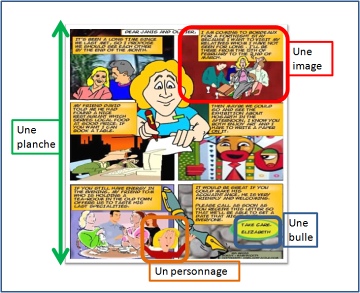
Grove begins by defining a number of basic terms, although he later warns against the obsession of defining BD. For example, a one-shot BD tells a unique self-contained story, which contrasts with an ongoing story told across several published works. BD can be serialized in a journal or can be published in book form (an album). A planche is a single page and most BD are published in the 48CC format. 48 represents the number of pages and CC denotes being published with cardboard covers (cartonnée) and in color (couleur). On each page, there are usually three rows (bandes) that each contain four individual images (cases) which are read from left to right. Of course, many BD creators break these rules from time to time. For example, the “Garage Hermétiqueseries by Jean Giruad, pen name “Moebius,” could often be read from left to right, top to bottom, or vice versa. The cadre is the boundary around each case. Speech bubbles are known as bulles or ballons. The gouttière is the gap between each case and is used to denote the passage of time. A wider gouttière represents more time (pg. 21-32).

42143

(Image from tolearnfrench.com)

In addition, Grove examines how literary elements have influenced bande dessinée. For example, the voix de narrateur is presented in a special block of text known as the récitatif (pg. 32). Grove also explains that cinematic styles have had a major impact on BD. Examples include the use of wide-angel shots (plan general), low-angle shots (contre plongée), and high-angle shots (plongée) (pg. 35).

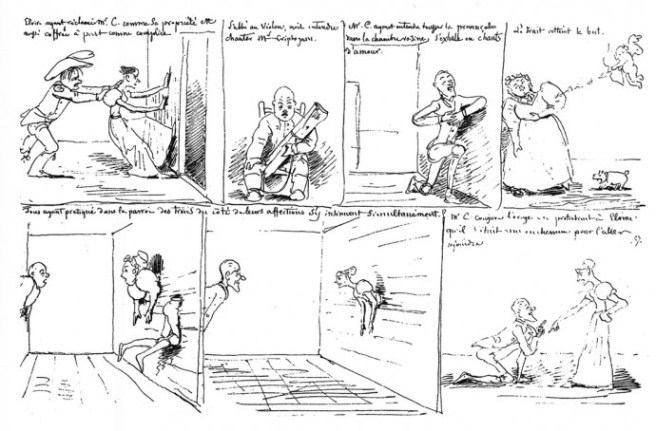
Furthermore, Grove refutes the chronological approach that is traditionally used to describe the history of Franco-Belgian comics. Rodolphe Töpffer, a Swiss teacher, is often credited with creating the first bande dessinée in the 1830s. However, Grove argues that there is a rich history of interaction between text and image in French culture. He asserts that focusing on Töpffer ignores how the emphasis shifted from the text to the images during the Industrial Revolution (pg. 88). I tend to agree with Grove’s thesis because it smacks of the “great man” theory of history, which emphasizes the importance of a single individual and ignores greater social and cultural trends.

topffer-manuscrit-cryptogame-690x454

(Image from Töpffer’s Histoire M. Cryptogame, 1840 – http://www.topfferiana.fr)

Grove asserts many similar proto-bande dessinée works were published around the same time, because the introduction of new lithography technology made it easier to mass produce images. He also argues that by the end of the 1800s, the image began to take a leading role. The growth of photography and the birth of motion pictures helped give birth to the modern BD (pg. 110). Grove claims that the interwar years was the golden age for bande dessinée and that BD became a distinctly French art form after World War II. In fact, BD has since become known as the “ninth art,” which puts it on equal footing with classical arts including architecture, painting, and sculpture.

Since the 1990s, more scholars have been writing about BD in English. Academic conferences have been organized to discuss Franco-Belgian comics and graduate students have published dissertations on bande dessinée in increasing numbers.

BD has become a big business with more than 4,000 new titles published in 2008. Five publishers control more than 75 percent of the market with sales totaling several hundred million euro. Bande dessinée also inspire television and film adaptations, along with merchandising and amusement parks.

On the other hand, independent publishers, such as l’Association, print works that encourage stylistic and narrative experimentation. Grove acknowledges that bande dessinée can also be analyzed through the lens of art history, linguistics, and psychoanalysis. He briefly mentions how male artists dominate the ninth art, and I would like to have read more criticism about the role of gender in Franco-Belgian comics.

Overall, Grove’s book provides a good overview of bande dessinée for both novice readers and experts looking for a more critical analysis. Now that we have a sound understanding of Franco-Belgian comics, I’ll post my first BD review in a few days.

Paul Glasser: Francophile

I’ve decided to start adding some original content to this blog, rather than just reposting some of my journalistic clips. I’m a Francophile and a graphic novel enthusiast, so I’ll combine these interests by discussing and reviewing bande dessinée (Franco-Belgian comics).

I first became interested in French culture and history at about age 12 or 13 when I read “A Year in Provence,” a memoir by British expatriate Peter Mayle. I attended Madeira Jr./Sr. High School in Cincinnati and we only had three options when it came to studying foreign language: French, Spanish, and Latin. I chose French and I took classes all the way up to Advanced Placement level as a senior. After graduating, I spent a few weeks in France as part of a group with other French students from Madeira.

I hate flying, and I took a bunch of Xanax to control my anxiety during the flight. We landed in Charles de Gaulle Airport and then took a bus tour around Paris. The bus was not air conditioned, and I had not slept well on the flight over. I got up and started walking towards the back of the bus with the hope that I could lay down and try to rest. But, about half way down the aisle I threw up everywhere. I blame it on the fact that I probably took too much Xanax. The first stop on the tour was the Louvre, and while everyone else in the group was checking out Mona Lisa, I was lying on a bench drinking water outside the museum.

We stayed with a local family outside of Paris and the first night we had egg salad for dinner. I hate egg salad, but I was pretty tired and hungry so I did my best to eat some. I went to the bathroom and promptly threw up again. The mom cleaned everything up and I was mortified.

After that first day, the rest of the trip was amazing. We went to Notre Dame and Versailles before visiting Château de Chenonceau and Château de Chambord in the Loire Valley. Our last stop was a few days in Nice. I hope to go back some day soon!

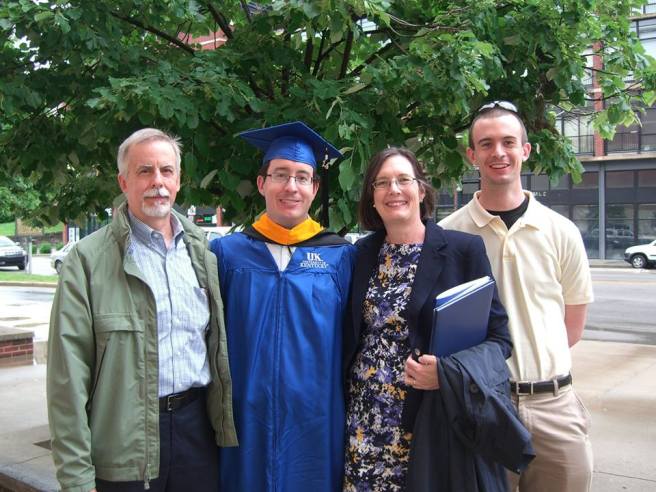
After returning home, I began my undergraduate studies at Purdue University. I took a class on French history and several more conversational courses. I also love French films, and Charles de Gaulle, leader of the Free French during World War II, is my favorite historical figure. I graduated in 2004, but let my interest in French languish until I started my master’s degree in French cultural history at the University of Kentucky in 2011.

I was always fascinated by the heroic mystique of the French résistance during World War II, so I studied the memoirs of men and women who had fought against the German occupation. Reading their memoirs forced me to revive my language comprehension skills.

Before I completed my master’s degree in 2014, I also rediscovered my interest in graphic novels. As a youngster, I had occasionally bought a few Transformers or Teenage Mutant Ninja Turtles titles. At the University of Kentucky, I started visiting local comic shops regularly with a particular eye for anything related to World War II.

graduation

During a trip to Louisville in 2010 or 2011, I stopped at The Great Escape, a comics and music store. I browsed the graphic novel section and found a story called “The Final Flight” (French title “Le Dernier Envol”). It was actually one of the few books from the French bande dessinée publisher Paquet that had been translated into English. This collection of short stories told the interconnected tales of four pilots during World War II. I loved how the stories were woven together, but the incredibly detailed and lavish artwork also stunned me. It was like nothing I had ever seen from an American graphic novel. Each panel could have been its own work of art. For example, in the following image, the artist Romain Hugault, captures the wear that has peeled off the paint from the fuselage. After finishing “The Final Flight,” I knew I had to have more. The book was part of Pacquet’s “Cockpit” series, which focuses on aeronautical tales from World War I to the contemporary era.

finalflight

I setup an account on amazon.fr and ordered the “Le Grand Duc” series, which focuses on a love story between a German and Soviet pilot during World War II. Since then, I’ve purchased a number of other World War II stories from the “Cockpit” collection. Over the coming weeks and months, I’ll publish reviews of “Le Grand Duc” and many others. However, the next installment in my bande dessinée blog posts will be an overview of the historical and artistic development of Franco-Belgian comics.