Women Steal the Show in Raw Deal (1948)

You can watch a trailer for Raw Deal here: https://www.youtube.com/watch?v=bphmrlpvJJo

Claire Trevor (as Pat Regan) and Marsha Hunt (as Ann Martin) are the real stars in Raw Deal while Dennis O’Keefe (as Joe Sullivan) is overshadowed by the two more dynamic characters. In addition, John Alton’s cinematography is very effective as well.

In my first paper, I lamented the fact that film noir tends to have a very misogynistic attitude towards female characters, and I was delighted to watch a film from the perspective of Pat (who provides the voice-over narration). Furthermore, both Claire Trevor and Marsha Hunt create much deeper characters than Dennis O’Keefe, who is relegated to the typical film noir tough guy role. On the surface, the plot is about Joe’s attempt to escape from prison, kill his betrayer, and flee to South America. However, the real tension is the love triangle between Joe and his two female accomplices/companions. The tension between the women is apparent even before the plot structure is clearly established. Pat throws an icy glare at Anne as she leaves the visiting room at the state prison where Joe is incarcerated, indicating her jealousy of the other woman who dared to visit her man.

After Anne is unwillingly drawn into the escape plan, the trio hit the road in her car. All three of them sit in a row in the front seats; however, the shot helps establish the nature of the relationship. Joe sits behind the steering wheel and is the closest to the camera. Anne sits next to him in the middle seat while Pat is furthest away. This reinforces Pat’s emotional and physical separation from Joe who has never professed his love to Pat (as we discover later). It also places Anne closer to Joe (physically and emotionally) and situates her as an obstacle in between the supposed couple. In addition, the characters are portrayed in descending order, with Joe appearing to be taller and more important than the women with Pat seeming to be the smallest and least powerful.

Pat, Anne, and Joe (left to right) from Senses of Cinema.

Anne is the most dynamic and intriguing character because she experiences the most development. Initially acting as Joe’s good conscious, Anne urges him to turn himself in soon after escaping. Later, Anne, also urges Joe to let the other fugitive hide in the tavern with them and warns Joe that he could share the killer’s same bloody fate (effective foreshadowing). However, her love for Joe gradually corrupts her and she begins to break the law on his behalf. Anne lies to the park ranger who intrudes on their campsite, and Anne even picks up a gun to shoot the hoodlum Fantail (played by John Ireland) during his fistfight with Joe at Grimshaw’s. Shocked by her own capacity for violence, Anne drops the gun and runs distraughtly down the beach.

Pat initially performs an opposing role as Joe’s “devilish” conscious in contrast to Anne’s “angelic” conscious. Pat unsuccessfully encourages Joe to leave the fugitive killer outside the tavern to save himself. While Anne is corrupted during the movie, Pat is partially reformed on the other hand. Pat is tempted to call the police in order to save Joe from being killed in his confrontation with Rick. In the end, she gives in to her own conscious and tells Joe that Rick has captured Anne.

The cinematography of the sequence while Pat wrestles with her own guilty conscious aboard the ship is also quite effective. Shown in profile in a dark cabin, Pat appears to be staring at the clock on the wall even though it’s off to the left side and probably at the edge of her peripheral vision. The light is placed so that the edges of the light shaft line up with the top of her forehead and the bottom of her chin so that it appears the light is shooting straight from her face on to the clock. The light appears to connect her mind to the clock. But the shadow cast by the clock also creates a black shaft (similar to the barrel of a gun) that looms menacingly at her face. Lost in contemplation, the dialogue mostly consists of Joe speaking while some eerie music wafts through the background. A subsequent shot shows Pat’s face reflected in the glass cover of the clock, as time grinds on inevitably. Each second seems like torture, which forces Pat to admit to herself that she would never be happy if she lives in a sham marriage with Joe while he still really loves Anne. She reveals that Rick has captured Anne, and Joe rushes off to his fatal confrontation with Rick.

However, the final scene felt a little forced as Pat miraculously appears at the doorstep of Rick’s liar just as Joe dies in Anne’s embrace. It’s unclear how the police arrested her or why they brought her to Rick’s hideout. It feels like an artificial excuse to reunite the trio for the tragic conclusion.

On the other hand, Joe has very little character growth. In a few disparate pieces of dialogue, Joe and Anne reveal that, as a child, he had once heroically rescued people from a fire. Later he sold the medal he received to buy food which helps explain how he became a hardened criminal. Otherwise, Joe is so stoic to the point that he’s never told Pat he loves her (if indeed he did). For example, he tells Pat she wouldn’t understand why he must mete out revenge on Rick.

Overall, it was very rewarding to see a film noir from a female perspective. It provides a fresh point of view that is a relief from the incessant misogyny of most other examples of film noir. The cinematography helped convey the power dynamics of the love triangle and highlighted various elements of character development.

References

Raw Deal. Directed by Anthony Mann. Performances by Dennis O’Keefe, Claire Trevor, and Marsha Hunt. Eagle Lion Films, 1948.

Misogyny & Gender in Scarlet Street (1945)

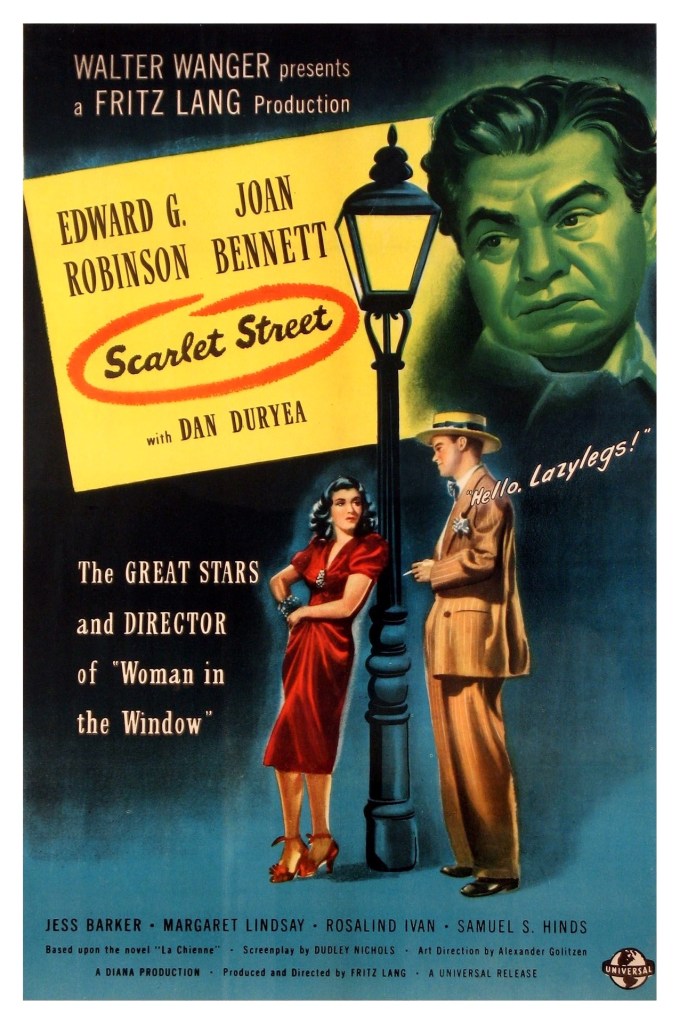
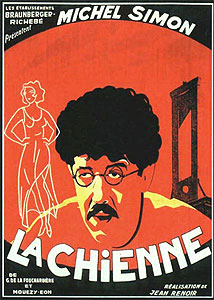
I am taking another film class this semester about American film noir. I wrote essays about two of the films we watched. The first is Scarlet Street (1945) which is based on the 1930 French novel La Chienne (the bitch). A 1931 French film preceded the American adaptation which was directed by Fritz Lang, one of my favorite directors! You can watch Scarlet Street free on Youtube here: https://www.youtube.com/watch?v=MNRSxu22NxU

Essay:

As discussed in the first chapter of Foster Hirsch’s The Dark Side of the Screen, film noir conveys a generally misogynistic attitude towards women who are portrayed as duplicitous and seductive. Fritz Lang’s Scarlet Street (1945) is certainly no exception.

Fritz Lang, from Mubi.com

Kitty (Joan Bennett) is a typical femme fatale in Scarlet Street. She manipulates a gullible cashier, Chris Cross (Edward G. Robinson), into stealing from his wife and his employer under false pretense of love. In addition, Kitty acts in a generally low-class and vulgar manner. For example, she reveals her ignorance of art by mispronouncing Cezanne’s name when discussing art with Chris. Furthermore, she is drunken and uncouth. Kitty stays out late drinking with lover Johnny Prince (Dan Duryea) and sleeps in until her friend Milly arrives the next morning to make amends. In the scene when Johnny convinces Kitty to extort Chris, Kitty also rudely spits out a piece of food. This vulgarity is followed by a telling closeup of a sink full of dirty dishes reveals that she is also a poor housekeeper (which would be seen a major failing for a woman in 1945). Kitty was unable or unwilling to maintain regular employment as a model (thus earning the nickname “Lazy Legs”). All of these elements would have persuaded viewers at the time that Kitty was a “failure” as a woman on several fronts.

From IMDB.com

Kitty also degrades herself by staying with Johnny who slaps Kitty on several occasions and takes money from her. He also insults Kitty, and her friend Milly (Margaret Lindsay) points out that Johnny has made Kitty into “a tramp.” Yet, despite these insults, Kitty clings to Johnny and doesn’t reject him in favor of Chris once Homer Higgins returns. The viewer would understand that Kitty is beyond redemption and refuses to even save herself. Kitty uses her sexuality to corrupt Chris. Even Johnny suggests that she is too sexual when he complained that she thought about nothing else. He told her to call a janitor if she needed more “heat” in the apartment since he could not accommodate Kitty’s lust!

Kitty and Chris from the Harvard Film Archive.

Hirsch attributes the misogyny of noir films to several factors, including anxiety about the social change and upheaval resulting from World War II. During the war, 6 million American women entered the workforce to replace men who had gone over seas to fight the Axis powers (“Watch Terrified Men”). Women became more independent which threatened the traditional patriarchal social structure. Released just after World War II had ended in 1945, Scarlet Street vividly captures the contemporary male anxiety. Although most female employees were fired so that returning veterans could reclaim their jobs, many men were clearly concerned that they had already let the cat out of the bag. Kitty, a modern/liberated woman, was the perfect scapegoat.

The other main female character, Adele Cross (Rosalind Ivan), is shown in a very negative light as well. Adele is an overbearing woman who dominates Chris to such a degree that their domestic rolls are “crisscrossed.” Adele berates Chris to do the dishes (which would typically be the wife’s job in 1945) until he meekly complies. Chris also wears a frilly feminine apron while preparing dinner. Ironically, Adele’s favorite radio program is called the “Happy Household Hour,” while the Cross’ domestic relationship is clearly upside down. Adele also belittles Chris’ art and forces him to take his canvases out of the apartment (and inadvertently pushes him into Kitty’s seductive embrace). Adele reveals that Chris was only able to propose marriage to her because she “put the words” in his mouth. Thus, even in the domestic sphere Chris allows himself to be dominated and bullied. Hapless Chris can’t even find refuge in the supposedly safe realm of his own household, where the man was supposed to rule as patriarch. The domineering Adele has usurped his role, thus reflecting the contemporary anxiety that men felt like they were under assault on all fronts.

Kitty’s friend, Milly (Margaret Lindsay), was the only positive or neutral female character in Scarlet Street. Milly acts as the voice of reason by trying to explain to Kitty how Johnny has mistreated her. When the two women argue, she is the first to make amends by offering a bottle of Scotch. Milly also warns Kitty that Johnny has made threats and is on his way back to her apartment to hurt her at the end of the film. Milly acts as a token example that not all women are bullies or seducers. Milly is also gainfully employed in contrast to Kitty. However, her role is very minimal, and she only offers a baseline for acceptable behavior. Milly’s modest behavior contrasts with Adele and Kitty only serves to make them more monstrous. Scarlet Street tells female viewers that they should toe the line and challenge men no further than Milly’s verbal sparring with Johnny.

Scarlet Street thus offers fertile ground for exploring the film noir trend towards misogyny. Shot during the later stages of World War II and released shortly after the fighting stopped, Scarlet Street affirms Hirsch’s thesis that film noir reflected male anxiety about potential gender roles becoming permanently “crisscrossed” as a result of the wartime labor crisis. Kitty was presented as a seductive woman who failed to uphold traditional gender expectations. Adele emasculated her husband and usurped the traditional patriarchal role as head of the household. Similar trends are evident in other films we’ve viewed so far, such as the predatory femme fatale Phyllis (Barbara Stanwyck) in Double Indemnity (1944) and the duplicitous Helen/Velma (Claire Trevor) in Murder, My Sweet (1944).

References

Hirsch, Foster. The Dark Side of the Screen: Film Noir. Cambridge: Da Capo Press, 1981.

McNeary, Allison. “Watch Terrified Men Learn to Deal With Women in the Workforce in WWII.” History.com, March 2, 2018. https://www.history.com/news/women-workforce-wwii-training-video-1940s. Accessed Feb. 3, 2002.

Scarlet Street. Directed by Fritz Lang. Performances by Edward G. Robinson, Joan Bennet and Dan Duryea. Fritz Lang Productions, 1945.

Industry Makeover

carry2-116

Published by IN Community Magazines – Penn Hills Winter 2016

PITTSBURGH – Clothing designer Cary Heard recently organized a makeover that gave the a local woman more energy and confidence.

“I would describe it as a total transformation,” Heard says.

More than 40 applicants applied for the makeover and Heard selected two winners, although one dropped out at the last minute. He says he picked the finalists based on their heart-felt applications. The makeover was completed in conjunction with a fashion show at Epiphany Church on Washington Place in August.

The makeover finalist walked down the runway at the start of the fashion show and then again at the end to show off her new look. The makeover took about two hours and included a new hairstyle and makeup. The makeover recipient was stunned by her transformation, according to Heard.

“She really couldn’t believe herself in the mirror,” he says. “The crowd was in awe. It was well worth all the time and energy spent.”

The event, which also included a fashion show that featured collections by Heard and three other designers, attracted a sellout crowd. Heard says he organized the makeover and fashion show to spread self-love and respect in the community. The proceeds from the event benefitted the NEED program which organizes tours for high school students so they can visit historically black colleges and universities in the eastern and southern United States. Heard says he is pleased with the results and plans to organize another event soon.

“It was also a humbling experience for me,” Heard says.

Heard, a 2011 graduate from Penn Hills High School, has been interested in fashion since he was a child. Unlike most kids, Heard enjoyed browsing in department stores with his mother and picking out his own clothes.

“I wasn’t the usual youngster who threw a tantrum and wanted to leave the store after only being there for 20 minutes,” Heard laughs.

He began drawing his own designs and got his first sewing machine at age 13. He taught himself how to sew and began making gowns and formal vests for his classmates at Penn Hills High School. Heard completed an internship at Sugar Boutique in Lawrenceville where he met a number of other designers and models. He hosted his first fashion show at the Omni William Penn Hotel and has participated in Pittsburgh Fashion Week for three years. Heard specializes in creating bold designs for full-figured women.

“There aren’t too many designers that take that avenue of clientele,” he says. “Plus size women don’t have the greatest selection to pick from in the department stores.”

Balmain is Heard’s favorite fashion line and a number of designers have influenced him, including Malcolm Williams, Darlene Perkins, Miyoshi Anderson, Kari Kramer, and Evon Renda. He also looks to his family for inspiration. When Heard begins creating a new collection, he starts with a color story and begins sketching designs, although some elements will change along the way. Then he selects fabrics and models.

Heard’s business has grown and, although it has been stressful at times, he says eventually it won’t feel like work because he’s so passionate about design. Heard says he has learned from his mistakes along the way and urges other aspiring designers to remain humble and follow their hearts.

“My heart has been my GPS through everything, even when I doubted myself,” he says. “Your heart will sort out the bad and guide you to your dreams faster.”

SpiderHAM

IMG_6292.jpg

Published in IN Community Magazines – South Fayette Summer 2016

PITTSBURGH – When Steve Rudzinski began acting in low-budget horror films more than a decade ago, he never expected he would eventually shoot a movie in his hometown of Bridgeville.

Rudzinski finished filming his horror comedy feature, called “CarousHELL,” there in late May and early June. The film is about a carousel unicorn that goes on a bloody rampage.  The script is extremely funny, Rudzinski says, and he hopes to have a local premiere for the film. His wife came up with the name for the movie while she was in the shower.

“I said ‘honey that’s a great title,’ which is like 90 percent of a picture idea,” Rudzinski says.

He grew up in Bridgeville but has lived in New York, New Jersey and California while pursuing his career as an actor, writer, producer and director. Rudzinski’s wife is also from Pittsburgh and they moved back to the area after they were married.

“It’s interesting and cool to be back home after being one for so long,” Rudzinski says. “But part of me is also saying I went nowhere.”

The iconic horror comedy movie “Army of Darkness” drove Rudzinski to pursue a career in film.

“It was a movie that very much wanted to be its own thing,” he says. “It really spoke to me because it didn’t care about being a comedy or horror or fantasy film because it was all of these things. It was completely up my alley.”

Bruce Campbell, the star of “Army of Darkness,” also inspired Rudzinski with his expressive acting style.

“His entire being is expressed through his face,” Rudzinski says. “Emotions in a face can tell so much more of the story than almost anything else on the screen.”

When he turned 18, Rudzinski began acting in micro-budget films and he says it was a learning experience. Because the budgets were so small, there was a lot of pressure to get scenes right on the first shot. He also wrote and directed, and in 2010 he started producing his own horror comedy films.

“I am extremely lucky with what I have accomplished, because I can do it as a career instead of struggling to do it on the side,” Rudzinski says.

His advice to aspiring actors is to follow their dreams, but he also cautions them that it’s a lot of hard work.

“You have to keep practicing, even in your bedroom by yourself,” Rudzinski says. “Audition for as much as you can for whatever you can. You may not like the project or character but it’s a job as much as it’s an art. I don’t think people can be choosey in a very difficult industry.”

For aspiring directors, Rudzinski says they need to learn that nothing will ever be perfect.

“Sometimes you have to say it’s good enough,” he says. “The whole movie matters more than just this one shot right now.”

In addition to being filmmaker, Rudzinski works for Marvel Live Appearances and portrays Spiderman at parades, stage shows, and other events around the world. Rudzinski is a comic book fan and says the job has fulfilled his childhood dream of becoming a superhero. He loves meeting children and making their dreams come true. Some children love to ask questions but Rudzinski says he’s never been stumped. However, sometimes a child is too overwhelmed by the experience and it helps when the parents can step to make them feel more comfortable.

“It’s really fun when the parents are part of the fantasy,” Rudzinski says.

He also acts in stage shows where Spiderman and other superheroes battle a villain. The shows are very similar to professional wrestling because there are a lot of choreographed falls, leaps and hits. The events also teach children the importance of physical fitness or standing up to bullies, among other messages.

Rudzinski also had the opportunity to portray the Joker at the Shrine Circus in Pittsburgh in April. Although he usually plays heroes, Rudzinski says he also enjoyed being a villain.

“I jumped at the offer because it’s so nice to be the heel,” he says.

The Shrine Circus was very different from the Spiderman events because he appeared before a much a larger audience. He had to exaggerate his movements even more than usual. Plus, he had to avoid all the circus animals.

“The tigers act more like house cats but you still have to be very careful,” Rudzinski says.

In the future, Rudzinski says he would like to act in more films and direct projects with bigger budgets. He would also hopes to become a Power Ranger but says that will have to wait until “CarousHELL” is finished.

“I never worry about more than one major project at a time,” Rudzinski says.

For more information visit: http://silverspotlightfilms.moonfruit.com/

Taking it to the Streets

IMG_6425.jpg

Published in IN Community Magazines – Moon Township Winter 2016

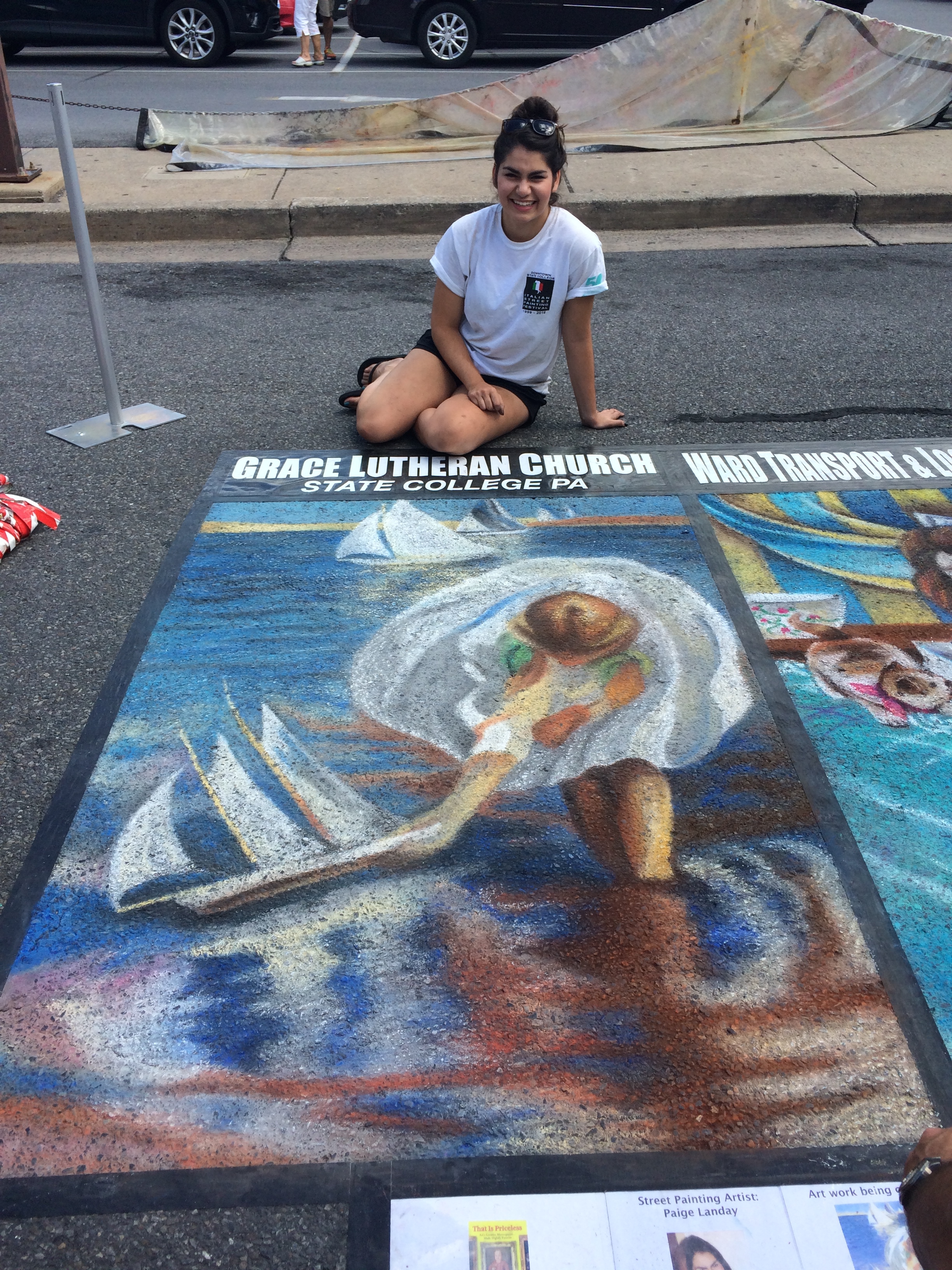
PITTSBURGH – Paige Landay, an art student from Moon, says her first attempt at street painting with chalk pastels was a challenging and rewarding experience. She created the painting for the Central Pennsylvania Festival of the Arts in State College in July.

Landay graduated from Moon Area High School in 2014 and is a junior at Penn State University where she studies art education. After attending the arts festival for several years, she decided to participate in this year’s street painting event. Using chalk pastels and painting on the street surface were both new experiences, Landay says.

“Working on the street surface is not like canvas or paper,” Landay says. “You are on top of the artwork rather than having paper on an easel.”

She created a grid to help her map out the painting and create the proper perspective. Landay brought a gardening kneepad because she had to kneel for many hours while completing her painting.

“I was in many different awkward positions to try and work on the piece without ruining it,” she says.

Landay also had to contend with the weather and two rainstorms threatened to wash away her work. She had to use tarps and a tent to protect her painting. It took about 20 hours to complete the work and the weather was also very hot.

Landay and several other artists completed their works while the art festival was ongoing, so attendees could watch them work. Many passersby asked questions and offered compliments while Landay worked, and she sometimes took breaks to chat with onlookers. One observer told Landay she will be a great inspiration as an art teacher.

“It was a very interactive experience,” she says. “It was fun to get that immediate response rather than waiting until the piece is finished.”

Her piece was based on the painting “Girl with Sailboat,” which was originally created by artist Edmund Charles Tarbell in 1899. She chose that picture because it had a summer theme and incorporated lots of colors.

“Since the street surface is already dark, I wanted to make sure I could use very vibrant colors,” Landay says.

After the festival ended, the streets were washed and the paintings disappeared. Landay says she would have been frustrated if the rain had washed away her painting while she was working on it, but she was not disappointed that her painting was only on display temporarily.

“It served its purpose,” she says. “We also took lots of pictures.”

In the future, Landay would like to expand her artistic skills by exploring other media. She is enrolled in a studio art class this semester and is looking forward to trying her had at oil painting because many famous artists have worked in that medium. Landay says she has always wanted to be an art teacher and that art was her favorite class in school. Her family supported her artistic pursuits and encouraged her to attend different workshops and camps. Landay also enjoys studying art history and impressionists, such as Claude Monet and Vincent van Gogh, are among her favorite artists. Landay enjoys working with many different media but says painting and drawing are her two favorite pursuits.

“I feel more comfortable with a paintbrush or pencil in my hand,” she says. “But, you have to know how to do everything to be an art teacher.”

Landay says she has always wanted to be an art teacher and would prefer to teach either elementary school students or high school students. Working in an elementary school means she could help students develop a passion for art at a young age. On the other hand, she could also help high school students further develop their talents. She advises students of any age who are interested in art to continue practicing.

“Never stop doing it because you can do artwork as long as you live,” Landay says. “I don’t want them to be discouraged about doing art in their life.”

Since she was three years old, Landay has also been passionate about dancing.

“Using the body, lighting, and costuming means that dance is an art as well,” Landay says. “I like doing art with both my hands and my entire body.”

She is a member of the Penn State Ballet Club where she performs in many different styles, including lyrical and modern dance. She plans to continue pursuing her interest in dance when she begins teaching and would like to contribute to theatrical performances at her school, because she is also interested in special effects makeup. While attending Moon Area High School, she learned how to create different makeup effects by watching Youtube videos. She used her talents to help the school principal become the Grinch for a holiday assembly.

“It got a great reaction and he really got into the role,” Landay says.

Hollywood Theater Celebrates 90 Years of History

Hollywood_Theater.png

Published in IN Community Magazines – Keystone Oaks Winter 2016

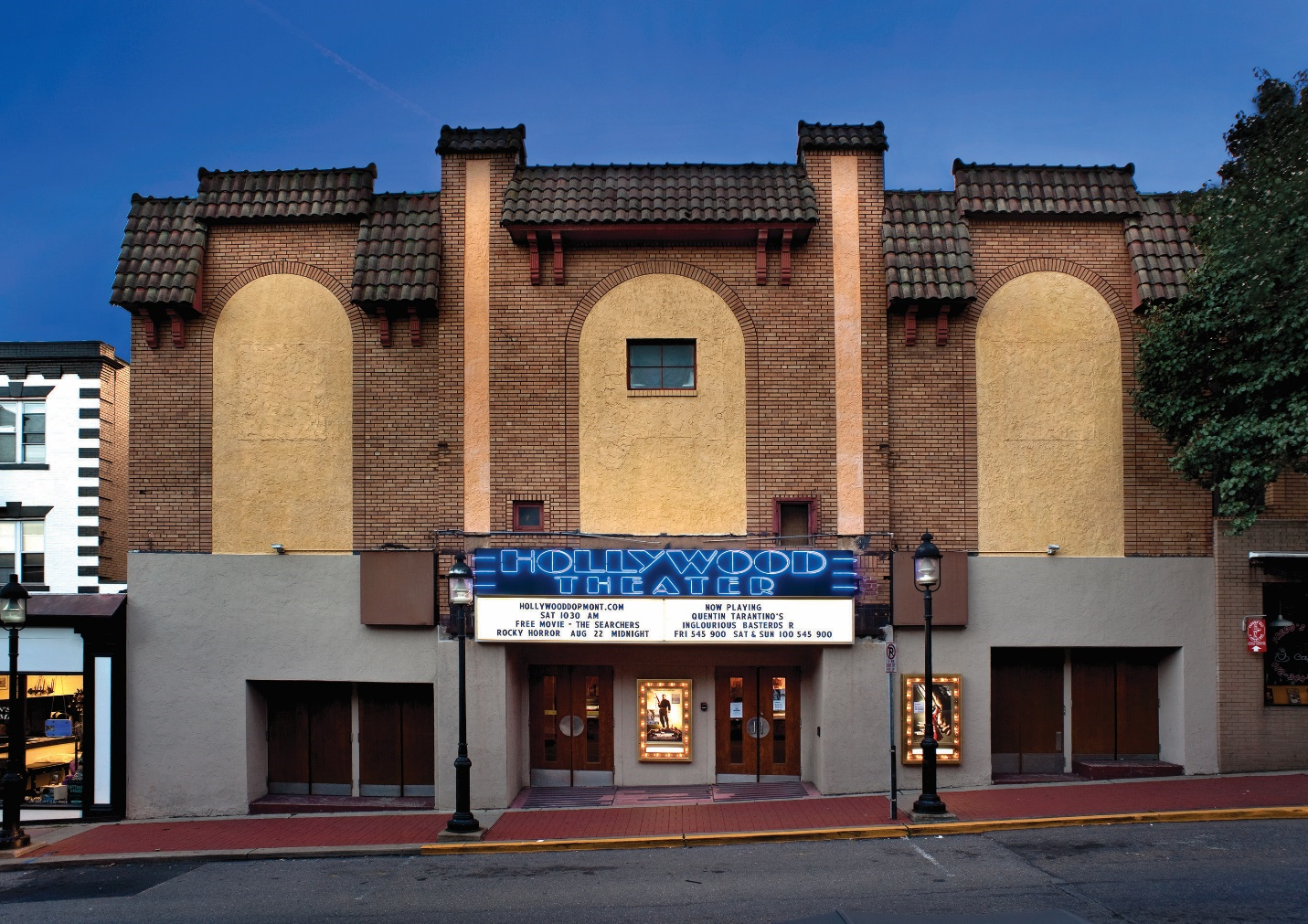
PITTSBURGH – The Hollywood Theater has been a cultural anchor in Dormont for 90 years, and supporters hope it will remain so for years to come.

Monique Fontaine, secretary for the theater’s board of directors, grew up in Dormont and has fond memories of the cinema. She saw “Flashdance,” the first R-rated movie she ever attended, there in 1983 and remembers attending performances of the Rocky Horror Picture Show at the cinema in the 1990s.

“It thrills me now to see all of the families and the kids of my friends coming to the theater for a show on their own,” Fontaine says.

Like Fontaine, many patrons also have strong memories associated with the Hollywood Theater. Sometimes, simply going into the bathroom, which still has the original tiles, can trigger a strong emotional reaction, Fontaine says

“Some patrons have come back upstairs with tears in their eyes,” she says. “It transports them back to the last time they were here. It’s our own time machine.”

Colin Matthews, president of the theater’s board of directors, says local patrons are very loyal to the Hollywood Theater in a way that a multiplex theater could never reproduce.

“So many people think of the Hollywood as their theater,” he says. “We’ve proud to serve as a landmark for the residents in Dormont, the greater South Hills community, and the entire Pittsburgh region.”

The Hollywood Theater also provides a social experience that’s absent in larger cinemas. Board member Margaret Jackson says she remembers how patrons began clapping during a screening of the “Princess Bride” a few years ago.

“I don’t believe that would ever happen in a multiplex,” Jackson says. “It created this wonderful feeling of community.”

The Hollywood first opened in 1926 and the building included a bowling alley in the basement. The theater has changed hands a few times and has been closed for several years. A major renovation was completed in 2007.

The board of directors celebrated the Hollywood Theater’s 90th anniversary in May by showing a restored version of 1949 British noir film “The Third Man.” Actor David Conrad, a Pittsburgh native, attended the event, which attracted a sell-out crowd. Board member Annette Bassett says that was one of her favorite memories of the Hollywood Theater because it was a great opportunity to welcome people to the cinema for the first time.

A fundraising campaign, called “90 for 90,” is also underway to help celebrate the Hollywood Theater’s anniversary. So far, about $18,000 has been raised and the average donation is about $80. The fundraiser will continue into 2017. The funds will be used to replenish savings that were spent on HVAC repairs earlier in 2016.

“We wanted to come out the gate strong, which we accomplished, but still have a long way to go,” Matthews says.

The Hollywood Theater is unique in several ways – it has a balcony, features an organ, and is one of the few surviving single-screen cinemas in Pittsburgh. However, the theater faces several obstacles as well, because it’s harder for a small theater to secure certain bookings. In addition, attendance has dropped off this year because of construction in the Dormont business district as well as increased competition from video streaming services such as Netflix and Hulu, Matthews says.

The Hollywood Theater has survived by innovating, Matthews says. The theater offers innovative programming and hosts a number of special events. For example, several couples have been married at the Hollywood Theater after saying their vows on the stage. In addition, the theater recently organized a Halloween party that featured a showing of the 1961 gothic horror film “The Innocents.” Doug Bradley from “Hellraiser” attended the event, which included a raffle and costume contest.

“Many of the attendees really get into the spirit and arrive in some truly amazing costumes,” Matthews says.

Matthews says the board of directors is pursuing several long-term goals that will ensure the Hollywood Theater remains an important part of the Dormont community. First, the directors hope to secure a long-term lease or purchase the building that houses the theater. After that, Matthews says they will execute a capital improvement campaign that focus on electrical, plumbing, and structural upkeep. Other priorities include adding an expanded and improved concessions stand, additional screening rooms, and a new marquee.

In addition, the board of directors is also re-evaluating its structural organization. Chad Hunter, the Hollywood Theater’s executive director, left in July 2016 and the board has decided to postpone the search for a potential replacement. In the interim, operations manager Joseph Morrison and several board members have assumed the responsibilities of the executive director.