
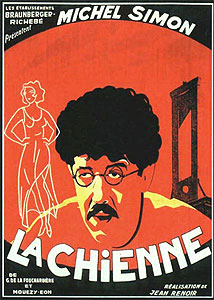
I am taking another film class this semester about American film noir. I wrote essays about two of the films we watched. The first is Scarlet Street (1945) which is based on the 1930 French novel La Chienne (the bitch). A 1931 French film preceded the American adaptation which was directed by Fritz Lang, one of my favorite directors! You can watch Scarlet Street free on Youtube here: https://www.youtube.com/watch?v=MNRSxu22NxU
Essay:
As discussed in the first chapter of Foster Hirsch’s The Dark Side of the Screen, film noir conveys a generally misogynistic attitude towards women who are portrayed as duplicitous and seductive. Fritz Lang’s Scarlet Street (1945) is certainly no exception.

Kitty (Joan Bennett) is a typical femme fatale in Scarlet Street. She manipulates a gullible cashier, Chris Cross (Edward G. Robinson), into stealing from his wife and his employer under false pretense of love. In addition, Kitty acts in a generally low-class and vulgar manner. For example, she reveals her ignorance of art by mispronouncing Cezanne’s name when discussing art with Chris. Furthermore, she is drunken and uncouth. Kitty stays out late drinking with lover Johnny Prince (Dan Duryea) and sleeps in until her friend Milly arrives the next morning to make amends. In the scene when Johnny convinces Kitty to extort Chris, Kitty also rudely spits out a piece of food. This vulgarity is followed by a telling closeup of a sink full of dirty dishes reveals that she is also a poor housekeeper (which would be seen a major failing for a woman in 1945). Kitty was unable or unwilling to maintain regular employment as a model (thus earning the nickname “Lazy Legs”). All of these elements would have persuaded viewers at the time that Kitty was a “failure” as a woman on several fronts.
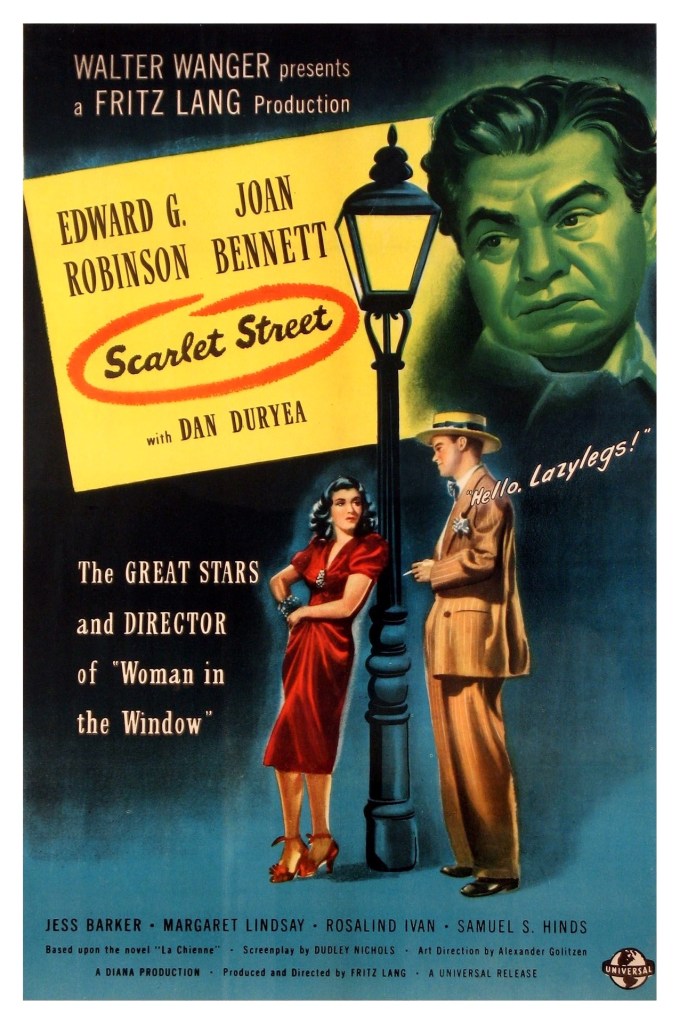
Kitty also degrades herself by staying with Johnny who slaps Kitty on several occasions and takes money from her. He also insults Kitty, and her friend Milly (Margaret Lindsay) points out that Johnny has made Kitty into “a tramp.” Yet, despite these insults, Kitty clings to Johnny and doesn’t reject him in favor of Chris once Homer Higgins returns. The viewer would understand that Kitty is beyond redemption and refuses to even save herself. Kitty uses her sexuality to corrupt Chris. Even Johnny suggests that she is too sexual when he complained that she thought about nothing else. He told her to call a janitor if she needed more “heat” in the apartment since he could not accommodate Kitty’s lust!

Hirsch attributes the misogyny of noir films to several factors, including anxiety about the social change and upheaval resulting from World War II. During the war, 6 million American women entered the workforce to replace men who had gone over seas to fight the Axis powers (“Watch Terrified Men”). Women became more independent which threatened the traditional patriarchal social structure. Released just after World War II had ended in 1945, Scarlet Street vividly captures the contemporary male anxiety. Although most female employees were fired so that returning veterans could reclaim their jobs, many men were clearly concerned that they had already let the cat out of the bag. Kitty, a modern/liberated woman, was the perfect scapegoat.
The other main female character, Adele Cross (Rosalind Ivan), is shown in a very negative light as well. Adele is an overbearing woman who dominates Chris to such a degree that their domestic rolls are “crisscrossed.” Adele berates Chris to do the dishes (which would typically be the wife’s job in 1945) until he meekly complies. Chris also wears a frilly feminine apron while preparing dinner. Ironically, Adele’s favorite radio program is called the “Happy Household Hour,” while the Cross’ domestic relationship is clearly upside down. Adele also belittles Chris’ art and forces him to take his canvases out of the apartment (and inadvertently pushes him into Kitty’s seductive embrace). Adele reveals that Chris was only able to propose marriage to her because she “put the words” in his mouth. Thus, even in the domestic sphere Chris allows himself to be dominated and bullied. Hapless Chris can’t even find refuge in the supposedly safe realm of his own household, where the man was supposed to rule as patriarch. The domineering Adele has usurped his role, thus reflecting the contemporary anxiety that men felt like they were under assault on all fronts.
Kitty’s friend, Milly (Margaret Lindsay), was the only positive or neutral female character in Scarlet Street. Milly acts as the voice of reason by trying to explain to Kitty how Johnny has mistreated her. When the two women argue, she is the first to make amends by offering a bottle of Scotch. Milly also warns Kitty that Johnny has made threats and is on his way back to her apartment to hurt her at the end of the film. Milly acts as a token example that not all women are bullies or seducers. Milly is also gainfully employed in contrast to Kitty. However, her role is very minimal, and she only offers a baseline for acceptable behavior. Milly’s modest behavior contrasts with Adele and Kitty only serves to make them more monstrous. Scarlet Street tells female viewers that they should toe the line and challenge men no further than Milly’s verbal sparring with Johnny.
Scarlet Street thus offers fertile ground for exploring the film noir trend towards misogyny. Shot during the later stages of World War II and released shortly after the fighting stopped, Scarlet Street affirms Hirsch’s thesis that film noir reflected male anxiety about potential gender roles becoming permanently “crisscrossed” as a result of the wartime labor crisis. Kitty was presented as a seductive woman who failed to uphold traditional gender expectations. Adele emasculated her husband and usurped the traditional patriarchal role as head of the household. Similar trends are evident in other films we’ve viewed so far, such as the predatory femme fatale Phyllis (Barbara Stanwyck) in Double Indemnity (1944) and the duplicitous Helen/Velma (Claire Trevor) in Murder, My Sweet (1944).
References
Hirsch, Foster. The Dark Side of the Screen: Film Noir. Cambridge: Da Capo Press, 1981.
McNeary, Allison. “Watch Terrified Men Learn to Deal With Women in the Workforce in WWII.” History.com, March 2, 2018. https://www.history.com/news/women-workforce-wwii-training-video-1940s. Accessed Feb. 3, 2002.
Scarlet Street. Directed by Fritz Lang. Performances by Edward G. Robinson, Joan Bennet and Dan Duryea. Fritz Lang Productions, 1945.

 Freelance Writer Paul Glasser