
Maison Close (2010-13) and Jeanne Dielman, 23 Quai du Commerce, 1080 Bruxelles (1975) offer contrasting approaches to addressing the issue of prostitution (albeit in different time periods). Although director Chantal Akerman presented an innovative perspective on the daily routine of Jeanne Dielman during the 1970s, the film does not appear to have had much commercial success.[i] On the other hand, Maison Close used a more conventional approach to depict the women of the Le Paradis brothel in the early 1870s. Maison Close attracted enough attention to only last two seasons on French TV.[ii]

Akerman shot Jeanne Dielman in a hyper-realist style with no musical soundtrack and a focus on real-time activity. On the other hand, the movie also elides the details of Jeanne’s prostitution until the very end in contrast to the frequent explicit and more erotic sex scenes in Maison Close. Although Jeanne Dielman is not an easy or short watch ( nearly 3.5 hours) with numerous “unwatchable dull moments,” it also received critical acclaim.[iii] Jeanne Dielman has experienced a slight renaissance in recent years after being released on DVD and in conjunction with the COVID 19 pandemic.[iv]
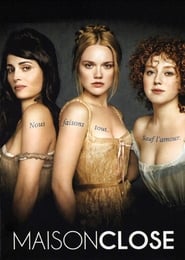
On the other hand, Maison Close told the stories of 19th century prostitutes with a more modern style. The series includes a soundtrack featuring modern music (as opposed to songs from the late 1800s) with some lyrics inexplicably in English. The show has several gritty and realistic moments (such as the brutal rape of Rose) but also glamorizes the story as well with more explicit sex scenes (such as the introduction to the 1st episode or the orgy in episode 2). Maison Close apparently did not offer enough to keep viewers watching and was not renewed for a third season on French TV. HBO had also planned to remake Maison Close for an American audience, but the project seems to be dead in the water.[v]
However, I think critics and professors will still be discussing Jeanne Dielman for years to come because Akerman dared to create something bold and innovative. On the other hand, Maison Close will probably not stand the test of time since it did not distinguish itself from other costume dramas. Akerman challenged the viewer while Maison Close did not.
[i] Lim, Dennis. “Then as Now, the Terrors of the Routine.” New York Times, Jan. 16, 2009.
[ii] “Maison Close ferme ses portes définitivement, pas de saison 3 pour la série de Canal,” Internet Archive, May 7, 2013, https://web.archive.org/web/20130510074830/http://series-tv.premiere.fr/News-Series/Maison-Close-ferme-ses-portes-definitivement-pas-de-saison-3-pour-la-serie-de-Canal-3750303
[iii] Schwartz, Dennis, “Jeanne Dielman, 23 Quai de Commerce, 1080 Bruxelles,” Aug. 5, 2019, https://dennisschwartzreviews.com/jeannedielman/
[iv] Trnka, Alexandra, “Domestic Gestures: Revisiting Jeanne Dielman in Social Isolation,” July 2020, https://www.sensesofcinema.com/2020/cinema-in-the-age-of-covid/domestic-gestures-revisiting-jeanne-dielman-in-social-isolation/
[v] Willmore, Allison, “BO Remaking Racy French Brothel Costume Drama ‘Maison Close’,” Nov. 9, 2012, https://www.indiewire.com/2012/11/hbo-remaking-racy-french-brothel-costume-drama-maison-close-43541/

 Freelance Writer Paul Glasser